Circle has expanded its Cross-Chain Transfer Protocol, known as CCTP, to include support for the Stellar network, broadening the infrastructure available for native USDC transfers across bloc
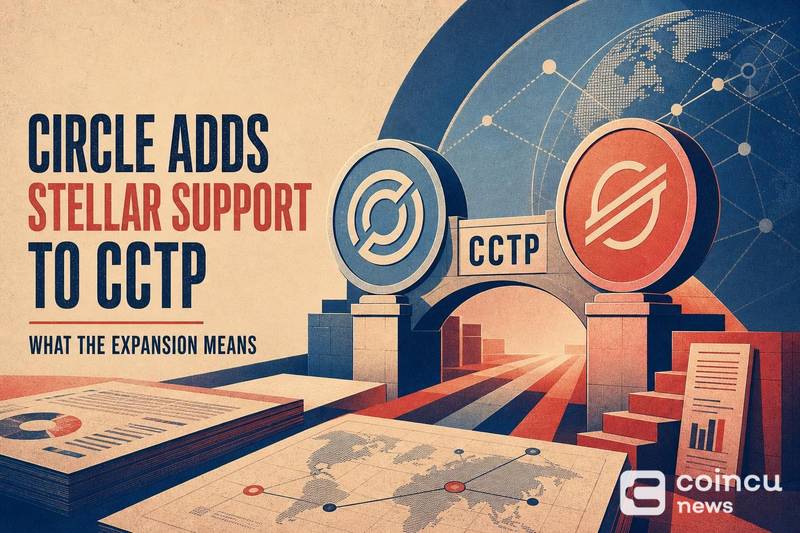
Circle has expanded its Cross-Chain Transfer Protocol, known as CCTP, to include support for the Stellar network, broadening the infrastructure available for native USDC transfers across blockchains.
The integration means that USDC can now move natively between Stellar and other CCTP-supported chains without relying on traditional bridge mechanisms that lock and mint wrapped tokens. Circle confirmed the expansion through its USDC product page, which lists supported networks and transfer rails.
The Stellar Development Foundation also announced the launch, noting that CCTP is now live on Stellar, making the network part of a growing set of chains with native USDC burn-and-mint capability.
What CCTP Does Differently From Bridges
CCTP is Circle's protocol for moving USDC across blockchains without wrapped tokens. Instead of locking USDC on a source chain and minting a synthetic version on the destination chain, CCTP burns the tokens on the source chain and mints native USDC on the destination.
This approach removes the risk associated with wrapped asset pools, where a bridge exploit can leave wrapped tokens unbacked. With CCTP, every USDC token on the receiving chain is fully native and backed by Circle's reserves.
For developers building cross-chain applications, CCTP provides a standardized transfer rail. Applications can integrate one protocol to enable USDC movement across all supported networks rather than managing multiple bridge integrations with varying security models.
Why Stellar Is a Strategic Addition
Stellar has long positioned itself as a network optimized for payments and asset transfers, with low transaction fees and fast settlement times. Adding CCTP support connects Stellar's payment-focused ecosystem to the broader multi-chain USDC infrastructure.
The integration could simplify treasury operations for organizations that hold USDC across multiple chains. Rather than maintaining separate liquidity pools or using third-party bridges, entities on Stellar can now move USDC natively to and from other CCTP-supported networks.
This matters for cross-border payment corridors where Stellar already has adoption. Remittance platforms and fintech applications built on Stellar gain direct access to USDC liquidity on chains like Ethereum, Avalanche, and others already in the CCTP network.
Wallet providers and exchanges that support Stellar-based USDC could benefit from simplified deposit and withdrawal flows. CCTP integration means these platforms no longer need to manage wrapped USDC variants or maintain separate liquidity across chains.
For decentralized application developers, the expansion adds another network to the set of chains where USDC can flow without friction. This is particularly relevant as the broader crypto industry continues building toward multi-chain interoperability, a trend visible in initiatives like blockchain infrastructure capital raises aimed at cross-chain connectivity.
Liquidity routing could also shift. Aggregators and payment processors that optimize for cost and speed now have Stellar as an additional path for USDC settlement, potentially offering lower-cost routes for certain transfer corridors.
Stellar joins a list of networks that already support CCTP, including Ethereum, Avalanche, Arbitrum, Base, and others. Each addition expands the protocol's utility by increasing the number of possible transfer routes.
Circle has been steadily expanding CCTP's reach as part of its broader strategy to make USDC the default stablecoin for cross-chain transfers. The protocol's burn-and-mint model avoids fragmented liquidity, a persistent problem in multi-chain ecosystems where wrapped tokens create isolated pools on each network.
As stablecoin infrastructure becomes increasingly central to both DeFi and traditional financial applications, moves like this position USDC as a programmable transfer layer rather than just a token. Companies exploring new financial product structures and tokenized fund distributions may find standardized cross-chain stablecoin rails increasingly relevant.
FAQ
What does CCTP stand for?
CCTP stands for Cross-Chain Transfer Protocol. It is Circle's system for moving native USDC between supported blockchain networks using a burn-and-mint mechanism.
Why does Circle adding Stellar support matter?
Stellar is widely used for payments and remittances. Adding CCTP support connects Stellar's ecosystem to native USDC liquidity across multiple blockchains, simplifying cross-chain transfers without relying on wrapped tokens or third-party bridges.
Is this update mainly about interoperability?
Yes. The core purpose of CCTP is blockchain interoperability for USDC. Stellar's addition expands the number of networks where USDC can move natively, reducing fragmentation and bridge-related risks across the multi-chain landscape.
Disclaimer: This article is for informational purposes only and does not constitute financial or investment advice. Cryptocurrency and digital asset markets carry significant risk. Always do your own research before making decisions.
The post Circle Adds Stellar Support to CCTP: What the Expansion Means was initially published on Coincu.