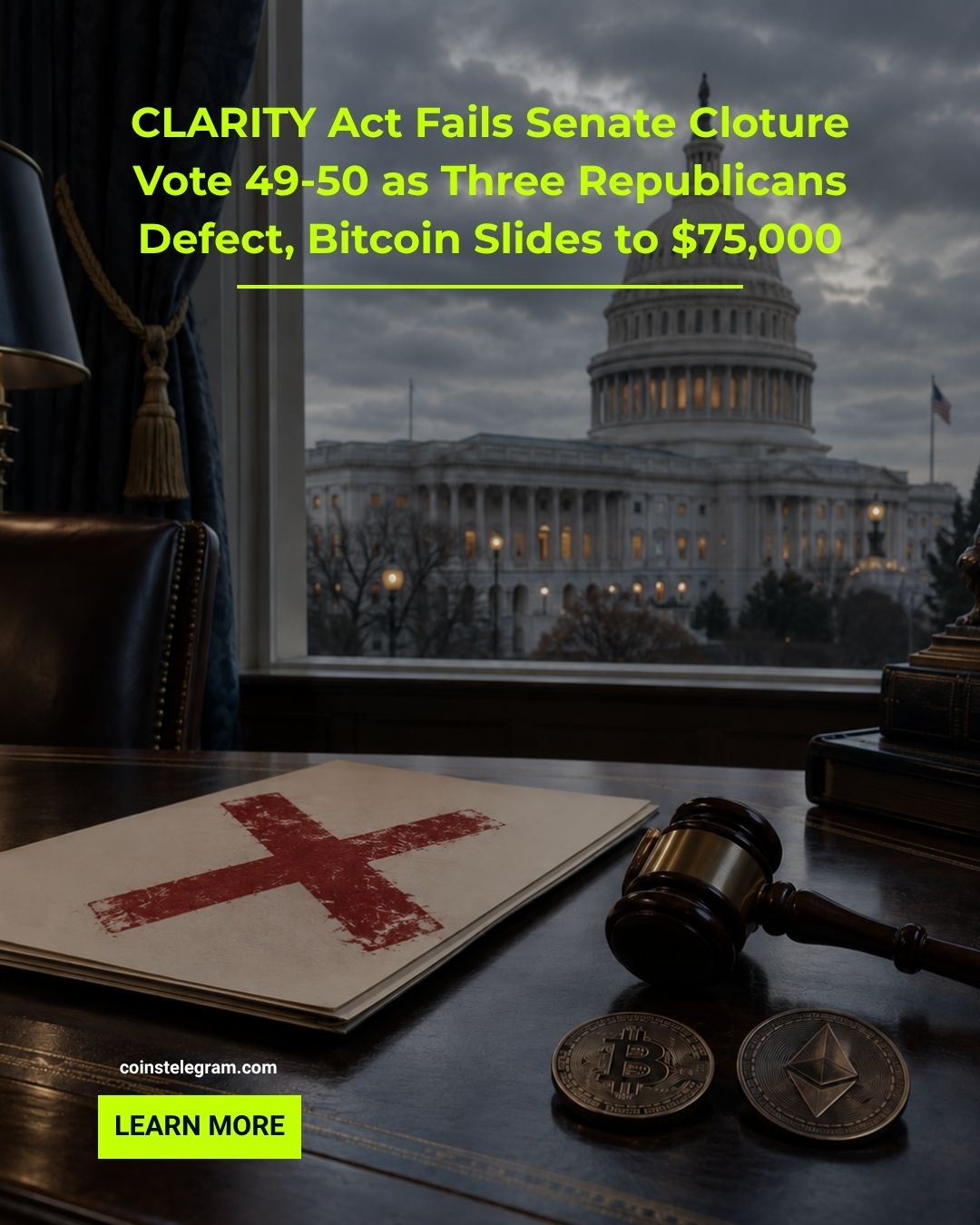
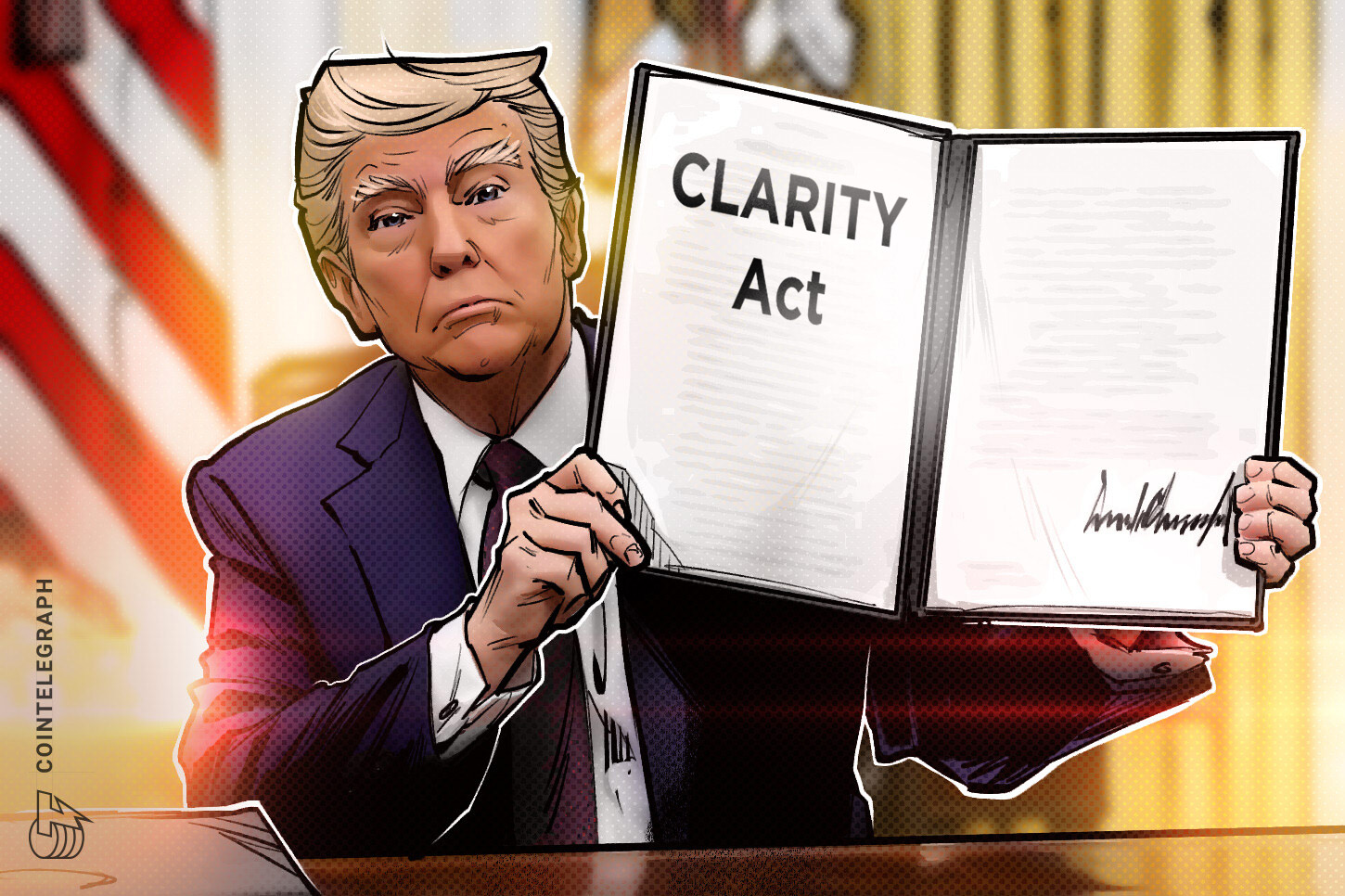
The CLARITY Act failed to clear a critical Senate procedural vote Tuesday, dealing a major blow to the crypto industry’s top legislative priority and leaving the future of comprehensive U.S.
The CLARITY Act failed to clear a critical Senate procedural vote Tuesday, dealing a major blow to the crypto industry’s top legislative priority and leaving the future of comprehensive U.S. digital asset regulation deeply uncertain heading into the November midterms.
The cloture vote fell short 49-50, well below the 60 votes required to advance the bill, with Bitcoin dropping to as low as $75,000 in the immediate aftermath before stabilizing around $75,249.
How the Vote Broke Down
The Senate’s cloture vote on H.R. 3633, the Digital Asset Market Clarity Act, produced an outcome that surprised almost no one who had been tracking the bill’s momentum in the days before the vote. Every Senate Democrat voted against the measure, but the more consequential defections came from within Republican ranks: Senators Susan Collins, Josh Hawley, and Jerry Moran all voted no, denying the bill the near-unanimous GOP support it needed to have any realistic path to 60 votes.
In an unusual procedural twist, Republican Senator Thom Tillis of North Carolina changed his recorded affirmative vote shortly before the tally closed specifically to file a motion to reconsider — a maneuver that keeps the door open for a second cloture attempt after the midterm elections, rather than closing the book on the legislation entirely for 2026.
A Bill That Nearly Had Momentum
The failure comes despite a late push that briefly generated real optimism among industry executives. Late Sunday night, Republican senators released what they described as the final version of the CLARITY Act, incorporating additional ethics concessions from the White House alongside new limitations on a provision known as BRCA, added as a nod to law enforcement concerns. Monday morning brought a wave of cautious optimism, and momentum appeared to build further that afternoon at the Solana Policy Institute Summit in Washington, D.C., where lawmakers, regulators, and industry leaders gathered to discuss the state of digital asset policy.
Senator Cynthia Lummis of Wyoming, who is retiring in a few months, used the summit to press for immediate action, arguing Democrats had not been negotiating in good faith:
“It’s time to vote now. This is as good as it’s going to get… This is the right product at the right time.”
But by Monday evening, reports emerged that Senate Democrats intended to counter with their own competing version of the legislation — surfacing less than 24 hours before the scheduled vote, at a point when the path to 60 votes was already widely viewed as dismal. Notably, Senator Kirsten Gillibrand of New York had reportedly been actively urging fellow Democrats to support the Republican-authored bill, though she ultimately joined the rest of her party in voting no on Tuesday. Republicans were largely dismissive of the Democratic counteroffer when it emerged Tuesday morning, and the vote proceeded to its expected outcome.
Why Democrats Opposed the Bill
The central obstacle throughout negotiations has been a dispute over ethics provisions that many Democrats view as inadequate to prevent conflicts of interest tied specifically to President Trump’s personal financial stake in the crypto industry. Trump has publicly positioned himself as the industry’s biggest champion heading into and following the last presidential election, but his own business interests in crypto have simultaneously fueled the fiercest Democratic resistance to the legislation, effectively placing the bill’s fate in tension with the very administration pushing hardest for its passage.
Beyond the ethics dispute, the final draft attempted to address a separate sticking point raised by the banking industry: concerns that stablecoin rewards authorized under the bill — offered directly by crypto platforms — could threaten traditional bank deposits by pulling customer funds toward higher-yielding crypto alternatives. The last-minute changes specifically granted the Treasury secretary new authority to intervene and prevent deposit flight if that risk materialized, though the concession evidently wasn’t enough to shift the overall vote count.
Senator Elizabeth Warren has been among the most vocal Democratic opponents throughout the process, arguing that passing the CLARITY Act in its current form puts the United States at risk of a broader economic crash.
What the Bill Was Trying to Accomplish
The Digital Asset Market Clarity Act represented an attempt to build the first comprehensive federal regulatory framework for the crypto industry, an industry valued at approximately $2.3 trillion. Its core structural goal was dividing regulatory oversight cleanly between the Securities and Exchange Commission and the Commodity Futures Trading Commission, explicitly resolving years of ambiguity over which digital assets should be classified as securities versus commodities — a distinction that has driven much of the “regulation by enforcement” approach that has defined U.S. crypto policy for years, leaving both investors and financial institutions without clear compliance guidance.
Beyond jurisdictional clarity, the bill sought to establish federal oversight specifically for crypto exchanges, brokers, and digital commodity spot markets that had previously operated without a defined federal regulatory framework, alongside new consumer protection measures including standardized token disclosure requirements, stricter custody rules for digital assets, and expanded anti-money laundering controls across the industry.
Industry Reaction: Coinbase Signals a Pivot to Regulators
Coinbase CEO Brian Armstrong, one of the bill’s most prominent public supporters, responded to the failed vote on X with a notably pragmatic tone rather than despair.
“The CLARITY Act didn’t advance in the Senate today, which was a disappointment,” Armstrong wrote. “While it’s possible bi-partisan conversations continue and it lives to fight another day, we can’t wait on Congress anymore. The SEC and CFTC have the tools they need to create clear rules under existing authority, and I expect will begin working on this in earnest. So clarity is coming to crypto regardless.”
Armstrong specifically pointed to existing law as a partial substitute for the failed legislation: “And of course GENIUS is already the law of the land for stablecoins, which is even more permissive on rewards. There were some concessions we made on CLARITY that were tough to swallow, so perhaps it’s for the best. Crypto can’t be uninvented. With clarity emerging through the regulators, we’ll continue updating the financial system.” His comments suggest at least part of the industry now views agency-level rulemaking by the SEC and CFTC — rather than new congressional legislation — as the more realistic near-term path to regulatory clarity.
Market Reaction
Bitcoin’s price reaction to the failed vote was immediate but relatively contained. The asset slid to approximately $75,000 the day of the vote before holding within a narrow range around $75,249 the following day — a meaningful decline reflecting disappointment over the bill’s failure, though not the kind of severe crash that might have accompanied a complete and permanent collapse of prospects for U.S. crypto regulation.
What Happens Next
Tillis’s procedural motion to reconsider technically keeps the door open for another cloture vote after the November midterm elections, meaning the CLARITY Act is not necessarily dead for good, even though its 2026 path forward is now effectively closed given the Senate’s shrinking legislative calendar. In the meantime, industry attention appears likely to shift toward the SEC and CFTC’s own regulatory authority as a more immediate avenue for establishing clearer digital asset rules, with Armstrong’s comments suggesting Coinbase and potentially other major industry players are already preparing to engage directly with regulators rather than continuing to wait on a divided Congress.