Coinbase VS JPMorgan: The CLARITY Act at the Heart of a Historic Rivalry
Coinbase and JPMorgan face off over the CLARITY Act, a bill that could revolutionize stablecoins. Between crypto innovation and banking resistance, this historic duel divides Wall Street. Who
A
AnonymousCryptoCompass newsroom
May 30, 2026
3 min read
NEWS
CryptoCompass editorial visual for policy coverage.
Coinbase and JPMorgan face off over the CLARITY Act, a bill that could revolutionize stablecoins. Between crypto innovation and banking resistance, this historic duel divides Wall Street. Who will win? And what impact will it have on the market?
In Brief
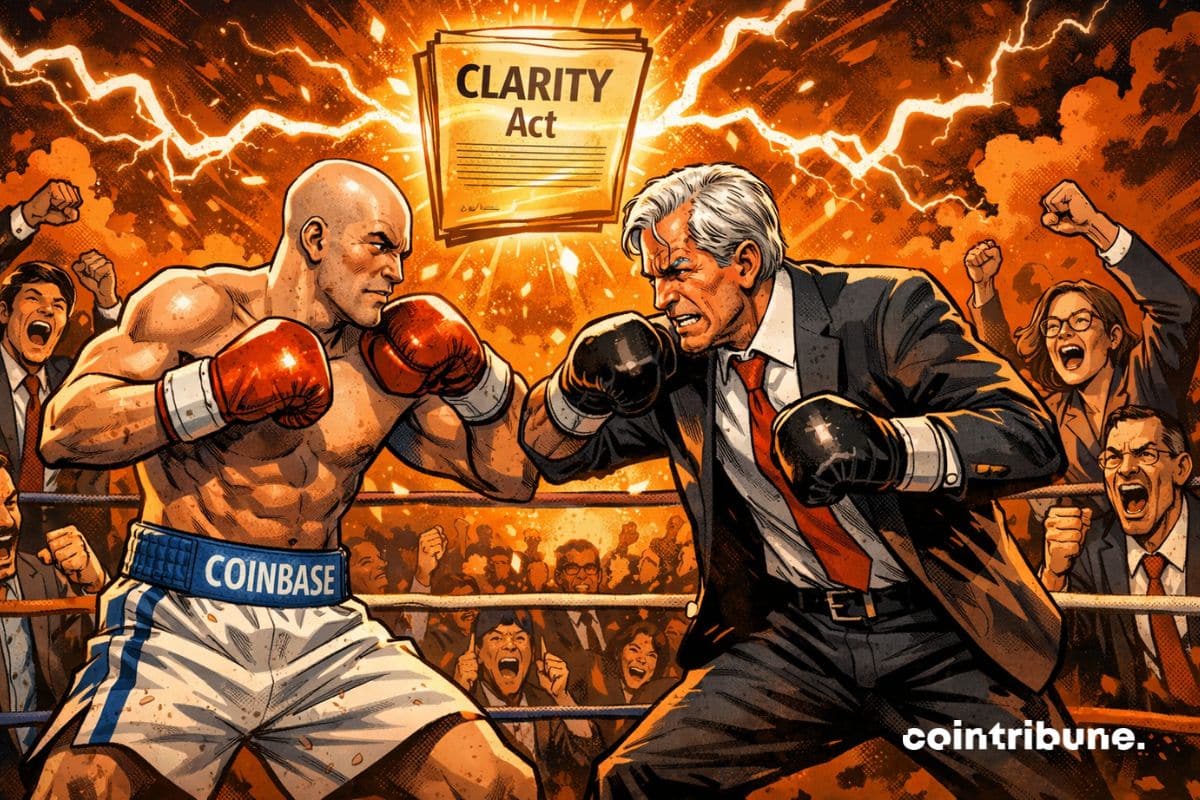
Historic conflict of Coinbase (Brian Armstrong) against JPMorgan (Jamie Dimon) over the CLARITY Act on stablecoins.
The stakes are high because adoption or rejection of the bill could boost or collapse the crypto market.
Stablecoins (USDC, USDT) and cryptos (Bitcoin, Ethereum) are currently under pressure.
CLARITY Act: Coinbase and JPMorgan Face Off Over Stablecoins
The CLARITY Act, a bill aiming to regulate stablecoins, has become the epicenter of a confrontation between Brian Armstrong (Coinbase) and Jamie Dimon (JPMorgan). Indeed, Dimon, a fierce opponent, believes that stablecoins issued outside the traditional banking system pose a systemic risk, mentioning billions laundered through banks in 2025. On his side, Brian Armstrong counters by accusing banks of protectionism, with a viral meme that has ignited social networks.
On May 14, 2026, the project passed a key milestone by being approved by the Senate Banking Committee (15-9). But its final adoption remains uncertain because it still needs 60 votes in the Senate. Meanwhile, the crypto industry, led by Mike Novogratz (Galaxy Digital) and Peter Van Valkenburgh (Coin Center), denounces banking interference in legislation. For them, existing rules like the Bank Secrecy Act are already sufficient to regulate exchanges.
Stablecoins in Turmoil: Will the Crypto Market Collapse or Explode?
The conflict between Coinbase and JPMorgan could have major repercussions on the crypto market. Indeed, if the CLARITY Act is adopted, stablecoins like USDC or USDT could gain legitimacy, attracting institutional investors and boosting their adoption. Conversely, rejection of the bill would maintain regulatory uncertainty, hindering sector growth. Major cryptos, bitcoin and ethereum could also react in contrasting ways:
Possible increase if the market sees this conflict as a symbolic victory of decentralization over banks;
Temporary decline in case of panic linked to JPMorgan’s opposition, perceived as a threat to the crypto ecosystem.
Traders are therefore closely monitoring senators’ statements and lobbying movements.
Between innovation and banking resistance, the Coinbase-JPMorgan duel could tip the crypto market. Would stablecoins come out stronger or weaker? And you, would you be ready to invest in this uncertain context?
Three developments shaped crypto infrastructure this week: DTCC and Stellar advanced tokenized securities planning with a 2027 horizon, Sui experienced another network outage raising reliabil
Major financial institutions continue to explore blockchain for settlement, collateral management, and cross-border payments, but growing concerns about AI-enhanced cyber threats are complica
Ripple Chief Legal Officer Stuart Alderoty says the company has expanded into a full-service crypto infrastructure provider for enterprises. Speaking in an interview with the New York Stock E