Crypto Council for Innovation and Blockchain Association filed suit against the State of Illinois on August 21 in Sangamon County Circuit Court, asking a judge to block enforcement of the sta
Crypto Council for Innovation and Blockchain Association filed suit against the State of Illinois on August 21 in Sangamon County Circuit Court, asking a judge to block enforcement of the state’s Digital Asset Tax Act before it takes effect.
The law would charge a 0.2% tax on the value of digital assets whenever they are exchanged, transferred, or held in custody, collected by “digital asset brokers” serving Illinois customers with more than $100,000 in receipts. The state expects it to raise about $60 million a year starting in 2027.
The complaint names David Harris, director of the Illinois Department of Revenue, Attorney General Kwame Raoul, and Sangamon County State’s Attorney John Milhiser as defendants. It raises seven counts, including that the tax violates the federal Internet Tax Freedom Act, a law that bars states from taxing electronic commerce differently than equivalent offline activity, and the Constitution’s dormant Commerce Clause, which limits a state’s power to burden interstate business.
“A tax on digital asset activity with no equivalent tax for traditional assets unlawfully picks winners and losers through the tax code,” CCI CEO Ji Hun Kim said in a statement.
A Maryland court already tested this argument
The four-day gap matters because of what the Maryland ruling found, not just when it landed. On August 17, a Maryland court struck down that state’s digital advertising tax on the Internet Tax Freedom Act, the dormant Commerce Clause, and the Due Process Clause: the same three grounds Illinois’s complaint now raises against its crypto tax. Maryland’s levy was also a “first-in-nation” tax on a digital activity with no identical offline counterpart, the same structural feature underlying Illinois’s law.
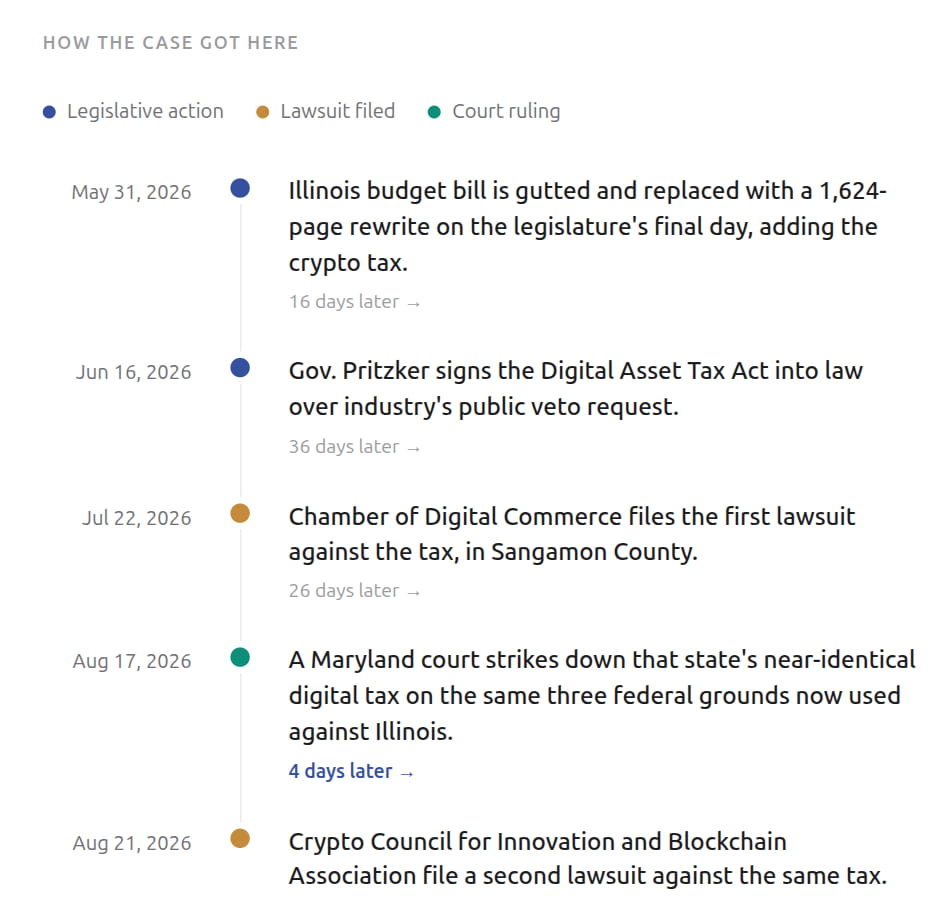 Illinois crypto tax timeline from legislation to lawsuits
This second lawsuit landed just four days after a near-identical tax fell in court in Maryland, the shortest gap of any interval in this five-month sequence.
Jared Walczak, a senior policy analyst at the Tax Foundation, said officials in Illinois, Utah, and Washington are “looking very closely at this decision because they see a preview of what might be coming for them,” and that those states “very much have exposure here if this ruling is replicated elsewhere.” Walczak was referring to Illinois’s separate digital advertising tax, not the crypto tax, but both came out of the same bill.
One bill, three new taxes
The Digital Asset Tax Act was not written as a standalone crypto bill. According to the complaint, it began as a two-page agricultural finance measure introduced in January 2026, then was stripped and rewritten into a 1,624-page package on May 31, the legislature’s final day of session, and passed by both chambers within 24 hours. That same bill, SB 3019, also created Illinois’s new digital advertising tax and a social media fee, the taxes Walczak flagged as exposed by the Maryland ruling.
The complaint’s other four counts target that legislative process directly: that the bill violates Illinois’s constitutional Three-Readings Rule, its Single-Subject Rule, its Uniformity Clause by taxing digital assets differently than stocks or bonds, and that it improperly delegates taxing authority to federal definitions. If those procedural counts succeed, they could unwind more of SB 3019 than the crypto tax alone.
The second attempt to stop it
Industry groups have been fighting this law since before it existed. CCI publicly urged Governor JB Pritzker to veto the bill, and he signed it anyway on June 16. The Chamber of Digital Commerce, a separate trade group representing more than 250 companies, filed the first lawsuit against the tax on July 22, arguing it improperly taxes digital assets based on how they are recorded rather than what they are. Neither that case nor the August 21 filing has been ruled on.
Illinois’s Department of Revenue and the Governor’s office have not publicly responded to either lawsuit. Both Blockchain Association and Crypto Council for Innovation are trade associations funded by digital asset companies that would themselves pay this tax, the same companies whose interests the lawsuit represents.
With the tax still about four months from taking effect and a favorable federal precedent now on the books in Maryland, the more immediate question is whether an Illinois court treats that ruling as persuasive.