Crypto Projects Shut Down in 2026: What Happens to User Funds? Crypto had a hard year. Prices fell, funding dried up, and many teams switched off their products. Key Takeaways A shutdown trac
Crypto Projects Shut Down in 2026: What Happens to User Funds?
Crypto had a hard year. Prices fell, funding dried up, and many teams switched off their products.
Key Takeaways
A shutdown tracker verified 75 crypto project closures in 2026, spanning exchanges, DeFi, blockchain networks, wallets, and gaming platforms.
Weak demand, empty treasuries, and hacks drove most exits.
Deadlines are short. Lisk Chain closes on 31 October, and Sophon users must withdraw by 25 November.
Crypto Projects Shut Down in 2026: The Big Picture
The tracker covers projects that announced a shutdown, sunset, or wind-down. Its editors checked each entry against the team’s own post or dated reporting. They removed six widely shared entries they could not verify.
Other trackers show different totals. Researcher Stacy Muur lists 82 projects, RootData counted 99 by late July, and DeFiLlama recorded 100 by August. Each uses its own rules, so the numbers should not be added together.
Why Are Crypto Projects Shutting Down?
The reasons behind recent crypto project shutdowns fall into three groups.
Weak demand and thin money.Bitcoin slid from above $126,000 in October 2025 to below $60,000 earlier this year. Startups raised about $10 billion in the first half of 2026, roughly half of the 2025 total, according to Galaxy Research.
Hacks. More than 230 protocols lost at least $50,000 each to attacks this year.
No product-market fit. Many failed crypto projects relied on token rewards to hold users. When rewards faded, so did the users.
Crypto Projects Shut Down Recently: List of 75 by Category
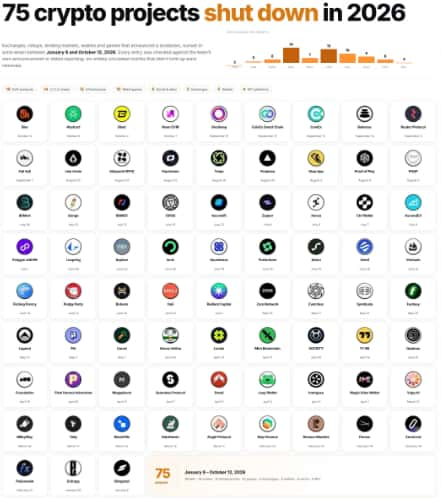
Here is the list of crypto projects that closed, grouped by sector.
Category
Projects
Layer 1 and Layer 2 networks
Blast, Abstract, Sophon, Neon EVM, Polygon zkEVM, Loopring, Botanix, Zero Network, Mint Blockchain, Lisk Chain, CoinEx Smart Chain, Hyli
Exchanges and trading firms
BitMEX, BitMart, AscendEX, CoinEx, BlockFills
DeFi and on-chain trading
Dango, Balancer, Radiant Capital, Ionic, Seamless Protocol, Polynomial, Step Finance, Zerolend, Slingshot, ODOS, Router Protocol, Everclear, Swell, MilkyWay, Angle Protocol, Satori, Trepa, Legend
Wallets and tools
SecondFi, Leap Wallet, Magic Eden Wallet, Ctrl Wallet, Xenea, Zapper, Parsec, Dmail, Entropy, Tally
NFTs, games, and social
Blur, Foundation, POAP, Proof of Play, Pudgy Party, Fantasy, Fishing Frenzy, Step App, Genso Online, Opulous
AI, data, and developer tools
Syndicate, Yupp AI, Powerloom, DataHaven
Other tracker listings
OneSwap, Fireplace, Full Sail, Paystream, Ventuals, Remora Markets, Pixel Heroes Adventure, Shipyard (IPFS), Phi, Carrot, Luckio, Intergaze, Megaphone, Soundness, XOCIETY, 77-Bit
Layer 1 and Layer 2 Shutdowns
Blockchain project closures hit the base layer hard.
Blast
Blast was an Ethereum Layer 2 that once held over $2 billion. The team announced the closure on 2 October because costs passed revenue. Coinbase halted BLAST trading on 20 October, and users had until 26 October to move assets.
Abstract
Abstract was a consumer-focused Layer 2 from Igloo, the Pudgy Penguins' parent. It closes on 15 December after stagnant growth, thin liquidity, and “tens of millions” in losses. About $76 million sat on the chain at the announcement.
Source: official announcement.
Sophon
Sophon raised $70 million for its zk chain. The mainnet closes on 30 November, and the withdrawal deadline is 25 November. No Ethereum exit route exists, so late assets can become permanently inaccessible.
Neon EVM
Neon EVM ran Ethereum apps on Solana and raised $40 million. The project has ceased operations, and the NEON token hit an all-time low on 15 October. No single reason was stated.
Polygon zkEVM
Polygon Labs switched off its sequencer on 1 July. The closure was announced a year ahead, and the bridge stayed open. Users can claim funds on Ethereum through 2027.
Loopring
Loopring was a zk rollup that closed its wallet in 2025 and then its DEX, citing low adoption. Value locked fell about 99% from its peak, and the LRC token dropped to about $0.01.
Botanix
Botanix ran Spiderchain, a Bitcoin Layer 2. The team announced the wind-down on 5 June and closed it on 10 June. It cited weak demand for Bitcoin-based DeFi.
Zero Network
Zero Network was an Ethereum Layer 2 from the Zerion team. It closed after about 1.5 years because of low adoption. Users had until 31 July to bridge out.
Mint Blockchain
Mint Blockchain was an NFT-focused network. News sites list it among NFT platforms that closed or pivoted this year. The sources reviewed give no separate date or reason.
Lisk Chain
Lisk is a ten-year-old project once worth about $4 billion. Its chain shuts on 31 October, and any remaining LSK becomes inaccessible. The team will burn 100 million LSK and pivot to business stablecoin finance.
CoinEx Smart Chain
This is the blockchain of the CoinEx exchange. The tracker lists it separately from the exchange, which is winding down amid weak markets.
Hyli
Hyli ran a zero-knowledge blockchain network. It shut down on 10 June after two years. Reports group it with chains that closed for lack of user demand.
Exchange and Trading Firm Shutdowns
BitMEX
BitMEX was an 11-year-old pioneer of perpetual futures. Owner HDR Global Trading announced on 23 July that operations would end on 23 September after an internal review. New sign-ups stopped at once.
BitMart
BitMart announced an orderly shutdown on 27 July after a business review and weak market conditions. It stopped new users and deposits and let existing users withdraw.
AscendEX
AscendEX announced its termination on 1 July. It cited regulatory, financial and operational pressure, including the EU’s MiCA rules. Users were offered withdrawal services.
CoinEx
CoinEx will wind down its exchange business by 22 December. It pointed to weak markets, falling liquidity and rising regulatory costs.
BlockFills
BlockFills was a Chicago lender and liquidity provider with over 2,000 institutional clients. It froze withdrawals in February after the crash and filed for Chapter 11 in March. Liabilities exceeded assets by $100 to $500 million.
DeFi and On-Chain Trading Shutdowns
DeFi protocol shutdowns came from both hacks and slow revenue.
Dango
Dango was a DEX perp with its own Layer 1. It raised $3.6 million and launched in April. Trading halted on 29 July because the team saw no path to lasting commercial success.
Balancer
Balancer was a long-running automated market maker hit by a $128 million exploit in November 2025. Balancer Labs closed in March, and BAL holders approved a wind-down on 29 September. The $9 million treasury returns to holders.
Radiant Capital
Radiant Capital was a cross-chain lending protocol. It announced its wind-down in June after it never recovered from a 2024 exploit.
Ionic
Ionic was a lending protocol. RootData lists it among DeFi projects that went dormant or shut down, and links such cases to weak fees and lower activity.
Seamless Protocol
Seamless was a lending protocol on Base. It announced its sunset on 7 April, blaming volatile markets. The app went offline on 1 July.
Polynomial
Polynomial was a DeFi derivatives platform that stopped in February. The team said it preferred closing over launching a token for a dying product.
Step Finance
Step Finance was a Solana portfolio platform. Attackers drained about $40 million from its treasury in January. No rescue funding arrived, and the team closed in February.
Zerolend
ZeroLend was a multichain lender that once held nearly $359 million. Its founder announced the wind-down in February after losses on inactive chains. The ZERO token fell 45%.
Slingshot
Slingshot was a DEX aggregator. It began winding down in late January and fully closed by the end of February.
ODOS
ODOS was a DEX aggregator that routed over $100 billion in trades. It closed on 30 July with no stated reason. Volume was down about 98% from its peak.
Router Protocol
Router Protocol ran a cross-chain messaging network. It ended operations by 30 September, citing relayer costs after failed financing. The team burned 303 million ROUTE tokens, and the price fell about 50%.
Everclear
Everclear was a cross-chain clearing protocol, formerly Connext. Pantera and Polychain backed it. It closed on 21 May after never building the commercial depth it needed, and CLEAR fell 48%.
Swell
Swell is a liquid staking project that also ran the Swellchain network. The chain was wound down before mid-June. No detailed reason was found.
MilkyWay
MilkyWay was a liquid staking protocol for modular chains. It announced its closure in January, citing mainly financial pressure.
Angle Protocol
Angle Protocol began shutting down its EURA and USDA stablecoins in the first quarter. Users were expected to redeem their holdings.
Satori
Satori was a Coinbase-backed project. It closed because it could not earn enough revenue to continue.
Trepa
Trepa was a prediction market that began as a Telegram mini-app on TON. Its last round ran on 12 August. The app stays open for withdrawals until 30 September.
Legend
Legend was a mobile DeFi app by former Compound executives. It raised $15 million, announced closure on 13 May after missing growth targets, and went offline on 12 July.
Wallet and Tool Shutdowns
Web3 project shutdowns were common among apps that depended on user fees.
SecondFi
SecondFi was formerly the Yoroi wallet. A cryptographic flaw let attackers steal about 16.1 million ADA in June. The team announced a wind-down on 22 July.
Leap Wallet
Leap Wallet confirmed a full shutdown by late May. It was a complete exit, not a pivot.
Magic Eden Wallet
Magic Eden closed its multi-chain wallet and non-Solana marketplaces to refocus on Solana, where most volume sat. The wallet moved to export-only mode.
Ctrl Wallet
Ctrl Wallet shut down on 3 August. RootData lists it as a discontinued service and a strategic closure.
Xenea
Xenea terminated its multichain wallet on 9 July. It gave users only 72 hours to export their private keys.
Zapper
Zapper was a DeFi portfolio tracker that ran nearly seven years. It closed on 3 August after concluding it could not continue independently.
Parsec
Parsec was an on-chain analytics platform and one of the crypto projects shut down in 2026. It closed on 19 February despite raising $5.25 million in seed funding, with its CEO saying the market had moved away from the product.
Dmail
Dmail was a decentralized email service. It began closing on 15 May after five years, citing high costs and weak token use. The DMAIL token fell about 70%.
Entropy
Entropy was a decentralized custody startup that raised $25 million. It closed in January after pivots failed and returned about $27 million to investors.
Tally
Tally was a governance platform used by more than 500 DAOs. It wound down on 18 March after concluding there was no viable market.
NFT, Gaming, and Social Shutdowns
Blur
Blur was once the largest Ethereum NFT marketplace. Its frontend closes on 12 November after volume falls over 99%. BLUR dropped about 29% on the news, though the protocol stays on-chain.
Foundation
Foundation was a curated NFT marketplace with about $230 million in primary sales. A sale to Blackdove collapsed, and the site went offline on 15 April.
POAP
POAP issued event-attendance badges for over five years. It stopped new issuers in March, and its co-founder announced the shutdown on 3 August.
Proof of Play
Proof of Play was an a16z-backed Web3 game studio. It announced a shutdown after its blockchain gaming idea fell short.
Pudgy Party
Pudgy Party was a mobile game from Pudgy Penguins that passed one million downloads. The team wound it down in June to focus on Pudgy World.
Fantasy
Fantasy.top, a crypto trading card platform, announced in May that its product had not found the right fit. Its core mode was sunset around mid-June.
Fishing Frenzy
Fishing Frenzy was a game on Ronin. The team could not prove its crypto gaming thesis, and servers closed on 25 June. The FISH token became spend-only.
Step App
Step App was a move-to-earn fitness app that ran four years. It ended all services on 21 August. Its FITFI token was down 99.9% from its peak.
Genso Online
Genso Online was a fantasy RPG. Its servers and marketplace closed on 30 April. The team said server costs ran five times revenue.
Opulous
Opulous was a music rights tokenization platform. One source reports it shut down after a bridge exploit released many OPUL tokens. Other details were not found.
Syndicate
Syndicate raised over $27 million to build tools for DAOs. It wound down on 21 May after five years, saying the rollup market had shrunk.
Yupp AI
Yupp was an AI-driven incentives platform that raised $33 million, led by a16z crypto, and reached 1.3 million users. It found no product-market fit and closed in April.
Powerloom
Powerloom was a data protocol built over five years. Its founders announced the wind-down on 15 June, citing no sustainable model. The chain shut on 21 July, and POWER is down about 99%.
DataHaven
DataHaven was an AI storage project that became one of the crypto projects shut down on 5 March after a year of development, citing the lack of a sustainable path forward.
Other Tracker Listings
Sixteen projects appear in the tracker, but no public notice with a date or reason was found for them: OneSwap, Fireplace, Full Sail, Paystream, Ventuals, Remora Markets, Pixel Heroes Adventure, Shipyard (IPFS), Phi, Carrot, Luckio, Intergaze, Megaphone, Soundness, XOCIETY, and 77-Bit. Readers should check each team’s own posts for details.
Crypto Projects That Announced Closure Recently: Roam Network
Roam Network was not in the tracker, but it is one of the latest cases. On 27 October, the team said it would wind down both the company and the project in the coming weeks, citing current market conditions. No closing date was given, and the post said nothing about user data or collected points.
The project pitched itself as “Waze for Robots,” using phones to map signal quality. Its domain is listed for sale on GoDaddy. At the time of reporting, the official X post was the only source.
What Happens When a Crypto Project Shuts Down?
The steps are usually the same. The team posts a notice, crypto exchanges set delisting dates, and a withdrawal window opens. After it closes, users may need a bridge contract, as the Blast case shows. Tokens left on Sophon or Lisk can become permanently inaccessible.
Crypto Shutdowns and Their Impact on Users
Users face lost access, locked tokens, and scams. Fake “refund” messages often appear within hours of a shutdown.
Risk
What you can do
Missed deadline
Read the team’s notice on day one and note every date.
Funds on an exchange
Send them to a wallet you control.
Fake refund links
Ignore DMs. Trust only the official account.
Hidden decline
Watch value locked and network revenue before buying a Layer 2 token.
Final Thoughts
The Crypto Projects Shut Down in 2026 list highlights the challenges facing the crypto industry like a clean-out of weak business models, not the end of the industry. Crypto projects closed in 2026 mostly ran out of users, money, or security. Users should read official updates, keep assets in their own wallets, and treat falling revenue as an early warning.
Disclaimer: This article is for information only and is not financial advice.