Crypto Tax Rules 2026: A Global Country-by-Country Guide A widely shared Cointelegraph post on crypto tax rates around the world sparked fresh debate this week about how differently countries
Crypto Tax Rules 2026: A Global Country-by-Country Guide
A widely shared Cointelegraph post on crypto tax rates around the world sparked fresh debate this week about how differently countries treat digital assets. That single graphic is a useful trigger for a bigger question: What are the actual crypto tax rules 2026 brings for investors in each major market?
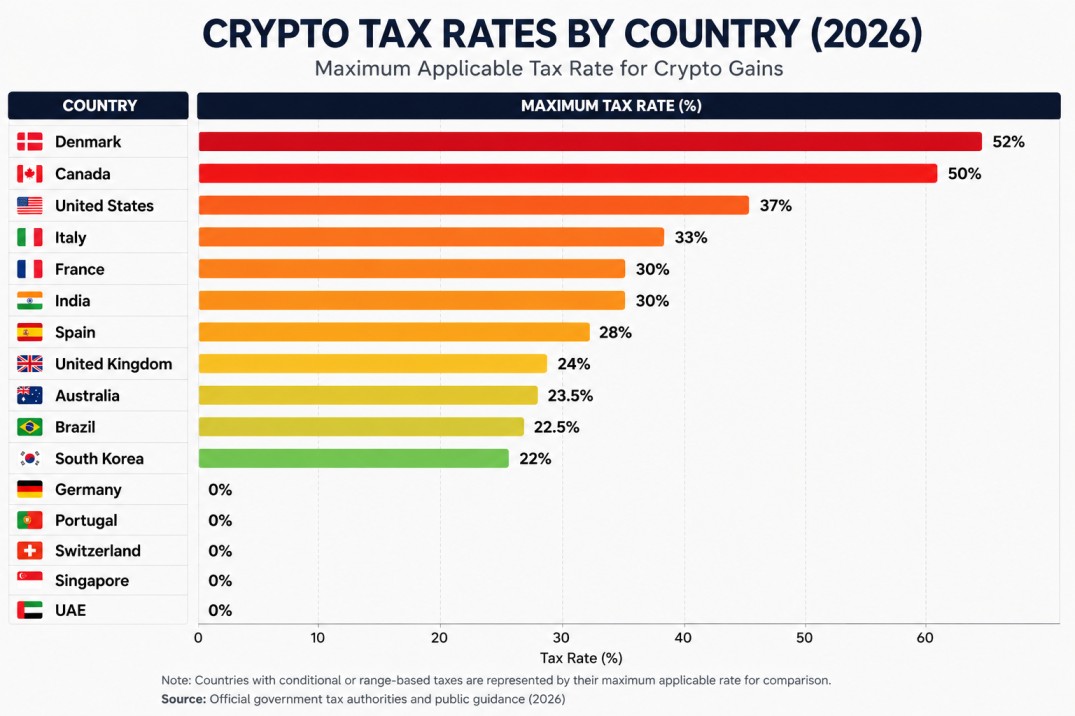
This guide walks through 0% jurisdictions, high-tax countries, and everything in between, using each government's own authority as the source for every figure below.
Why Crypto Tax Rules Matter in 2026
Over 40 countries began sharing crypto transaction data on January 1, 2026, under the OECD's Crypto Regulation Reporting Framework, with the first automated exchange between tax authorities expected in 2027. That makes where you're a tax resident more consequential than ever.
Understanding crypto tax rules this year isn't optional for active traders. Moving countries doesn't erase past gains either, since most liability authorities still expect reporting on income earned while you were a resident.
Global Crypto duty Comparison Table
Country
duty Rate
Key Rule
UAE
0%
No personal income or capital profits taxable
Singapore
0%
No CGT for personal investors
Switzerland
0%
No liability on private capital gains
Germany
0% after 1 year
Tax-free if held over 365 days
Portugal
0% after 365 days
Tax-free for non-professional holders
United States
0-20% (long-term)
Up to 37% short-term as ordinary earnings
United Kingdom
18-24%
Capital profits Tax bands
Australia
0-23.5%
50% CGT discount after 12 months
Canada
~50% inclusion
Only half the gain is taxable income
France
30%
Flat PFU (flat tax)
Italy
33%
Flat rate from 2026
Spain
19-28%
Progressive savings earnings bands
India
30% flat + 1% TDS
No loss offsetting allowed
Netherlands
Box 3 wealth-based
Taxes deemed return, not actual gains
Denmark
Up to 52%
Taxed as personal income
Brazil
15-22.5%
Progressive by gain amount
South Korea
22% (delayed to 2027)
Postponed from earlier 2025 start date
0% Crypto duty Countries
Five jurisdictions currently charge nothing on personal crypto profits, though the conditions behind each vary:
UAE: The Federal taxable Authority imposes no personal income or capital profits liability on individuals at all, pertax.gov.ae.
Singapore: The Inland Revenue Authority of Singapore treats personal asset profits as capital in nature, not taxable, under its Digital Tokens e-Tax Guide atiras.gov.sg.
Switzerland: The Swiss Federal Tax Administration exempts private capital profits from liability entirely, per, though an annual wealth taxes on holdings still applies at the cantonal level.
Germany: The Bundesministerium der Finanzen's guidance on Kryptowerte confirms profits become tax-free once an asset is held for more than one year, perbundesfinanzministerium.de.
Portugal: The Autoridade Tributária e Aduaneira exempts personal, non-professional asset profits held over 365 days, perportaldasfinancas.gov.pt.
Major Countries and Their Crypto Tax Rules
United States:The IRS classifies cryptocurrency as property, meaning selling, trading, or spending asset can create a taxable event. Long-term capital gains on assets held for more than one year are taxed at 0%, 15%, or 20%, while short-term profits are taxed as ordinary income at rates of up to 37%. In addition, income earned through activities such as mining, staking, or receiving asset as payment is generally taxed as ordinary income based on its fair market value.
United Kingdom:HMRC generally treats cryptocurrency as an investment asset subject to Capital Gains Tax (CGT) when investors dispose of their holdings.
Depending on the taxpayer's income level, gains are taxed at 18% or 24%. However, crypto earned through mining, staking, or employment-related activities may instead be taxed as income under separate rules.
Australia:The Australian Taxation Office (ATO) considers cryptocurrency a Capital Gains (CGT) asset. Profits are generally taxed at the investor's marginal income liability rate. Individuals who hold asset for more than 12 months may qualify for a 50% CGT discount, reducing the taxable portion of their capital gains.
Canada:Canada taxes cryptocurrency based on how it is used. For most individual investors, only 50% of a capital gain is included in taxable income.
However, if crypto trading is considered a business activity, profits may be taxed as business income, making the full amount taxable.
France:France generally applies a30% Prélèvement Forfaitaire Unique (PFU), commonly known as the flat tax, on cryptocurrency gains earned by individual investors.
This rate combines both income tax and social contributions, while professional trading activities may be subject to different taxable treatment.
Italy:Italy increased its cryptocurrency capital gains liability to 33% from 1 January 2026 under the latest Budget Law, replacing the previously proposed 42% rate. Investors may also need to comply with reporting requirements for qualifying assets held during the liability year.
Spain:Spain taxes cryptocurrency profits as savings income under a progressive liability system. Depending on the total gain, taxable rates currently range from 19% to 28%, meaning investors with larger profits fall into higher liability brackets.
India:India imposes a flat 30% tax on income from Virtual Digital Assets (VDAs), regardless of the taxpayer's income level.
A 1% duty Deducted at Source (TDS) also applies to eligible crypto transactions, and investors are not allowed to offset asset losses against other income or carry those losses forward.
Netherlands:The Netherlands taxes cryptocurrency under its Box 3 wealth liability system, where liability is based on the deemed value and expected return of assets rather than actual realized capital gains. As a result, investors may owe taxable even if they have not sold their crypto holdings.
Denmark:Denmark generally treats cryptocurrency gains as personal income, with liability rates that can reach around 52% for higher-income taxpayers. The final liability treatment depends on factors such as the purpose of holding the crypto and whether the activity is considered speculative investing.
Brazil:Brazil applies progressive capital gains duty rates ranging from 15% to 22.5%, depending on the size of the profit. Higher gains are subject to higher liability rates, and taxpayers are expected to maintain accurate records of their cryptocurrency transactions for liability reporting purposes.
South Korea:South Korea has repeatedly delayed the implementation of its planned 22% cryptocurrency duty, with the latest schedule targeting 2027. Until the new framework comes into effect, investors continue to follow the existing liabilityrules while awaiting final legislative implementation.
User Impact
For everyday holders, these crypto tax rules mean the same trade can carry a vastly different bill depending on where you live. A long-term holder in Germany or Portugal pays nothing, while the same gain in Denmark could lose over half its value to liability.
Traders in high-tax countries have more incentive to hold long-term where a discount or exemption exists, such as Australia's 12-month discount.
CARF reporting means underreporting foreign gains is riskier than in prior years, regardless of country.
Anyone relocating should confirm exit-tax rules, since past gains often remain taxable in the country where they were earned.
Market Impact
liability policy shapes where trading volume and company headquarters concentrate. Zero-tax jurisdictions like the UAE and Singapore continue attracting exchanges and crypto-focused firms seeking regulatory and duty certainty.
Meanwhile, high-tax markets like Denmark and India have both seen public debate over whether steep rates push trading activity offshore or onto platforms outside domestic reporting. Neither effect is easy to measure directly, but it remains a recurring theme in policy discussions this year.
Conclusion
Crypto tax rules in 2026 span the full range, from complete exemption to rates above 50%, and that gap is unlikely to close soon. Whether you're comparing the UAE's 0% to Denmark's 52%, or watching Japan's reform move toward a flat rate, the one constant is that your specific country's official guidance is what actually governs your filing, not a general comparison chart of crypto exchange regulation.
Disclaimer
This article is for educational and informational purposes only and does not constitute financial or liability advice. liability rules change frequently and vary by individual circumstances, so consult a qualified liability professional or your local duty authority before making any decisions.