Europe’s shift to the Markets in Crypto-Assets Regulation (MiCA) is creating fresh friction for international exchanges, with ESMA stressing that EU crypto clients must be handled through MiC
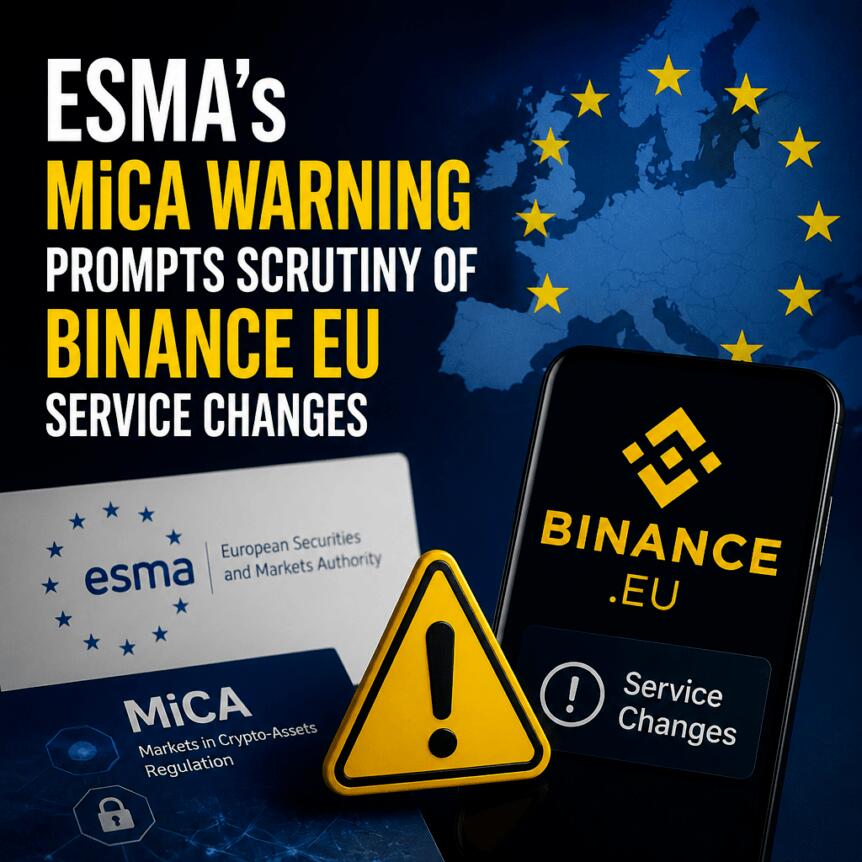
Europe’s shift to the Markets in Crypto-Assets Regulation (MiCA) is creating fresh friction for international exchanges, with ESMA stressing that EU crypto clients must be handled through MiCA-authorized entities after the bloc’s July 1 transitional deadline. The guidance arrives as questions grow over how global platforms can keep servicing customers across the EU and EEA while meeting the licensing rules.
According to ESMA, crypto asset service providers (CASPs) must hold MiCA authorization to serve clients across the EU and European Economic Area. ESMA also clarified that MiCA protections apply only to the specific legal entity that is licensed in the EU—not to any other group entity located outside the bloc.
Key takeaways
- ESMA says EU/EEA clients should be served through a MiCA-authorized legal entity after July 1, rather than through non-EU arms.
- Reverse solicitation under MiCA is narrow: non-EU firms can only serve EU clients when the client initiates the relationship without any solicitation or promotion.
- ESMA points to activities like websites, apps, social media, online ads, sponsorships, and influencer campaigns as evidence of “solicitation.”
- Legal experts argue that third-country licensing (including Abu Dhabi) does not substitute for MiCA authorization for EU clients.
ESMA’s post-deadline message to the industry
ESMA’s spokesperson told Cointelegraph that CASPs must be MiCA-authorized to serve clients throughout the EU and EEA. ESMA further emphasized that “EU clients should be serviced through a MiCA-authorized entity,” adding that the protections under MiCA apply only to the licensed EU legal entity.
The clarification matters because it underlines a practical compliance distinction: an exchange can be active across multiple jurisdictions, but EU customers must ultimately connect to the regulatory perimeter of the MiCA-authorized entity if the business is operating in the EU market.
The guidance also comes amid broader uncertainty over how global exchanges will structure operations and customer servicing when licensing deadlines arrive. For traders and users, the concern is not just whether services continue, but whether the regulatory framework that applies in the EU actually attaches to the provider interacting with them.
What MiCA allows—and what it blocks for non-EU firms
ESMA said CASPs based outside the EU cannot provide services to local customers unless they qualify under MiCA’s “narrow exemption” for reverse solicitation, set out in Article 61.
Article 61 permits a non-EU crypto company to serve an EU client only when the client initiates the relationship entirely on their own—without any solicitation, marketing, or promotion by the firm. ESMA highlighted that the exemption does not apply if the third-country company solicits clients or prospective clients in the Union.
In ESMA’s explanation to Cointelegraph, the regulator pointed to language indicating that where a third-country company solicits clients in the EU, it should not be treated as a service provided solely at the client’s exclusive initiative.
ESMA also referenced its official solicitation guidelines, which enumerate examples of conduct that can amount to solicitation targeting EU users. The regulator’s list includes operating websites and mobile apps, using social media, running online advertising, and engaging in sponsorships and influencer campaigns aimed at EU audiences.
For exchanges with established marketing footprints in Europe, that framing raises the compliance stakes: ongoing user acquisition and brand presence—especially through digital channels—may be difficult to square with a “reverse solicitation only” business model.
Binance transition questions and the Abu Dhabi servicing debate
The ESMA clarification followed Binance’s communications to users about adjusting services in certain EU countries as part of its MiCA transition. Binance told users in countries including Poland, France, Spain, and Italy that changes were underway, while stating that users in other jurisdictions would not need to take action if the exchange did not operate through a local registered entity in their location—saying “no action is required at this time” in those cases.
In parallel, screenshots of Binance customer support messages circulated on social media appeared to suggest that some EU users could be serviced through Binance’s Abu Dhabi Global Market (ADGM) entity. That possibility triggered legal pushback.
Yuriy Brisov, a lawyer at Digital & Analogue Partners, told Cointelegraph that an Abu Dhabi license has no effect under MiCA for the purpose of serving EU clients, because MiCA treats Abu Dhabi as a third country—similar to other non-EU jurisdictions such as the United States or Singapore.
Brisov argued that if Binance claims certain EU users are being serviced through ADGM, then under MiCA terms this would still mean a non-EU company is serving those users. He added that the reverse solicitation exemption was intended for isolated situations where an EU customer independently approaches a non-EU firm, rather than for maintaining an existing customer base built through years of marketing and outreach.
Binance did not respond to repeated requests from Cointelegraph seeking clarification on whether any EU users would be serviced through its ADGM entity after the MiCA deadline.
Why this distinction may shape compliance—and user experience—across the EU
MiCA’s structure, as reflected in ESMA’s guidance, places the burden on the legal entity doing the serving. The result is that corporate group complexity may not help exchanges avoid licensing requirements: a non-EU entity cannot rely on the existence of a separate regulated license elsewhere to automatically bring EU services under MiCA.
For investors and users, this matters in concrete ways. The question is not only whether an exchange remains accessible, but which entity is actually providing the service after the deadline—because that determines whether MiCA’s consumer and regulatory protections attach.
Looking ahead, the most important variable will be how exchanges implement their transition in practice. ESMA’s emphasis on “solicitation” through everyday digital operations suggests that firms may need to take careful steps to ensure their EU-facing activities do not undermine any attempt to rely on reverse solicitation. Meanwhile, regulators and courts are likely to treat “entity-level” licensing compliance as a central requirement rather than a technicality.
Readers should watch for more direct confirmations from exchanges about which specific MiCA-authorized entities will handle EU/EEA users after July 1, and whether regulators pursue cases where marketing activity and account servicing appear inconsistent with the reverse solicitation framework.
This article was originally published as ESMA’s MiCA warning prompts scrutiny of Binance EU service changes on Crypto Breaking News – your trusted source for crypto news, Bitcoin news, and blockchain updates.