TLDR: Federal Reserve rate hike odds climbed to 38% after Brent crude crossed $100, reversing the market’s earlier confidence in near-term rate cuts. Two-year Treasury yields reached 4.37%, w
TLDR:
- Federal Reserve rate hike odds climbed to 38% after Brent crude crossed $100, reversing the market’s earlier confidence in near-term rate cuts.
- Two-year Treasury yields reached 4.37%, while the ten-year yield approached 4.7%, increasing financing pressure across stocks, housing, and crypto.
- June CPI cooled to 3.5%, but May PCE inflation reached 4.1%, leaving policymakers divided before the July 28–29 policy meeting.
- Bitcoin traded near $64,000 as higher bond yields and stronger cash returns reduced the appeal of volatile, non-yielding risk assets.
Investors have sharply increased bets on a Federal Reserve rate hike after Brent crude briefly moved above $100 a barrel. The surge followed renewed supply fears linked to the Iran conflict and shipping risks across key Middle East routes. Futures markets now assign a 38% chance of a quarter-point increase on July 29, up from 13% one week earlier.
Rising oil prices have also lifted Treasury yields and tightened financial conditions across global markets. Bitcoin traded near $64,000 during a volatile trading week. Investors reassessed demand for risk assets before next week’s scheduled Federal Open Market Committee policy decision.
 Brent Crude Oil Last Day Financ (BZ=F)
Federal Reserve Rate Hike Bets Rise as Oil Fuels Inflation
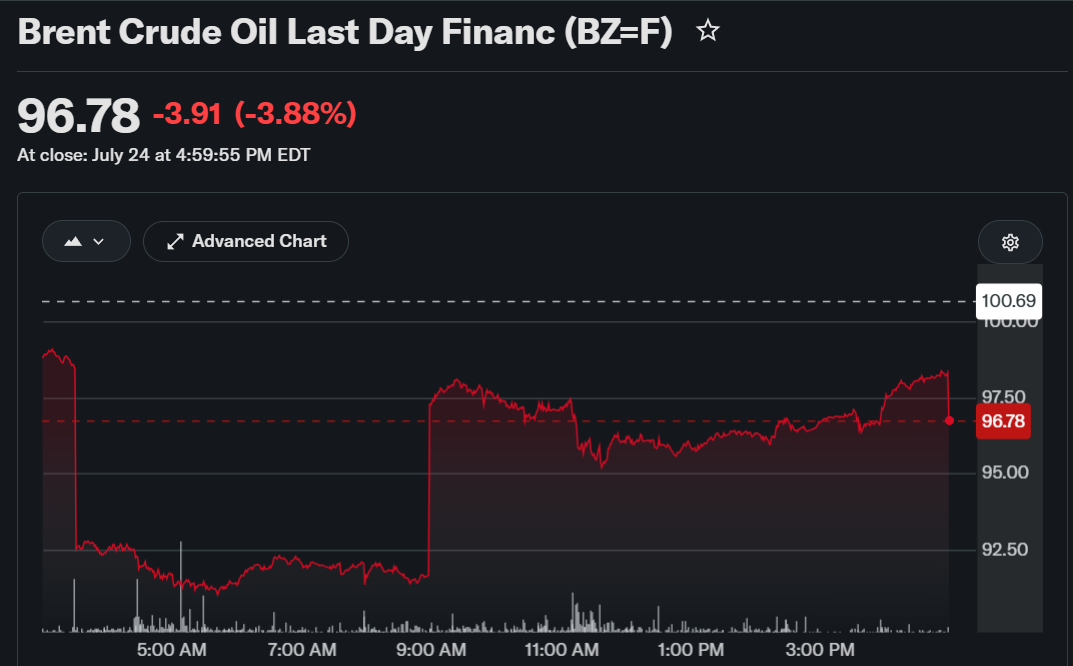
Brent crude settled above $100 on Thursday after gaining 7% during the session. West Texas Intermediate also climbed above $92 as traders priced possible supply disruptions. The move placed Brent about 25% above its level at the June Fed meeting. Higher fuel costs can quickly reach transport, manufacturing, and household budgets.
The inflation picture gives policymakers conflicting signals. June consumer prices fell 0.4% from May, while annual inflation slowed to 3.5%. Core inflation held at 2.6%, offering support for officials who prefer patience. Yet May PCE inflation reached 4.1%, while core PCE stood at 3.4%. Both readings sit well above the Fed’s 2% target.
The central bank kept its federal funds target at 3.5% to 3.75% in June. Its statement said inflation stayed elevated partly due to supply shocks, including energy. A Federal Reserve rate hike next week would lift the range by 25 basis points. It would also mark a rapid response to renewed inflation pressure.

Source:
CME GroupShort-term Treasury yields reflect that policy risk. The two-year yield reached 4.37% on July 23, its highest level since early 2025. The ten-year yield approached 4.7%, raising borrowing costs for companies and households. Higher Treasury yields can pressure equity valuations, mortgage rates, and speculative assets.
CME said federal funds futures trading was 50% higher than before the comparable July 2025 decision. That volume reflects wide uncertainty over whether policymakers will act immediately or wait for more inflation evidence.
Federal Reserve Rate Hike Risk Pressures Bitcoin Markets
Bitcoin faces a difficult backdrop when yields rise and liquidity expectations weaken. The asset traded near $63,993 on July 25 after moving between roughly $63,700 and $65,055. A Federal Reserve rate hike could increase demand for cash and government bonds. Those instruments provide income without Bitcoin’s price volatility.
The oil shock also creates a policy problem that rates cannot solve directly. Higher borrowing costs may reduce demand, but they cannot restore disrupted crude supply. That trade-off increases recession concerns if energy prices stay high while credit conditions tighten. Investors must therefore track both inflation data and geopolitical developments.
Fed officials appear divided before the July 28 and 29 meeting. Some policymakers have argued that inflation requires faster action. Others favor waiting until September for more evidence on prices and economic activity. That disagreement leaves markets sensitive to every oil move, public comment, and inflation release.
The next PCE report arrives on July 30, one day after the Fed decision. Policymakers will not have that data before voting. They must instead assess June CPI, May PCE, energy markets, tariffs, services inflation, and labor conditions. That limited information raises the risk of a divided committee.
Oil prices eased below $100 on Friday, but Brent still ended near $96.78. A sustained retreat could reduce immediate pressure for a Federal Reserve rate hike. Another supply disruption could reverse that relief quickly. Markets will watch the Strait of Hormuz, Red Sea shipping, Treasury yields, and Fed guidance through Wednesday.
The post Federal Reserve Rate Hike Bets Surge as Oil Crosses $100 Mark appeared first on Blockonomi.