Four months after FIP.16 won 98.06% support, Flare is beginning to demonstrate whether an L1 can replace inflation-led incentives with economics tied to actual network activity. Crypto govern
Four months after FIP.16 won 98.06% support, Flare is beginning to demonstrate whether an L1 can replace inflation-led incentives with economics tied to actual network activity.
Crypto governance is full of ambitious proposals. Far fewer survive contact with the blockchain.
Flare’s FIP.16 is beginning to look like one of the more interesting exceptions. Approved on April 24 with 98.06% support, the proposal was not a cosmetic adjustment to FLR tokenomics. It attempted to change the economic relationship between the network and its native asset: less inflation, more staking, higher transaction fees, automatic burns and, through the Flare Income Reinvestment Entity (FIRE), a mechanism for routing protocol revenue back into the system.
Four months later, the first evidence is visible onchain.
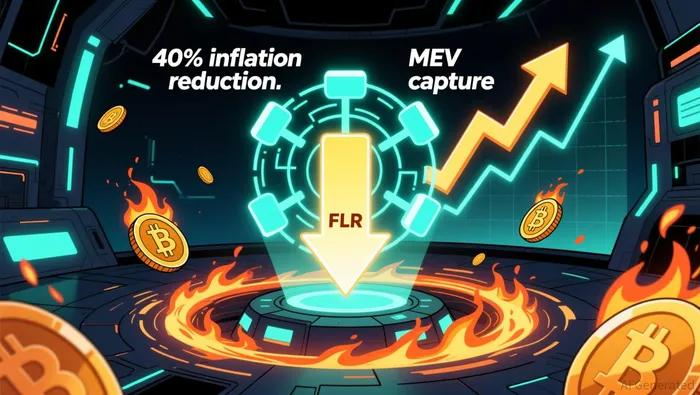
Annual inflation has fallen from 5% to 3%, while the annual issuance ceiling has been reduced from 5 billion to 3 billion FLR. The July hard fork then increased the base transaction fee from 25 gwei to 500 gwei, a 20-fold increase designed to turn network activity into a larger supply sink. The important point is that Flare did not simply promise a tighter token supply. It changed the machinery that determines it.
That distinction matters.
For years, L1 tokenomics has often relied on a familiar bargain: issue tokens to pay validators and participants, then hope network adoption grows quickly enough to justify the dilution. It works as a bootstrapping mechanism. It becomes less convincing when emissions remain the primary economic engine after the network has established real activity.

FIP.16 is effectively testing the alternative: can network usage itself become the economic engine for FLR?
The early staking numbers are encouraging.
Flare now has 21.5 billion FLR staked, compared with roughly 16 billion in July, while staking's share of all staked-or-delegated FLR increased from around 32% in April to approximately 46% by late August. Most of that movement occurred within weeks of the hard fork.
That is not merely a supply statistic. It changes the security economics of the network.
FIP.16 gives P-chain staking five times the signing weight of C-chain delegation and increased the maximum validator size from 200 million to 300 million FLR. The design deliberately places more influence behind capital that is actually committed to securing the network rather than capital that can be withdrawn at any time.
Then there is the burn.
Flare has burned 15.6 million FLR year to date through transaction fees, with more than 40% of that total occurring after the July 14 fork. The resulting burn rate is now more than 10 times the pre-fork baseline.
That is arguably the more important signal.
A token burn can be manufactured. A burn mechanism that scales with transactions is different. Every transaction permanently destroys FLR, meaning the supply reduction is mechanically connected to network usage rather than a discretionary treasury decision. The more the network is used, the more the mechanism has the potential to offset issuance.
But the most interesting part of FIP.16 may be FIRE.
FIRE is designed to collect protocol revenues from multiple sources and use them first and foremost for supply reduction, while also supporting validators, applications, asset issuers and ecosystem development. The proposal specifically targets revenues from FAssets, the Flare Data Connector, Flare Smart Accounts, Confidential Compute and eventually protocol-level MEV.

The first receipts are already appearing.
According to the DefiLlama Research analysis supplied with the report, FIRE had accumulated $31,438, with FAssets minting fees contributing $18,248 and FDC request fees another $12,676. Tag registrations and redemption fees made up the remainder.
Those numbers are still small. Pretending otherwise would undermine the argument.
But small revenue is not the failure here. The significance is that the revenue loop exists.
FIP.16 created a structure in which economic activity on Flare can generate fees, fees can flow into FIRE, and FIRE can then support supply reduction and network incentives. Flare itself describes the objective as creating a stronger transmission mechanism between network activity and FLR economics.
That is the experiment worth watching.
There is also a reason not to declare victory yet. Several of the potentially largest pieces of the model are still being switched on. The report identifies MEV capture and Confidential Compute fees as future phases, while FIRE's current revenue base is still concentrated in FAssets and FDC activity.
That makes the next phase more important than the first four months.
If FAssets usage expands, FDC activity grows and additional revenue streams begin contributing, FIRE could increasingly substitute organic network revenue for inflation-funded rewards. The original FIP.16 proposal explicitly envisioned that progression: FLR would first move toward lower inflation and eventually toward a model where growing ecosystem activity could make the token non-inflationary and potentially deflationary.

But there is a hard test ahead.
Can Flare generate enough economic activity to make the tokenomics sustainable without relying on the very emissions it is trying to reduce?
That question separates a genuine redesign from a sophisticated supply narrative.
For now, the answer is not proven. The current revenue pool is modest, and the largest planned sources have yet to arrive. But the early indicators are moving in the intended direction: inflation is lower, staking has increased sharply, burns have accelerated by an order of magnitude, and protocol revenue is beginning to accumulate.
That is enough to make FIP.16 more than governance theater.
The broader lesson is even more interesting. Tokenomics is increasingly becoming a test of whether a blockchain can capture economic value rather than merely distribute incentives. Flare is betting that FLR can move from being primarily an asset used to pay for network security toward being an asset whose economics increasingly reflect the activity taking place on the network.
Four months is far too early to call the experiment a success.
But it is long enough to see whether the machinery actually works.
So far, Flare's blockchain is beginning to give the proposal the one thing tokenomics cannot manufacture: onchain evidence.