IBM's watsonx integration brings Hedera IDTrust into discussions about verifying AI agents beyond conventional customer identity checks. IDTrust uses verifiable credentials and Hedera records
- IBM's watsonx integration brings Hedera IDTrust into discussions about verifying AI agents beyond conventional customer identity checks.
- IDTrust uses verifiable credentials and Hedera records to help businesses check identities and review agent activity.
- Enterprise uptake will depend on real deployments, permission controls and compliance with the rules governing digital identity.
Hedera IDTrust is part of IBM's AI identity work, with a system designed to help businesses verify software agents before they act.
IBM's Digital Identity Project Moves Beyond KYC
Tokenicer has returned to IBM's digital identity work on Hedera, first discussed in 2024. The analyst says the project reaches beyond routine customer checks as businesses begin using autonomous AI agents. This is the new focus, Know Your Agent (KYA).
Source:
X
AI agents can interact with company systems, fetch data, or execute actions for a user. The businesses should be aware of the agent that is performing and what permissions it possesses. Identity checks can help establish whether that software has been authorised.
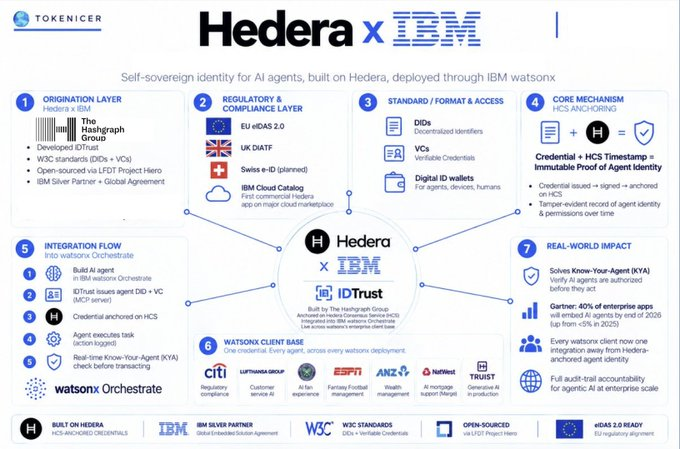
The infographic places IDTrust within IBM's watsonx environment. It names The Hashgraph Group as the solution's developer and links the system to Hedera. The aim is to bring identity checks into enterprise AI processes rather than leave them as a separate step.
IBM watsonx Orchestrate is displayed in the illustrated workflow. An agent is given a task, and his credentials are evaluated, and it logs his activity. Those records can be useful for a business to take a look at when there is a security concern or a dispute.
How Hedera Records Agent Credentials
IDTrust provides verifiable credentials to represent identity information that can be verified by authorised entities. The infographic presents a cryptographic hash and timestamp anchored via Hedera Consensus Service. These records will enable verification if a credential is presented for reference with an earlier credential.
This credential does not have to be published on the network in its entirety. Rather, a matching record may be kept on Hedera and private information remains elsewhere. This separation can aid safeguard delicate details and confirm.

W3C Verifiable Credentials standards are also referenced in the graphic. These are used to issue and verify digital claims between compatible systems. Different organisations can exchange identity information, with a little less effort, using shared standards.
The compliance panel features EU eIDAS 2.0, the UK's Digital Identity and Attributes Trust Framework, and Switzerland's eID plans. Their inclusion in this graphic does not mean that IDTrust is approved under each framework. Organisations are required to verify what rules are applicable in their use cases.
Adoption Will Depend on Enterprise Use
Organizations that are associated with IBM watsonx are listed in the infographic, including Citi, Lufthansa Group, ESPN, ANZ, NatWest, and Truist. Their presence indicates the spectrum of companies related to the platform. It does not attest to the use of IDTrust or verification of agents by these companies.
For businesses to handle autonomous software safely, more than just an identity record will be needed. They need to manage permissions, remove access to resources when it's needed and track agent activity. These protections are important because software can act without a person's permission.
If an AI agent gets something wrong, responsibility also is up for debate. An identity record may be useful in determining if an action was taken, but does not verify its correctness. We need clear guidelines for accountability and monitoring in businesses.
The more people use IDTrust, the more identity-based activities can be introduced into Hedera, for HBAR. The effect would be related to the number of deployments and frequency of verification events recorded by the system. The supplied material gives no transaction forecasts or evidence of additional HBAR demand.
Tokenicer's main point is that AI agents will need reliable ways to prove their identity as their duties grow. One is to use IBM's watsonx environment and Hedera's record-keeping service. Full adoption will rely on business requirements and technical performance as well as the rules that organisations need to fulfil.