Introduction Every technological revolution begins with skepticism. When cloud computing emerged, many believed it would never replace traditional servers. When GitHub became mainstream, some
Introduction
Every technological revolution begins with skepticism.
When cloud computing emerged, many believed it would never replace traditional servers.
When GitHub became mainstream, some developers insisted local repositories were all they needed.
When low-code platforms appeared, many predicted the end of professional software engineering.
Now the industry faces another major transformation.
Artificial Intelligence.
More specifically, AI coding assistants and autonomous coding agents.
Over the past year, tools such as Cursor, GitHub Copilot, Claude Code, OpenAI Codex, and other AI-powered development environments have fundamentally changed how software is built.
After experiencing this firsthand, I no longer believe AI will replace developers.
Instead, I believe it will redefine what being a developer actually means.
Three Days of Debugging…
Recently I encountered a problem while building a Web3 payment integration.
Everything appeared correct.
The APIs responded.
Wallet signatures verified.
The code compiled successfully.
Yet one critical component simply refused to work.
I spent nearly three days:
- Reading documentation
- Searching GitHub issues
- Browsing Stack Overflow
- Comparing SDK versions
- Adding logging statements
- Testing different implementations
Nothing solved the issue.
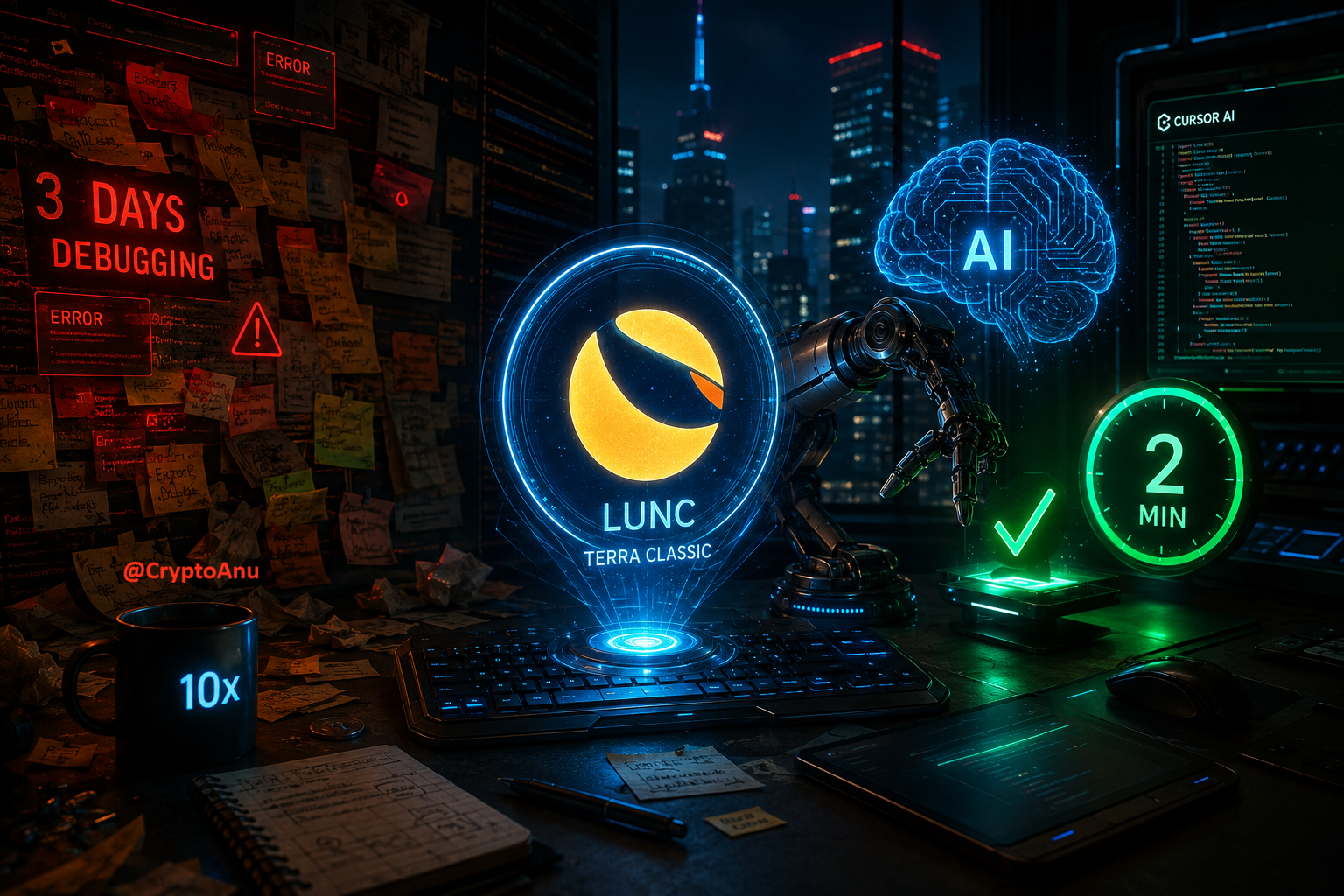
Eventually I asked Cursor AI to analyze the entire project.
Within minutes it identified the actual cause of the bug.
The suggested fix worked almost immediately.
Three days of frustration became a two-minute solution.
That experience fundamentally changed my perspective on AI-assisted development.
AI Doesn't Think Like Google
Traditional software development often involves searching for information.
Developers constantly move between:
- Documentation
- Stack Overflow
- GitHub
- Reddit
- API references
- Discord servers
The challenge isn't simply finding answers.
It's connecting those answers to your specific codebase.
AI agents approach the problem differently.
Instead of searching isolated snippets, they analyze context.
They inspect multiple files simultaneously.
They understand dependencies.
They follow execution flow.
Rather than suggesting generic solutions, they explain problems within the architecture of your actual project.
That distinction is enormous.
From Writing Code to Designing Systems
Perhaps the biggest shift isn't speed.
It's responsibility.
Historically developers spent much of their time writing repetitive code.
Boilerplate.
Configuration.
Error handling.
Debugging.
Today AI increasingly handles many of those repetitive tasks.
That allows developers to focus on:
- Product architecture
- User experience
- System design
- Security
- Business logic
- Innovation
Coding is gradually becoming less about typing syntax and more about solving problems.
Web3 May Benefit More Than Any Other Industry
Artificial intelligence could have an even greater impact on Web3 than traditional software development.
Building blockchain applications often requires knowledge across multiple disciplines simultaneously:
- Smart contracts
- Frontend development
- Backend APIs
- Wallet integration
- Cryptography
- Security
- Infrastructure
- Indexers
- RPC providers
- Payment protocols
Managing this complexity has traditionally slowed development.
AI dramatically reduces that barrier.
Developers can now prototype decentralized applications, troubleshoot integrations, and iterate on ideas significantly faster than before.
This acceleration may shorten innovation cycles across the entire blockchain industry.
AI Doesn't Replace Developers
One of the most common fears surrounding AI is job displacement.
Will developers become obsolete?
Probably not.
Instead, the profession itself is evolving.
AI is exceptionally good at:
- Explaining unfamiliar code
- Finding bugs
- Writing repetitive functions
- Generating documentation
- Refactoring existing code
- Suggesting optimizations
Humans remain responsible for:
- Product vision
- Strategic decisions
- Architecture
- Security trade-offs
- User needs
- Creative problem solving
The relationship is complementary rather than competitive.
Developers become directors.
AI becomes an incredibly capable assistant.
Productivity Is Becoming the Competitive Advantage
Throughout history, every major technological breakthrough has increased productivity.
The printing press amplified writers.
Spreadsheets amplified accountants.
Photoshop amplified designers.
Digital cameras amplified photographers.
AI is beginning to amplify developers.
The result isn't fewer builders.
The result is builders who can accomplish dramatically more in the same amount of time.
One experienced developer equipped with AI tools can now complete projects that previously required entire teams.
This changes startup economics, product development, and innovation itself.
The Rise of AI-Native Web3
The intersection of blockchain and artificial intelligence is only beginning.
Future applications may combine:
- Autonomous AI agents
- Smart contracts
- On-chain payments
- Decentralized identity
- Tokenized incentives
- Multi-agent systems
- Real-time blockchain analytics
Instead of simply using blockchain applications, users may increasingly interact with intelligent agents capable of executing transactions, analyzing markets, negotiating contracts, and managing digital assets autonomously.
This represents a fundamental evolution of Web3.
The Developers Who Will Win
History suggests that technological revolutions rarely eliminate skilled professionals.
Instead, they reward those who adapt earliest.
Developers who embrace AI today gain several advantages:
- Faster development cycles
- Better debugging
- More experimentation
- Lower development costs
- Greater creative freedom
The competitive edge shifts away from typing code quickly.
It moves toward understanding problems, designing systems, and shipping products efficiently.
Execution becomes the defining skill.
Conclusion
Artificial intelligence is not ending software development.
It is accelerating it.
My experience with Cursor demonstrated something I had never experienced before:
Three days of debugging compressed into two minutes.
That wasn't merely a productivity improvement.
It represented an entirely new way of building software.
As AI agents continue improving, the most valuable developers won't necessarily be those who write the most code.
They'll be those who ask the best questions, design the best systems, and leverage AI to transform ideas into products faster than ever before.
The next generation of Web3 will not be built by humans alone.
It will be built by humans and AI working together.
And for developers willing to embrace that future, this may become the greatest opportunity the software industry has ever seen.