When thousands of students and activists gathered in New Delhi, India's capital, on July 20 for the Cockroach Janta Party's "Sansad Chalo" — Hindi for "March to Parliament" — many expected po
When thousands of students and activists gathered in New Delhi, India's capital, on July 20 for the Cockroach Janta Party's "Sansad Chalo" — Hindi for "March to Parliament" — many expected police barricades. Few expected their phones to become almost useless.
The rally capped more than 30 days of protests at Jantar Mantar, a historic site in central Delhi that serves as the city's designated protest ground, over a scandal familiar to millions of young Indians: repeated leaks of the country's high-stakes national exams, the competitive tests that determine university places and government jobs.
Protesters are demanding the resignation of Dharmendra Pradhan, India's federal education minister.
Related: XXI stock plunges 18% after CEO's abrupt exit
The demonstrations grew out of the Cockroach Janta Party, or CJP — "Janta" means "the people" in Hindi — a youth-led movement that began as online satire after India's chief justice likened unemployed young people to "cockroaches" during a court hearing in May.
What started as a meme-driven campaign quickly became one of the largest youth-led movements to challenge Prime Minister Narendra Modi's government, now in its third term.
Anger intensified after Sonam Wangchuk — a prominent education reformer and climate activist from the Himalayan region of Ladakh, and one of India's best-known campaigners — was forcibly moved to a hospital by police on June 28, one day before the march, after a 20-day hunger strike. The movement has since expanded beyond the exam leaks, drawing students and young professionals frustrated by chronic unemployment and what they describe as a lack of government accountability.
As protesters scattered through central Delhi during clashes, calls and mobile data became unavailable in parts of the city, according to protesters interviewed by TheStreet Roundtable. That left groups unable to locate friends or receive updates from organizers.
One unexpected tool emerged during the violent police brutality was Bitchat, a decentralized messaging app backed by Jack Dorsey — the co-founder of Twitter, now X — that works without internet access, phone numbers or central servers.
Police use batons and tear gas on student protesters
Tens of thousands joined the July 20 march toward Parliament, timed to the opening day of the monsoon session, one of the Indian Parliament's three annual sittings. Roundtable witnessed Delhi Police chase demonstrators toward Jantar Mantar, block exits with barricades and later force their way into the designated protest site.
The "Sansad Chalo" rally was the movement's largest demonstration yet. Officers used batons and fired dozens of tear gas canisters as protesters, including students, sat on the ground with folded hands. Families and children were also present. One protester, Anurag, said the tear gas caused panic and left people struggling to breathe.
“People couldn’t breathe,” he told TheStreet Roundtable. “There were people with family members, children. They were crying.”
Another student said many expected the crackdown to discourage demonstrators, but the opposite happened as thousands returned to Jantar Mantar the following day.
“Nobody has backed down,” the student said. “Everybody’s here with double the passion, double the frustration.”
Delhi Police said demonstrators had displayed “unruly, aggressive and violent behaviour” and violated prohibitory orders.
On July 21, Parliamentary Affairs Minister Kiren Rijiju said Modi had called for "strict steps" against those responsible for the exam leaks and for a "foolproof system" to protect students. Modi himself has not commented directly. Opposition lawmakers pushed for a parliamentary debate on the protests and the police response, but both houses of Parliament were repeatedly adjourned on July 21 as the opposition tried to raise the issue.
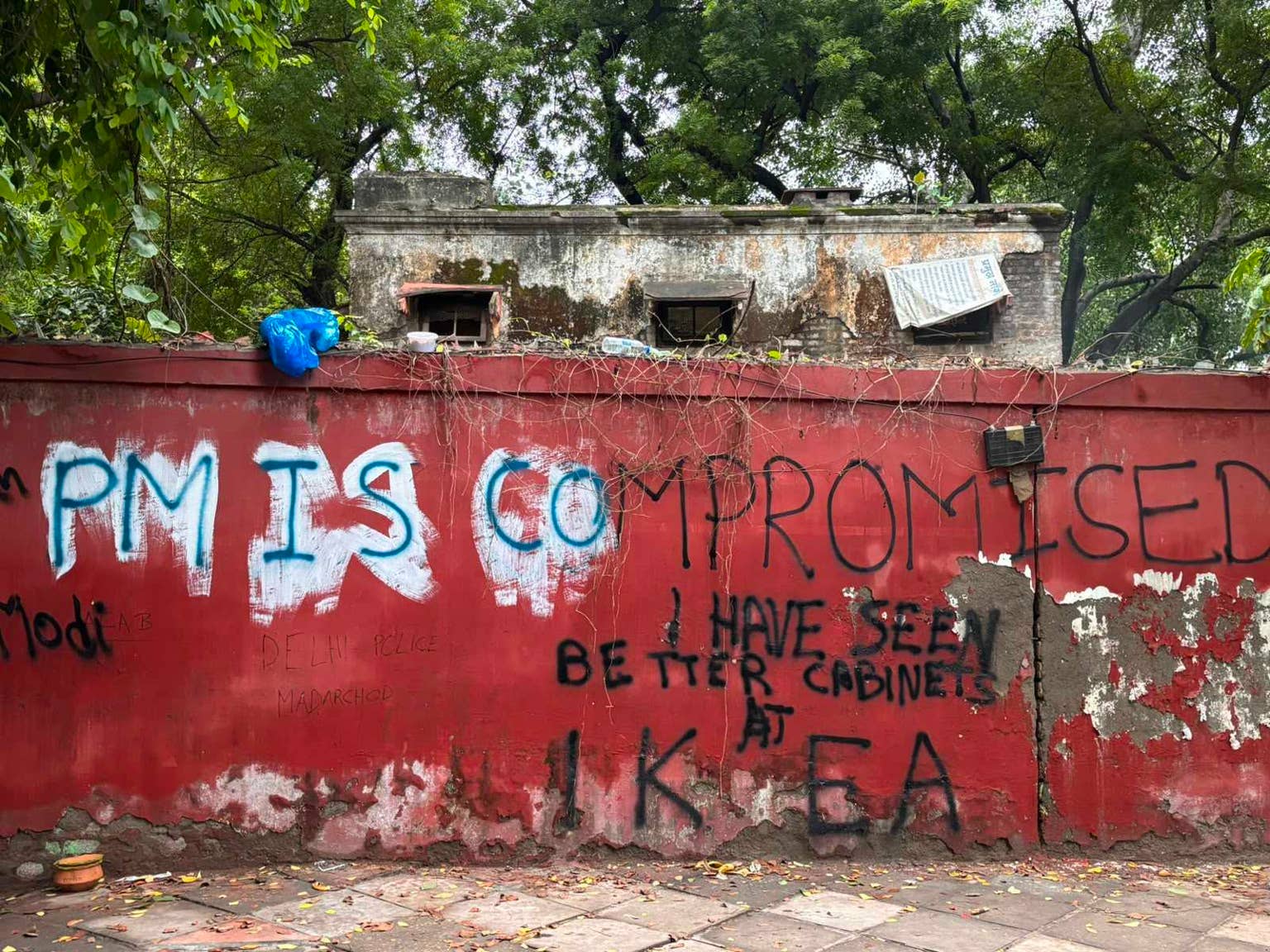
Graffiti near the Delhi protest grounds captures the anger of a movement that began as online satire. Photo: TheStreet Roundtable.
Trending on TheStreet Roundtable:
The confrontation has become one of the biggest political challenges of Modi's third term, growing from an online campaign into sustained street demonstrations that have drawn nationwide attention.
Bitchat becomes a protest communications lifeline
In the hours leading up to the march, posts circulating on social media platforms like Instagram and Reddit urged protesters to download Bitchat before arriving at Jantar Mantar, warning that mobile networks in Connaught Place (CP) could become unreliable or unavailable if authorities activated signal jammers.
Participants told TheStreet Roundtable the app quickly spread through word of mouth as connectivity deteriorated.
Bitchat uses Bluetooth Low Energy and mesh networking to connect nearby devices. Each phone can relay encrypted messages to others, extending the network across multiple hops without cellular infrastructure.
“Calls could not be reached,” one physics research student told TheStreet Roundtable. “We had to download these apps, which basically connect through Bluetooth. One of them is Bitchat.”
Another student said the app was shared before the protest in case networks failed.
“My friends told me about this app,” he said. “It is very useful for communication.”
Unlike traditional messaging platforms that depend on internet access and centralized infrastructure, Bitchat creates a peer-to-peer mesh network where nearby phones relay encrypted messages to extend the network's range.
Bitchat reflects Dorsey’s broader support for decentralized systems.
Block Inc (NYSE: XYZ) co-founder has made Bitcoin central to his payments company’s strategy, funded open-source Bitcoin development and backed projects designed to reduce reliance on centralized platforms.
Related: $4.1 billion firm discloses exposure to Bitcoin, XRP, Robinhood