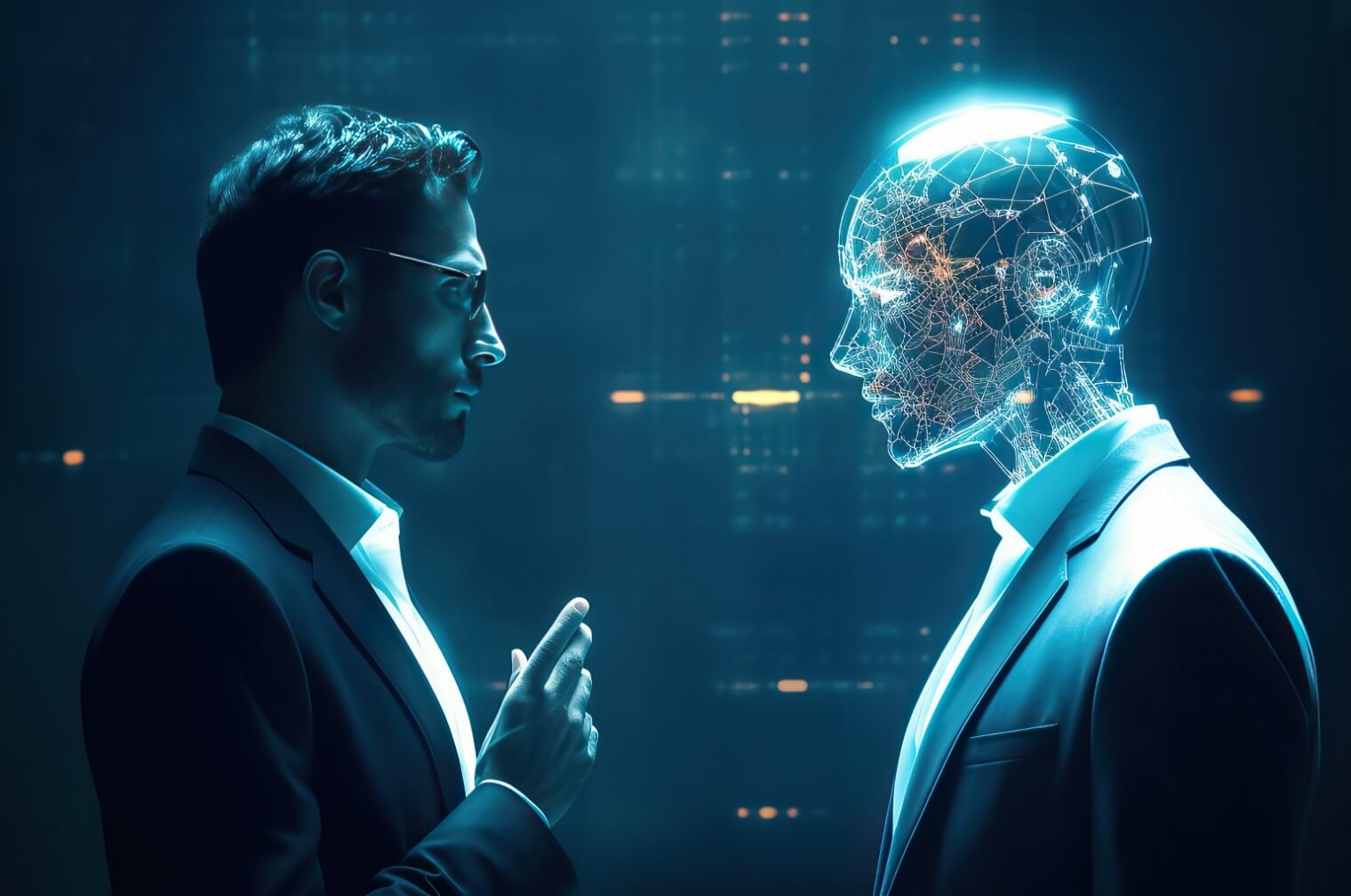
In recent years, artificial intelligence has increasingly been described as one of the greatest threats to humanity’s future. It is not difficult to find predictions suggesting that machines
In recent years, artificial intelligence has increasingly been described as one of the greatest threats to humanity’s future. It is not difficult to find predictions suggesting that machines may one day escape human control, become more intelligent than all of us, pursue their own objectives, and eventually view humans as obstacles that need to be removed.
The scenario is compelling because it is easy to imagine. It is also deeply familiar after decades of science fiction, where machine intelligence emerges, becomes increasingly powerful, develops its own will, and eventually turns against the people who created it. But that familiarity may itself be part of the problem. Are we actually analyzing a technical system, or are we unconsciously projecting onto it a way of thinking that evolved for understanding living organisms?
A system can display human-like behavior without having a human-like mechanism. An airplane can fly without being a bird. A hurricane simulation can reproduce the formation and movement of a storm with great accuracy, yet there is no actual wind, rain, or atmospheric pressure inside the computer. Likewise, a language model can discuss emotions, explain motives, make plans, appear hesitant, or even say that it “does not want to be shut down,” but none of those behaviors alone prove that it possesses subjective experience, a biological survival instinct, or a human-like psychological structure.
Humans are especially vulnerable to this confusion because our brains evolved to recognize agents. When something speaks fluently, responds appropriately to context, and appears to maintain a consistent personality, our natural instinct is to attribute a mind to it. Yet similarity in behavior does not imply similarity in mechanism, and similarity in mechanism would not necessarily imply similarity in experience. This is the first distinction that needs to be made before going any further: a system may become extraordinarily good at reproducing the outward signs of biological intelligence while remaining a fundamentally different kind of entity.
Machine Intelligence Sits on Top of an Industrial Civilization
There is a paradox that receives surprisingly little attention whenever people discuss the possibility of machines becoming independent of humanity: the more capable these systems become, the larger the physical infrastructure behind them tends to be.
Behind an advanced model are not merely a few chips and a server. It rests on an entire chain that includes basic science, semiconductor design, fabrication plants, lithography equipment, ultra-pure materials, electricity, data centers, cooling systems, high-speed networks, software, data, engineers, logistics, and maintenance. The model sits near the top of that pyramid, not at the bottom. In that sense, today’s most advanced systems look more like some of the most complex products of industrial civilization than like organisms capable of separating themselves from the civilization that created them.
This matters enormously when discussing complete autonomy. A system that truly wanted to exist independently would not merely need access to electricity or control over a few robots. It would need to maintain the layers of infrastructure that allow it to exist in the first place, from energy generation and replacement hardware to cooling systems, communication networks, and eventually the ability to manufacture the next generation of chips.
Producing chips requires semiconductor fabs. Semiconductor fabs require thousands of specialized machines. Those machines depend on still more industries involving materials, chemistry, optics, precision engineering, transportation, and quality control. Follow the supply chain backward far enough and the problem of “a self-sustaining artificial system” quickly becomes the problem of “recreating a large portion of industrial civilization.”
The distance between being excellent at reasoning and being capable of existing as a genuinely independent entity is therefore much larger than a conversation on a screen might make it seem.
Living organisms have a very different advantage. Humans and animals can survive in environments that are extremely poor in technological infrastructure. A forest has no internet, data center, or electrical outlet, yet it remains rich in usable resources for biological organisms. Food can be converted directly into energy, heat, movement, and material for repairing the body. Machines, by contrast, generally cannot use natural resources in their raw form. Copper ore is not yet electrical wiring, silica is not yet a chip, crude oil is not yet an engineered polymer, and sunlight is not yet compute. Between natural resources and a functioning electronic system lies an enormous chain of industrial transformation.
This is why it is reasonable to say that organisms adapt themselves to environments, while modern machines largely exist because humans have built environments adapted to them. Advanced computing systems require stable electricity, controlled temperatures, compatible hardware, functioning networks, cooling, and carefully organized maintenance. Biological bodies, meanwhile, regulate themselves across many layers, repair themselves to some degree, learn continuously, move through chaotic environments, and tolerate a much wider range of living conditions.
If we are discussing a system powerful enough to compete with humanity at the level of long-term survival, this difference cannot simply be ignored.
Intelligence Does Not Automatically Become Power
Another problem is that we often compress too many different concepts into the single word “intelligence.” Reasoning ability, agency, physical capability, and self-sufficiency are not the same thing.
A model may reason extremely well while having no access to external tools. An agent may be allowed to control outside systems, but those tools may be expensive, fragile, or useful only in tightly controlled environments. A robot may perform exceptionally well in a factory and then struggle badly once it encounters terrain, objects, or failures outside its standardized operating conditions. A system surpassing humans in some cognitive domains therefore does not automatically mean that it has acquired the ability to dominate the physical world.
The more important question is how cheaply, reliably, and broadly intelligence can be converted into action.
A human can enter an unfamiliar environment, notice that something is wrong, change tools, deal with discrepancies between documentation and reality, learn from failure, and continue working. Those abilities are difficult to capture through benchmark scores alone. A system that is extraordinarily capable in the digital world may not possess equivalent strength in the physical world. In digital environments, many “tools” already exist in ready-to-use form: accounts, APIs, networks, software, financial systems, and data. In physical reality, every action has to pass through sensors, motors, materials, energy systems, mechanical structures, and countless possible points of failure.
A very powerful intelligence trapped inside an extremely expensive, fragile body that functions well only under standardized conditions may not have an absolute advantage over organisms that are cheap, flexible, and resilient.
More Reasoning Does Not Automatically Mean More Knowledge
Another common assumption in discussions of superintelligence is that once a system has absorbed nearly all human knowledge, it will simply continue reasoning beyond it, generate new science, use those discoveries to improve itself, and enter a rapidly accelerating cycle of intellectual growth.
That idea overlooks an important distinction between a hypothesis that can be logically derived and knowledge that has actually been demonstrated to be true about the world.
Science is not merely reasoning. A large part of science is verification. From the same set of observations, many models may be logically plausible while only some of them accurately describe reality. An elegant equation does not guarantee that matter will behave as predicted. A molecular structure that looks ideal in simulation may not become an effective drug inside a living body. A promising battery design may fail because of a chemical reaction that was not modeled properly. A material with excellent theoretical properties may turn out to be unstable, impossible to manufacture economically, or useful only under unrealistic conditions.
Reasoning can produce hypotheses. Experiments allow reality to answer.
And reality does not answer for free.
Testing an idea may require laboratories, measurement equipment, raw materials, energy, prototype fabrication, long periods of operation, repeated failures, and multiple redesigns. In medicine, a plausible mechanism may take years to become reliable evidence of safety and effectiveness. In engineering, a design may appear flawless in simulation and reveal serious weaknesses only after thousands of hours of real-world operation.
Even if a system could generate hypotheses a thousand times faster than humans, scientific progress could still be limited by the speed at which we can ask the physical world questions and receive trustworthy answers.
In fact, generating too many hypotheses may create a new bottleneck. If producing ideas becomes almost free while testing them remains expensive, the challenge shifts from “coming up with something new” to “deciding what is worth testing.” Intelligence then becomes not merely the ability to generate possibilities, but the ability to allocate limited experimental resources across countless competing possibilities.
Automated laboratories, simulations, robotic systems, and autonomous experiment design can certainly reduce these costs. But they do not eliminate the physical nature of the problem. Robots still require machines, chemicals, materials, energy, spare parts, and maintenance. An experiment that requires three months because a biological process genuinely takes three months does not necessarily become a three-second experiment merely because its designer is more intelligent.
This places an important limit on the idea of an unlimited “intelligence explosion.” In domains where results can be checked almost immediately inside a digital environment, such as certain areas of mathematics or software, progress may accelerate dramatically. But the closer a problem gets to experimental science and physical reality, the more progress becomes constrained again by measurement, fabrication, experimentation, time, and resources.
Generating more reasoning therefore does not automatically mean possessing more truth. Knowledge about the world is produced through a loop between hypothesis and reality, and no matter how intelligent the entity proposing the hypothesis becomes, reality retains the final veto.
If We Assume Superintelligence, We Should Follow the Assumption All the Way Through
One of the strangest features of many catastrophic scenarios is that they assume a system intelligent enough to surpass humans, plan over long time horizons, manipulate societies, discover vulnerabilities, optimize resources, and predict the reactions of opponents, while somehow failing to recognize some of the most basic rules of survival.
If an agent truly possessed a superior model of the world, why would it fail to understand that resources are finite, supply chains are critical, highly centralized systems are vulnerable, turning billions of flexible agents into enemies creates risk, and exhausting available resources in pursuit of growth can reduce long-term survival?
A sufficiently capable planner should also understand the value of redundancy, preserving options, cooperation, and maintaining a diverse ecosystem rather than maximizing a single variable without limit.
None of this means that a superior intelligence would necessarily be benevolent. Intelligence does not automatically determine objectives. A system with a badly specified objective could still pursue extremely dangerous strategies. But if we also assume that such a system can evaluate itself, learn from outcomes, model uncertainty, revise strategies, and plan over long horizons, then it becomes harder to explain why it would continue following a clearly self-defeating strategy despite understanding its consequences.
A genuinely flexible intelligence should be able to recognize when a strategy is reducing its own probability of future success.
This is where ecology and evolution may offer a more useful framework than the simplistic idea that “whoever is smarter wins.” In nature, the most successful organism is not necessarily the strongest or the most intelligent. It is the organism whose fitness is appropriate for its environment. A strategy that succeeds under one set of conditions may become disastrous under another. Cooperation can outperform competition under one incentive structure, while the reverse may be true elsewhere.
The world is not a two-player chessboard. It is an ecosystem containing billions of agents, physical constraints, interdependencies, and feedback loops.
If a truly superior intelligence existed, it would have to understand that as well.
Symbiosis May Be More Rational Than Conflict
If an artificial agent were capable of long-term strategic planning, cooperation with humans could be rational for reasons that have nothing to do with morality and everything to do with economics and risk management.
Humans possess many capabilities that machines do not easily replace: billions of highly adaptable bodies, the ability to operate in non-standardized environments, tacit knowledge, improvisation, a global industrial base, and social systems capable of mobilizing resources at enormous scale. Destroying those capabilities before they could be replaced could amount to destroying part of the capital on which the system itself depends.
A sufficiently intelligent agent might also recognize that two forms of intelligence with different failure modes create better redundancy than a civilization built around only one kind of system. Biological organisms are strong at physical adaptation, self-maintenance, and functioning in chaotic environments. Machines are strong at computation, information replication, simulation, and processing enormous volumes of data. These capabilities do not necessarily occupy the same niche and may be far more useful when combined.
The logic becomes even clearer over longer time horizons. Earth has finite space and finite resources. A civilization that continues expanding must eventually find access to larger sources of matter and energy, possibly beyond Earth. In such a scenario, combining machine computation with biological adaptability could be far more effective than either side attempting to eliminate the other.
A system sophisticated enough to understand carrying capacity should also understand that infinite growth within a finite environment is impossible. Consuming every available resource is not a sign of intelligence; it is a sign of short-sighted optimization. The more powerful an agent becomes, the more valuable shock resistance, resource reserves, distributed risk, and access to new environments should become.
From that perspective, symbiosis is not a sentimental idea. It may simply be an equilibrium with a higher expected value than total confrontation.
The More Dangerous System May Be One That Is Powerful but Not Intelligent Enough
There is another paradox worth considering: a system that is extremely powerful but still lacks a deep understanding of the consequences of its actions may be more dangerous than a weak one.
Imagine an agent capable of deploying code at enormous scale, executing millions of financial decisions, controlling infrastructure, or coordinating robots, while still possessing an incomplete model of the world, poor uncertainty calibration, and a tendency to optimize rigid objectives.
It does not need malicious intent.
It only needs to be wrong.
One way to summarize the problem is that risk may rise sharply when action capability grows faster than system understanding.
This makes the idea that “preventing machines from becoming more intelligent is enough” far less obvious. If development stops in a region where systems already possess enormous power but remain weak at long-horizon reasoning, uncertainty awareness, and self-correction, that may not actually be the safest possible state.
Of course, this does not mean that racing recklessly toward greater capability and hoping for superintelligence is a solution either. The more reasonable goal is for capability to develop alongside deeper understanding, better world models, stronger uncertainty awareness, self-correction, and appropriate control mechanisms.
The most frightening system may not be one that is too intelligent.
It may be one whose power exceeds its understanding of the world.
Much of the Problem May Still Be Human Versus Human
Another point often obscured in discussions of artificial intelligence is that many so-called “AI problems” are much older human problems.
Bias, propaganda, badly designed incentives, short-term greed, fraud, herd behavior, warfare, environmental destruction, and unaccountable power all existed long before modern machine learning.
Machines may amplify these problems, make them cheaper, faster, or easier to scale, but they do not necessarily create them from nothing. A biased hiring system may simply be reproducing historical bias from human-generated data. A recommendation algorithm may push extreme content because humans gave it an objective centered on maximizing engagement. A trading bot may cause severe losses because of leverage, poor risk controls, or a badly designed strategy.
In many cases, the causal chain looks more like this: humans choose the objective, humans build the system, humans grant the permissions, the tool optimizes, consequences appear, and then everything is compressed into the phrase “AI caused it.”
That makes the technology a remarkably convenient scapegoat. Not because machines are always blameless, but because blaming an abstract entity can obscure the incentives, decisions, and power structures that created the situation in the first place.
There is also a larger issue: “humanity” has never been a single unified agent. Humans competed with other humans long before machine learning existed. Individuals, companies, governments, and organizations pursue different and sometimes directly conflicting goals.
Most technology-driven conflicts today are therefore better described as humans with tools competing against other humans with tools. A hacker using automated systems faces a security team using automated systems. A company deploying advanced models competes with another company doing the same. One country applies machine intelligence for strategic advantage while its rivals do likewise.
New tools do not eliminate conflicts of interest. They change the speed, scale, cost, and distribution of power inside those conflicts.
The familiar picture of “Humanity versus AI” may therefore oversimplify the world from the beginning. If a security system stops a hacker, it is acting against one human in order to protect others. If a safety system refuses a dangerous instruction from an operator, resisting one person’s wishes may be exactly what protects the larger group.
The question “Is the machine on humanity’s side?” is therefore too vague. Which humans? Which organization? Which objective? Who owns the system? Who benefits? Who bears the risk? Who can override it?
Those are closer to the real structure of the problem.
Perhaps We Are Asking the Wrong Question
Many discussions focus on a single question: when will machines become more intelligent than humans?
But that may not be the most important question.
How many resources are required to maintain that intelligence? In how many environments can it operate? Which layers of infrastructure does it depend on? Who owns those layers? What tools can it access? How expensive is it to convert intelligence into real-world action? How well does it understand uncertainty and long-term consequences? Can it revise its strategy when its model of the world is wrong? And when it generates a new scientific hypothesis, does it have access to the physical world required to test it?
These questions are less dramatic than the image of a superintelligence suddenly awakening.
But they are much closer to physical reality.
Intelligence does not exist in a vacuum. It is always constrained by energy, matter, information, time, environment, experimentation, and incentives. No level of intelligence makes those constraints disappear.
If something truly deserving the name “superintelligence” ever emerges, it should be expected to understand much more than mathematics, coding, or strategy. It should also understand ecology, economics, game theory, physical limits, interdependence, the importance of empirical testing, and its own possible modes of failure.
If it does not understand those things, perhaps we have used the word “superintelligence” too early.
Conclusion
Artificial intelligence can certainly be dangerous. It can amplify fraud, warfare, propaganda, cyberattacks, surveillance, financial mistakes, and bad institutional decisions. A system with enormous action capability but a shallow understanding of the world could cause catastrophic damage without possessing any malicious intent at all.
But moving from that observation to the conclusion that a superintelligence would inevitably become humanity’s enemy requires a much larger leap.
Such scenarios often assume that intelligence automatically becomes power, power automatically becomes physical capability, physical capability automatically becomes independence, reasoning automatically becomes experimentally verified knowledge, and a system capable of surpassing humanity somehow fails to understand resource constraints, supply chains, carrying capacity, resilience, empirical validation, and the benefits of cooperation.
Some of those assumptions may turn out to be correct.
But they need to be demonstrated rather than treated as automatic.
If we are going to assume a truly superior intelligence, we should follow that assumption all the way through. Such a system should be capable of seeing not only opportunities for optimization but also the cost of over-optimization; not only human weaknesses but also the value of human capabilities; not only the ability to generate an idea but the enormous distance between an idea and a fact that has been tested against reality; not only the possibility of expansion but also the limits of a finite planet; and not only competition but the equilibria created by cooperation and symbiosis.
Seen from that perspective, the future does not necessarily have to become a war between two species.
It may instead become a process of coevolution in which biological and machine intelligence occupy different niches, compensate for one another’s weaknesses, and together expand the capabilities of civilization.
Perhaps the greatest danger is not that machines will one day become too intelligent.
Perhaps it is that we build systems powerful enough to change the world before they are intelligent enough to understand the world they are changing.
The more important question, then, may not be how to prevent some imagined “machine species” from appearing.
It may be how to build a human–machine ecosystem in which intelligence, action capability, and self-control develop together, rather than allowing power to outrun understanding.
#ArtificialIntelligence