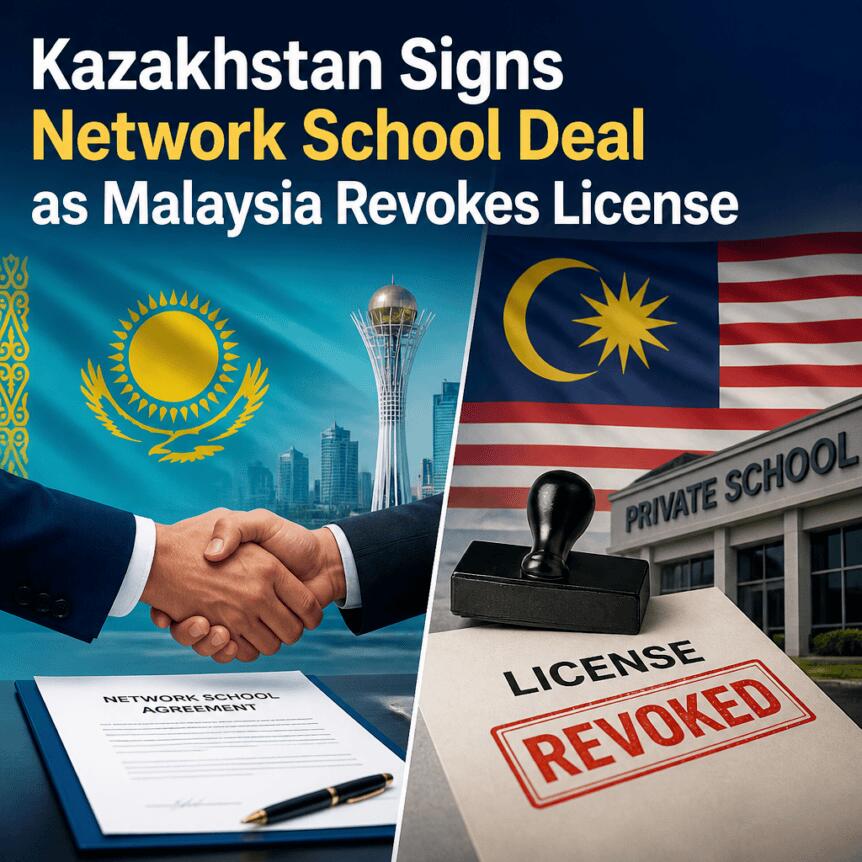
Balaji Srinivasan’s Network School is looking to expand into Kazakhstan after regulators moved against its Malaysia operations, according to a memorandum of understanding announced by Kazakhs
Balaji Srinivasan’s Network School is looking to expand into Kazakhstan after regulators moved against its Malaysia operations, according to a memorandum of understanding announced by Kazakhstan’s Ministry of Digital Development, Innovation and Aerospace Industry. The deal, signed with minister Zhaslan Madiyev, aims to establish what the ministry describes as the first Network School campus in the country.
The Kazakhstan announcement comes as Network School’s Forest City-area presence faces escalating regulatory pressure. Malaysia’s local authorities revoked the business license of the operator, NSO Malaysia Sdn Bhd, prompting the Malaysia Digital Economy Corporation (MDEC) to begin steps to remove the company’s Malaysia Digital status. The situation raises the question of how easily Network School can restart and maintain immigration- and incentives-related arrangements across borders.
Key takeaways
- Kazakhstan’s ministry says it has signed an MoU with Balaji Srinivasan to create the first Network School campus in the country.
- Malaysia’s Iskandar Puteri City Council revoked NSO Malaysia Sdn Bhd’s business license over alleged licensing and premises-use breaches.
- MDEC says it is taking immediate steps to revoke NSO Malaysia’s Malaysia Digital status, which comes with benefits such as tax incentives and employment flexibility.
- Local officials in Johor have urged federal authorities to keep investigating whether Network School violated immigration laws.
- Srinivasan has framed the developments as consistent with the “network state” concept, while also saying Malaysia issues are being addressed through a remedial process.
Kazakhstan MoU opens a new front for Network School
In a statement from Kazakhstan’s Ministry of Digital Development, Innovation and Aerospace Industry, the government said an MoU was signed with Zhaslan Madiyev and Network School founder Balaji Srinivasan to establish a campus in Kazakhstan. While the document signals a strategic expansion, details of implementation—such as timeline, campus location, and regulatory steps—were not included in the provided reporting.
Network School’s Kazakhstan pivot matters for prospective residents and investors because campus operations are closely tied to host-country regulatory conditions, especially around visas, employment rules, and corporate status benefits. Srinivasan has previously described Network School as a community built around attracting globally distributed talent and capital, and the Kazakhstan proposal positions the group to potentially preserve momentum rather than waiting for a resolution in Malaysia.
Kazakhstan has also been positioning itself as a technology hub, including plans connected to a “crypto city” in Alatau, as referenced in the source material. Against that backdrop, Network School’s presence could be marketed as part of a broader attempt to draw innovation-driven communities and companies to the region.
Malaysia: revoked license and a threat to Malaysia Digital status
Malaysia’s regulatory actions began after the Iskandar Puteri City Council (MBIP) revoked the business license of NSO Malaysia Sdn Bhd, the entity operating the Network School’s Johor-area campus. MBIP cited alleged breaches of licensing conditions and requirements related to how premises were used, according to a report linked in the source material from mediadigitaljohor.gov.my.
Following the license revocation, MDEC announced it was taking immediate steps to revoke NSO Malaysia’s Malaysia Digital status. The Malaysia Digital program recognizes qualified technology and digital companies and is described in the source material as offering incentives such as tax advantages, ownership flexibility, and permission to employ both local and foreign workers—benefits that can be critical for international communities that rely on a steady inflow of talent.
MDEC’s stated rationale is that Malaysia Digital status requires companies to comply with local and federal laws. Removing that status could complicate Network School’s ability to operate smoothly if the campus depends on the program’s employment and incentives framework.
Johor officials push for immigration-law scrutiny
The stakes extend beyond corporate licensing. The source material says Johor Chief Minister Onn Hafiz Ghazi urged Malaysia’s federal authorities to continue investigating whether Network School violated immigration laws. He characterized Johor as a “strategic entry point” because the state borders Singapore and therefore argued that any weaknesses or abuse of the immigration system should be addressed promptly and firmly.
That emphasis highlights a common tension for border-adjacent technology hubs: even when a concept has strong global appeal, enforcement actions tied to immigration compliance can quickly affect day-to-day operations, staffing, and residency arrangements for community members.
Earlier coverage referenced in the source material indicates that scrutiny has been ongoing, including questions about how the campus fits within existing legal frameworks. The current license revocation and the potential loss of Malaysia Digital status suggest authorities are not treating the matter as purely procedural.
As the regulatory situation unfolded, Srinivasan denied reports that Network School was shutting down. According to the linked social media statement in the source material, he said Network School had received two notices: one reportedly requiring “change the text of a sign,” and another related to a coworking setup formed by combining two adjacent units, where one side had a valid license but the other did not.
Srinivasan said the issues fell within a remedial period and that the organization would remediate them, adding that its members were otherwise unaffected. Cointelegraph also notes that it reached out to Srinivasan and Network School for comment, but the provided text does not include any additional responses beyond the denial and remediation framing.
Interpreting these statements alongside the MBIP and MDEC actions reveals an important asymmetry: public guidance from local authorities and program administrators may move faster than a company’s internal remediation plan. In practical terms, even if a remedial path exists on paper, the uncertainty can still disrupt hiring, occupancy, and community planning—especially for international residents who rely on predictable compliance timelines.
Meanwhile, Dragonfly Capital managing partner Haseeb Qureshi, quoted in the source material, linked the “Malaysia drama” to the broader “network state” argument. He suggested that the outcome could be used to negotiate new arrangements with other jurisdictions—an interpretation Srinivasan appears to be leaning into as the Kazakhstan MoU emerges.
What to watch next for Network School
Readers should focus on two tracks as the story develops: whether MDEC’s Malaysia Digital revocation proceeds and how quickly Malaysia’s immigration inquiries translate into enforceable outcomes, and—on the other side—how Kazakhstan operationalizes the MoU into concrete regulatory approvals for a Network School campus. Until those details are clear, Network School’s ability to retain its community and recruitment momentum will likely depend on jurisdiction-by-jurisdiction compliance rather than a single global brand narrative.
This article was originally published as Kazakhstan Signs Network School Deal as Malaysia Revokes License on Crypto Breaking News – your trusted source for crypto news, Bitcoin news, and blockchain updates.