European Central Bank (ECB) President Christine Lagarde said on Friday, November 20, that tokenization could give Europe something it has chased for decades: one market for financial assets i
European Central Bank (ECB) President Christine Lagarde said on Friday, November 20, that tokenization could give Europe something it has chased for decades: one market for financial assets instead of 27. She warned that the chance may not last, because the market is growing fast and its rules are still being written.
She made the case in a keynote at the Frankfurt European Banking Congress. She told the room it was her eighth speech there as ECB President, and her last.
Tokenization means issuing assets such as bonds, shares or fund units as digital tokens on a blockchain, where they can be traded and settled in one place. Europe’s own digital money, though, is still tiny next to the dollar’s. We compared euro and dollar stablecoins to see how far behind it is.
Discover: Bitcoin Falls With Stocks Again: A Link That Only Began in 2020 Is Getting Tighter
Lagarde Calls Tokenization a Chance for a Single Market
Lagarde spent most of the speech on why Europe acts too late on slow-moving problems. Tokenization was one of three areas where she said the ECB had tried to act early. The other two were the digital euro and the euro’s role abroad.
“With the right framework, tokenisation offers a chance to build a genuine single market in digital assets, integrated from the start. For Europe, that is a huge opportunity,” she said in the speech published by the ECB.
The catch is timing. Lagarde said the global market for tokenized assets was worth around €23 billion in March, five times its size a year earlier. As it grows, its standards will set.
She warned that if standards develop separately, the market could split into platforms that follow different rules and cannot settle with one another. Europe’s stock and bond markets already work that way, with separate national systems that have proved very hard to merge.
Crypto Expert Report: What Are the 10 Next Crypto to Explode in 2026?
The ECB has already built part of the plumbing. In September, it launched Pontes, a link that lets tokenized trades settle in central bank money, the safest form of money there is, on Eurosystem systems. Every platform can now use the same settlement asset.
Earlier this month, the European Stability Mechanism, the euro area’s rescue fund, settled a €1 billion bond issued directly as a token on Pontes.
A second project, Appia, is working with banks and other firms on common standards for an integrated European market. But Lagarde said the central bank cannot finish the job alone. “Infrastructure alone is not enough. Common rules will be needed too, and those lie with legislators,” she said.
Euro Stablecoins Are Small Next to Dollar Tokens
Stablecoins are tokens pegged to a currency, and they are the cash leg of most crypto and tokenized trades today. On that front, Europe is far behind.

Dollar stablecoins in circulation total about $283.7 billion, while euro stablecoins total about $815 million. That is $1 in euro tokens for every $348 in dollar tokens, or a 0.29% share.
The euro side is growing faster from its small base. Since the stablecoin rules in the EU’s Markets in Crypto-Assets (MiCA) law took effect on June 30, 2024, euro stablecoins have grown 244%, while dollar stablecoins grew 76%. That doubled the euro’s share, from 0.15% to 0.29%.
One issuer dominates. Circle’s EURC accounts for about 62% of the euro total, ahead of SG-Forge’s EURCV.
This is why the ECB wants tokenized trades in Europe to settle in central bank money rather than in private tokens. In a market run on dollar stablecoins, European tokenization would depend on a currency the ECB does not control.
Crypto Expert Report: What is the Best Meme Coin to Buy and Forget Until the Next Bullrun?
The post Lagarde Sees a €23 Billion Opportunity: Can Tokenization Finally Unite Europe’s 27 Markets? appeared first on Tokenist.

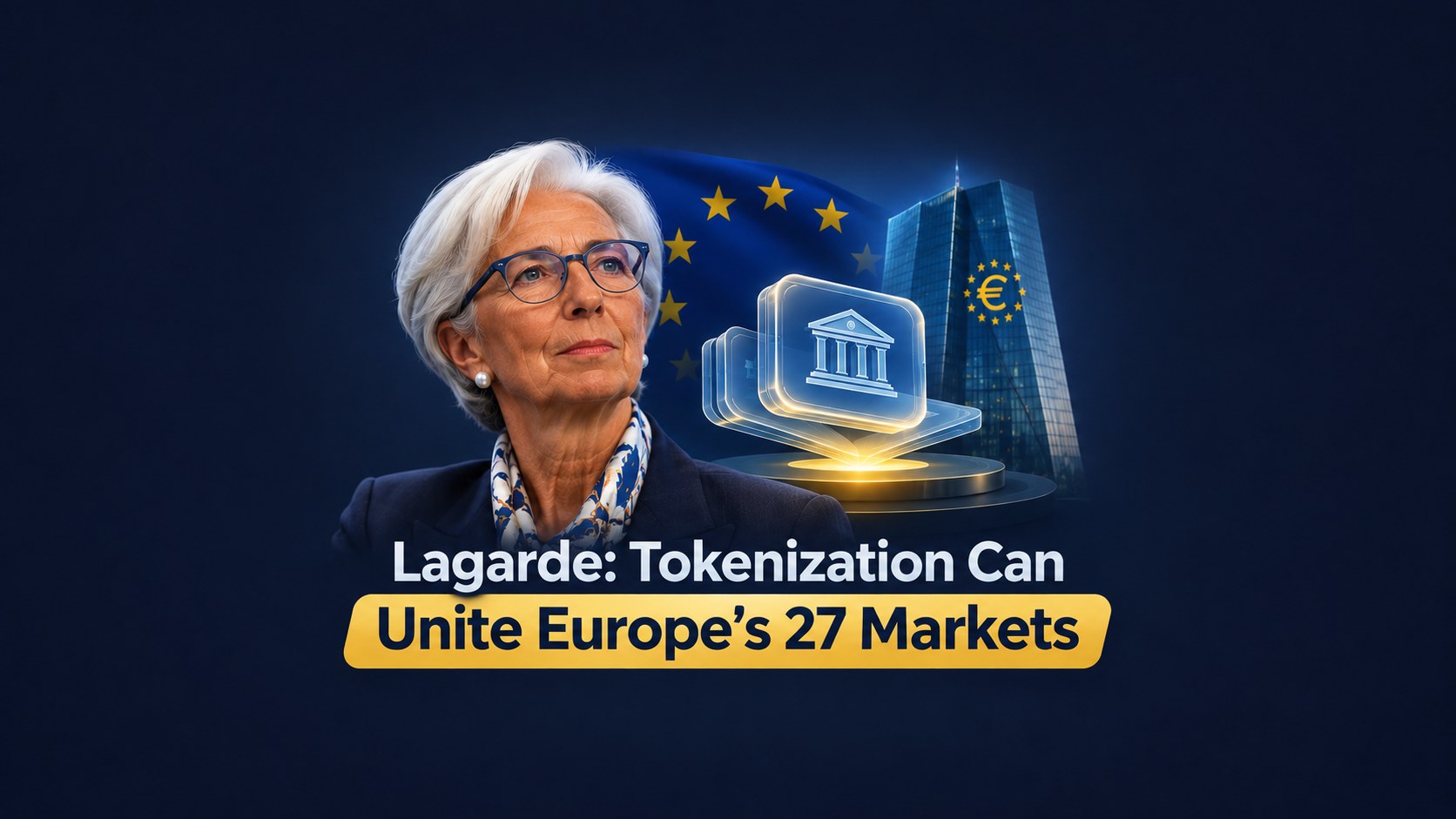
 ECB President Christine Lagarde says tokenization could create a unified European market for digital assets.