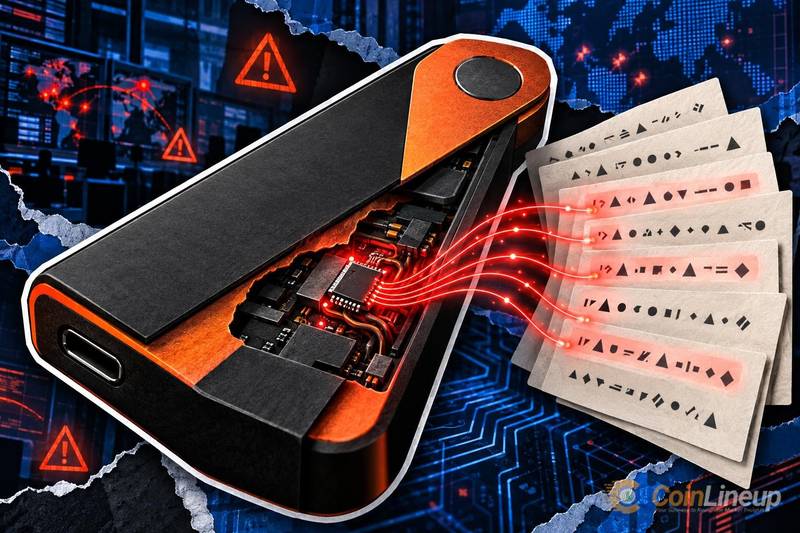
Ledger, the hardware wallet manufacturer, says a hidden implant was able to copy wallet recovery words from a device, even though its hardware is built around a secure chip designed to protec
Ledger, the hardware wallet manufacturer, says a hidden implant was able to copy wallet recovery words from a device, even though its hardware is built around a secure chip designed to protect exactly that kind of sensitive information.
Key Takeaways
- Ledger reported that a hidden implant copied wallet recovery words from a device.
- The copying occurred despite the presence of a secure chip, the core protection hardware wallets are marketed on.
- Recovery words give complete access to a crypto wallet. Anyone who has them can take all funds stored in that wallet.
What Ledger Says the Hidden Implant Did
According to Ledger, a hidden implant on a device managed to copy the wallet's recovery words. Recovery words, sometimes called a seed phrase, are a sequence of 12 to 24 words that act as a master key to a crypto wallet. Whoever holds those words controls the funds, regardless of what device they use. For related coverage, see Ripple, Privy Partner on XRP Ledger Embedded Wallets.
What makes this report notable is the claim that the implant worked around the device's secure chip. A secure chip is a tamper-resistant component that hardware wallets use to store sensitive data in an isolated environment, separate from the rest of the device's electronics. The intent is to prevent exactly this kind of extraction. For related coverage, see Standard Chartered Launches RLUSD Custody on XRP Ledger.
Ledger has not publicly confirmed details about how many devices were affected, when the incident occurred, or how the implant was introduced. CryptoSlate has reported on the broader question of supply-chain exposure for hardware wallets, noting that a device can pass through multiple hands before it reaches the end buyer. This reported incident fits that broader concern about physical tampering before a device arrives with a user. For related coverage, see AINext Awards & Conference Singapore 2026: Where AI Leaders, Innovators and Decision-Makers Shape the Future of Artificial Intelligence.
Based on Ledger's statement, the implant should be treated as a physical compromise, meaning someone with access to the device's hardware, at some point in its journey from factory to user, may have introduced the malicious component. No digital or software attack is implied by the reported description.
Why This Matters for Anyone Using a Hardware Wallet
Hardware wallets are considered the gold standard for securing crypto because they keep private keys offline. But this incident illustrates a limit to that protection: a secure chip secures against remote attacks, not against someone who has physical access to the device's internals before it ever reaches you.
The recovery words are the most sensitive piece of information associated with any crypto wallet. They are intentionally designed so that even without the physical device, anyone who knows the words can restore the wallet on any compatible hardware and access all funds. That design feature becomes a critical vulnerability if the words are copied without the owner's knowledge.
For anyone using a hardware wallet, or considering buying one, a few practical steps reduce risk. First, only buy directly from the manufacturer or an officially authorized reseller. Purchasing through second-hand markets or unofficial channels significantly increases the chance of receiving a tampered device. Second, inspect the packaging when it arrives. Legitimate devices ship with tamper-evident seals; if those seals look broken or resealed, do not use the device. Third, never store recovery words digitally, whether in a photo, a notes app, or a cloud document. Write them down on paper and keep that paper physically secure.
A hardware wallet is one layer of security, not a complete solution on its own. Seed phrase security continues to evolve across the industry, with some projects exploring account recovery methods that reduce reliance on a single written backup. Until those alternatives become mainstream, the safety of the written recovery phrase remains the responsibility of the wallet holder. Wallet transitions and shutdowns are also moments when recovery words are at heightened risk, since users are actively moving funds and may handle those words more carelessly than usual.
The central lesson from Ledger's report is straightforward: a device can have strong chip-level security and still be compromised if someone physically alters it before it reaches you. Verify the source of your device, inspect it on arrival, and treat your recovery words as the most sensitive piece of paper you own.
Additional source references: source document 1.
Disclaimer: This article is for informational purposes only and does not constitute financial or investment advice. Cryptocurrency and digital asset markets carry significant risk. Always do your own research before making decisions.
Read original article on coinlineup.com