Lido's governance forum has put forward a proposal to allocate up to $1.5 million in LDO tokens and $480,000 in USDC for centralized-exchange market making, with the stated objective of impro
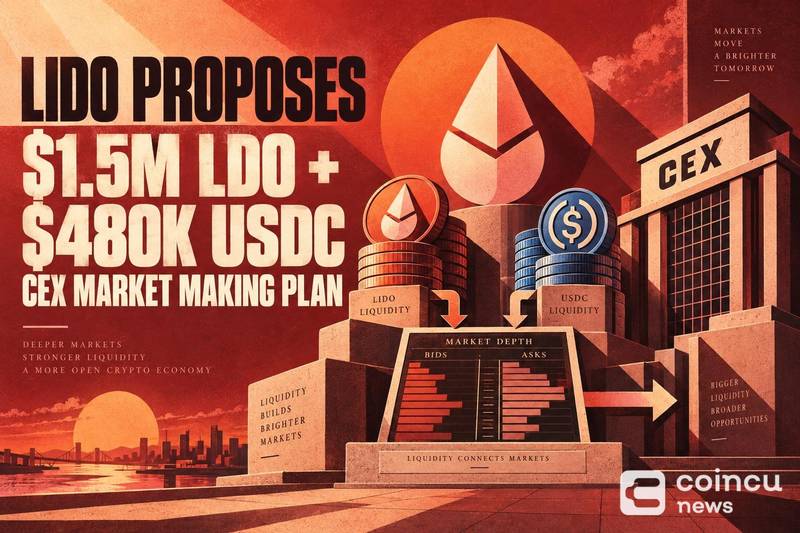
Lido's governance forum has put forward a proposal to allocate up to $1.5 million in LDO tokens and $480,000 in USDC for centralized-exchange market making, with the stated objective of improving on-exchange liquidity conditions and reducing the risk of LDO being delisted from CEX venues. The proposal has not yet been approved or deployed; any allocation remains subject to governance process.
Proposed Funding Breakdown
LDO and USDC caps as submitted
The proposal sets out two distinct funding components: a native-token tranche of up to $1.5 million in LDO and a stablecoin tranche of up to $480,000 in USDC. Both figures represent caps, meaning the actual deployment could be lower depending on how governance shapes the final mandate. The funds are earmarked exclusively for CEX market-making activity, not protocol operations or treasury diversification. For related coverage, see Lido Investigates stETH Yield Recalculation Discrepancy.
Deploying a mixed LDO-and-USDC structure is a common approach for governance-token market-making programs, as the stablecoin leg gives a market maker inventory to quote the bid side while the native-token leg supports offer-side depth. The $480,000 USDC component would anchor the program's stable-side liquidity without requiring the protocol to sell additional LDO at current market conditions.
Why Lido Is Targeting Delisting Risk
How exchange liquidity relates to listing status
The proposal's stated rationale ties directly to delisting risk: exchanges periodically review token listings against minimum liquidity and trading-volume thresholds, and tokens with thin order books or wide spreads are more likely to fail those reviews. By directing professional market makers to support LDO order books on CEX venues, the protocol aims to keep the token within the liquidity parameters exchanges typically require for continued listing.
Improving order-book depth can tighten spreads and reduce slippage for LDO traders, but market-making support does not determine LDO's price direction and does not guarantee that any specific exchange will retain the listing. The proposal addresses a structural liquidity condition, not a price outcome. Lido's ecosystem has drawn sustained institutional attention, as evidenced by SharpLink's decision to stake $200 million of Ethereum through Lido's wstETH, underscoring the broader relevance of LDO's market accessibility.
What the Proposal Could Mean for LDO Markets
Potential benefits and limits of the plan
If approved, the combined allocation of up to roughly $1.98 million in mixed assets would give contracted market makers sufficient inventory to operate across multiple exchange pairs. Tighter spreads and deeper books could lower execution costs for spot LDO buyers and sellers, and improved volume metrics may satisfy exchange listing-review criteria that are based on average daily volume or minimum bid-ask spread.
The proposal does not name specific exchanges targeted, specific market makers to be contracted, or reporting obligations that would let token holders audit how funds are used. Those details would need to be disclosed before or during the governance vote. What the proposal does not do is protect against price depreciation driven by broader market conditions or protocol-level developments; market making supports tradable structure, not valuation. Governance-level decisions of this kind follow a pattern seen elsewhere in DeFi, such as the ENS DAO's 5 million ENS delegation proposal aimed at restructuring governance influence.
Governance Approval and Implementation Remain Ahead
The proposal is at the discussion stage. Any deployment of LDO or USDC requires a formal on-chain governance vote to pass, and the outcome is not predetermined. Readers and LDO holders should monitor the Lido governance forum for the transition from informal proposal to a binding snapshot or on-chain vote, the identification of counterparties and exchange scope, and any reporting framework that would make fund usage auditable after deployment.
Lido's governance has addressed operational issues in recent months, including a stETH yield calculation discrepancy resolved after an oracle upgrade, indicating the DAO's capacity to act on protocol-level concerns through governance. Whether this market-making proposal follows the same path to resolution will depend on community consensus around the allocation size, counterparty selection, and accountability structures. An earlier on-chain signal worth watching: a Lido early investor deposited 4.3 million LDO to Kraken after a five-year hold, a data point that contextualizes existing sell-side LDO supply on centralized venues the proposal seeks to stabilize.
FAQ: Lido's LDO and USDC Market-Making Proposal
How much funding is Lido proposing for market making?
The proposal sets caps of up to $1.5 million in LDO and up to $480,000 in USDC, for a combined ceiling of approximately $1.98 million. These are maximum figures; actual deployment would be governed by the final mandate approved through the DAO vote.
What is the purpose of the LDO and USDC allocation?
The stated purpose is CEX market making, specifically to improve order-book depth and liquidity conditions for LDO on centralized exchanges. The proposal frames this as a measure to reduce the risk of LDO being delisted from CEX platforms by maintaining minimum liquidity thresholds.
Does the proposal guarantee that LDO will not be delisted?
No. The proposal aims to reduce delisting risk by improving liquidity metrics, but it does not and cannot guarantee that any exchange will retain LDO on its platform. Listing decisions remain at each exchange's discretion and depend on factors beyond order-book depth alone.
Additional source references: source document 1.
Disclaimer: This article is for informational purposes only and does not constitute financial or investment advice. Cryptocurrency and digital asset markets carry significant risk. Always do your own research before making decisions.
The post Lido Proposes $1.5M LDO, $480K USDC CEX Market-Making Plan was initially published on Coincu.