In Fresno, California, two McDonald's sit 1.3 miles apart. At the one on East Cesar Chavez Boulevard, a Big Mac costs $5.69. At the one on East Kings Canyon Road, the same sandwich costs $6.6
In Fresno, California, two McDonald's sit 1.3 miles apart.
At the one on East Cesar Chavez Boulevard, a Big Mac costs $5.69. At the one on East Kings Canyon Road, the same sandwich costs $6.69.
Same burger. Same city. Same week. One dollar apart.
Editor's inputs: "For anyone unfamiliar with how fast food pricing works: McDonald's runs on a franchise model, which means individual store owners have always set their own prices."
That is why the same Quarter Pounder can cost noticeably more or less depending on which side of town you are on. What is new is the layer of machine learning sitting underneath those decisions.
McDonald’s iconic McRib returns, and with it, talk of another Bitcoin rally (1:36)
The algorithm doing the homework
McDonald's has been rolling out an AI-powered pricing tool across roughly 14,000 restaurants in the United States.
The system pulls in local customer data, foot traffic, regional demand, even what nearby Wendy's and Burger King locations are charging. Then it spits out a recommended price for each menu item at each store.
What's new is the layer of machine learning underneath those decisions. Franchisees still get the final call. The AI tool just does the homework for them.
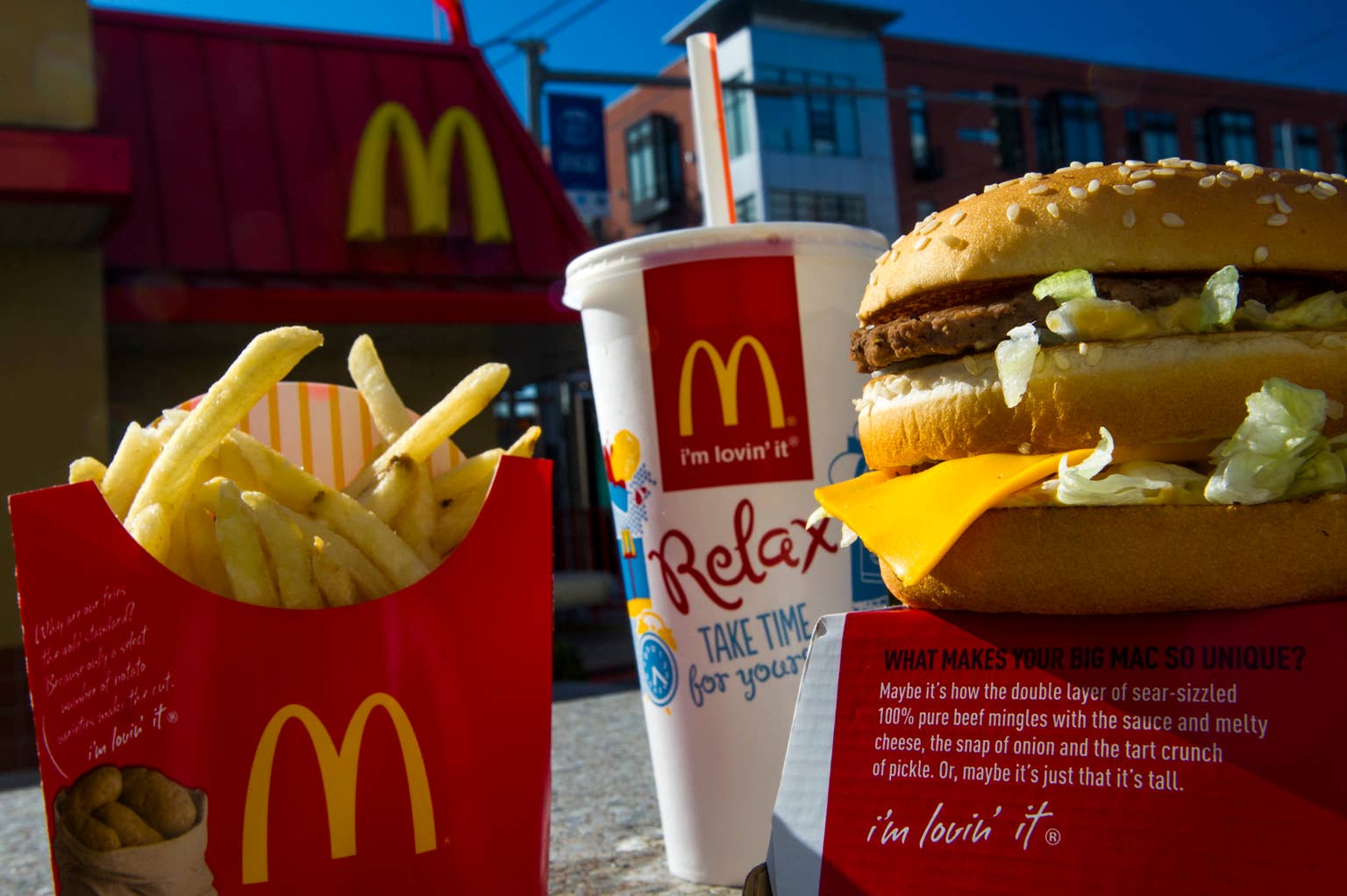
Big Mac meal is arranged for a photograph outside of a restaurant in San Francisco, California, U.S., on Jan. 22, 2014.
Bloomberg via Getty Images
And in Fresno, the homework shows. Beyond the Big Mac gap, an M&M McFlurry ran $4.69 at one store and $5.19 at the other. A Deluxe McCrispy: $5.99 versus $6.49.
McDonald's has pushed back, saying the technology doesn't set any prices, it merely suggests them.
Customers see it differently. One Fresno customer told the New York Post they had always assumed prices were the same everywhere. Another said the dollar gap made it worth driving the extra mile.
Golden arches meet digital coins
McDonald's flirtation with new technology doesn't stop at pricing. The chain has a longer history with cryptocurrency than most people realize.
Cryptocurrency, for the uninitiated, is digital money that runs on blockchain networks instead of banks. And in September 2021, when El Salvador became the first country to adopt Bitcoin as legal tender, McDonald's was one of the first major American brands to start accepting it there.
The chain partnered with Bitcoin payment processor OpenNode to take crypto at all 19 of its Salvadoran locations, including online and through the delivery app.
Then there's the Dogecoin saga. Dogecoin started as an internet joke and grew a massive following, including Elon Musk. In January 2022, Musk posted that he would eat a Happy Meal on live television if McDonald's accepted Dogecoin.
McDonald's never took him up on it. As recently as June 2026, Musk reaffirmed the offer. The market barely flinched.
Trending on TheStreet Roundtable:
What it means for your next drive-thru run
The pricing tool is one piece of a bigger tech bet. McDonald's is also working with Google Cloud on drive-thru voice ordering, part of a push to grow its loyalty program from 175 million members to 250 million by 2027.
A crypto-powered drive-thru isn't on the U.S. menu yet, though the El Salvador experiment shows the chain will test digital payments when the conditions are right.
Related: SharpLink CEO sees a five-year path to AI-managed finances