Though Americans might be divided along party lines, there is one concern that unites them all. According to a recent Reuters/Ipsos opinion poll, most American voters oppose using prediction
Though Americans might be divided along party lines, there is one concern that unites them all.
According to a recent Reuters/Ipsos opinion poll, most American voters oppose using prediction markets to bet on U.S. elections and other government actions.
Related: Gaming media stock surges on major stockholder approval
60% of Americans opposed to prediction markets betting on U.S. elections
Prediction markets are online platforms where users buy and sell shares representing the likelihood of the outcome of future events, such as elections, weather reports, or sports events. But it also raises concerns about potential manipulation and insider trading.
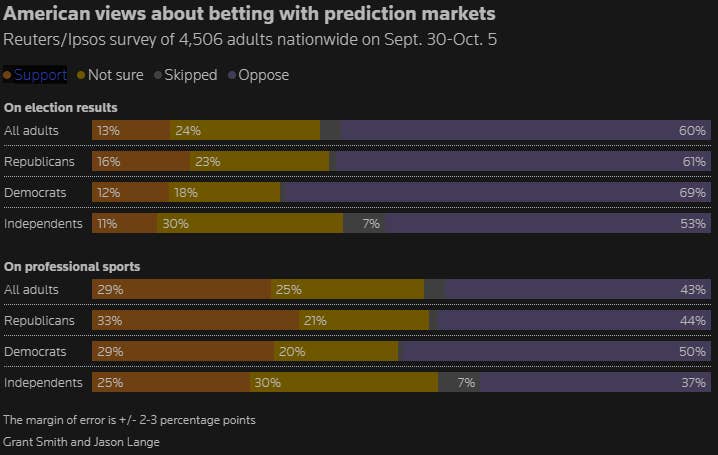
According to the Reuters/Ipsos poll conducted among 4,506 adults during Sep. 30-Oct. 5, a bipartisan majority of Americans is opposed to using prediction markets to bet on U.S. elections, military actions, and government policy announcements or decisions.
In fact, 69% of Democrats, 61% of Republicans, and 53% of Independents expressed their opposition to using prediction markets to bet on election results. Collectively, 60% of Americans are opposed to such markets.
Reuters/Ipsos survey of 4,506 adults nationwide on Sept. 30-Oct. 5
65% of Americans opposed prediction market betting on U.S. military actions and 63% opposed betting on government policy announcements or decisions.
93% of Democrats and 89% of Republicans are opposed to members of Congress or their staff betting on political events.
These concerns are particularly grave in the face of the upcoming U.S. midterm elections next month.
However, the attitude is far more relaxed when it comes to sports prediction markets.
Only 43% of Americans — 50% of Democrats, 44% of Republicans, and 37% of Independents — are opposed to these markets.
Popular on TheStreet Roundtable:
Prediction markets in the U.S.
One of the most popular prediction market platforms is Polymarket. Launched in 2020, it is built on the Polygon blockchain network and lets users trade contracts on future events with Circle's USDC stablecoin.
Polymarket has frequently run into trouble due to the political nature of the events traded on the platform.
In January 2022, the Commodity Futures Trading Commission (CFTC) charged the platform with offering illegal event-based binary options to U.S. users. The regulator also asked it to pay a $1.4 million civil penalty and wind down existing U.S. contracts.
In November 2024, FBI agents raided CEO Shayne Coplan's Manhattan penthouse around the U.S. presidential election. It was the most valuable market on Polymarket back then, with authorities alleging these markets were allowed to be traded by Americans.
‘People are putting money behind the outcome’ — Polygon CEO on Polymarket (4:35)
But when Donald Trump returned to the White House and things began to change for the better for the crypto industry, the Department of Justice (DOJ) and the Commodity Futures Trading Commission (CFTC) closed their probe into Polymarket in July 2025.
In September 2025, the CFTC gave a green light to Polymarket to serve American users through QCX, a CFTC-licensed derivatives exchange Polymarket acquired for $112 million in July.
1789 Capital, the VC fund at which the president's son Donald Trump Jr is a partner, is an investor in Polymarket. He is also an advisor at the prediction market platform.
While prediction market platforms such as Polymarket argue they want to be regulated only by the CFTC under a federal arrangement, several U.S. states, such as Arizona, Connecticut, and Illinois, have sought to ban them.
The Roundtable 100
If you follow our market coverage, don’t miss the Roundtable 100. Updated every Friday, it's a power ranking of the 100 most investable tech stocks, including digital assets. Check out the latest RTB 100 rankings at roundtable100.com.
Related: Musk's Tesla jumps 32 spots on the Roundtable 100 after 'flying car' reveal