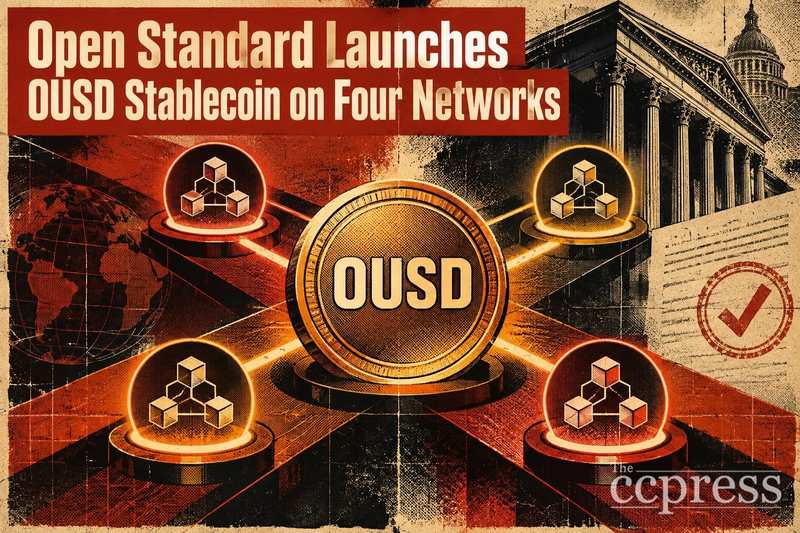
Open Standard has launched its OUSD stablecoin across four blockchain networks simultaneously: Ethereum, Solana, Base and Tempo. The multi-chain rollout marks a significant deployment for a s
Open Standard has launched its OUSD stablecoin across four blockchain networks simultaneously: Ethereum, Solana, Base and Tempo. The multi-chain rollout marks a significant deployment for a stablecoin backed by Coinbase, pushing OUSD into ecosystems that together host the majority of active DeFi activity.
Open Standard Deploys OUSD Across Four Networks at Once
Most stablecoin launches pick a single chain and expand later. Open Standard went the other direction, rolling out OUSD on Ethereum, Solana, Base and Tempo in one move, according to reporting from CoinGape. For related coverage, see Cyber Revolution Summit Saudi Arabia 2026.
The decision to target all four networks at launch signals a deliberate play for breadth. Ethereum is the original DeFi home. Solana handles high-throughput retail activity. Base, Coinbase’s own Layer 2, is the natural on-ramp for the exchange’s user base. Tempo rounds out a deployment that spans both legacy and emerging ecosystems. For related coverage, see Cyber Revolution Summit Morocco 2026.
The Coinbase connection matters here. Base is Coinbase infrastructure, and the exchange’s backing gives OUSD a distribution channel that most new stablecoins lack from day one. For related coverage, see CRYPTOCON SYDNEY RETURNS TO ICC SYDNEY WITH FREE GENERAL ADMISSION FOR 2026.
Launching on four networks creates optionality, but it also creates complexity. Each chain requires its own liquidity, its own integrations with DEXes and lending protocols, and its own user acquisition strategy. OUSD’s backers are betting they can execute across all four simultaneously.
Ethereum and Solana represent very different user profiles. Ethereum skews toward larger institutional and protocol-level activity; Solana attracts high-frequency retail traders who need fast, cheap transactions. Hitting both on day one suggests Open Standard is not narrowing OUSD to a single market segment.
Base, as Coinbase’s L2, adds a unique angle. Any OUSD integration on Base could benefit from Coinbase’s existing user onboarding, potentially giving the stablecoin a retail footprint that organic DeFi growth alone rarely delivers. Analysts have already raised questions about whether OUSD can carve out meaningful market share, with Cathie Wood publicly questioning OUSD’s chances against USDT and USDC, the two dominant players that together hold the vast majority of stablecoin supply.
The Real Test Comes After Launch
A multi-chain deployment announcement is a starting gun, not a finish line. Whether OUSD gains traction will depend on liquidity depth, protocol integrations, and whether DeFi users find a reason to hold it over established alternatives.
The stablecoin market is not short of competition. USDT and USDC hold entrenched positions across every chain OUSD just launched on. New entrants, even well-backed ones, have historically struggled to move the needle on market share without a specific yield or utility hook that the incumbents cannot match.
OUSD’s four-network launch creates the infrastructure for adoption. Whether adoption follows is the question that the current surge in altcoin activity may help answer sooner than expected. With liquidity rotating across chains at elevated levels, a well-timed stablecoin launch could land in favorable conditions, or get lost in the noise.
What does Open Standard do if one chain performs and three don’t?
Additional source references: source document 1.
Disclaimer: This article is for informational purposes only and does not constitute financial or investment advice. Cryptocurrency and digital asset markets carry significant risk. Always do your own research before making decisions.
The article Open Standard Launches OUSD Stablecoin on Four Networks first featured on theccpress.com.