Why I Wrote This Tunde sent me a voice note at 11:54 PM. You could hear the moment his excitement turned into panic. “Broooo, I just checked my dashboard. There is a whole new person sitting
Why I Wrote This
Tunde sent me a voice note at 11:54 PM. You could hear the moment his excitement turned into panic.
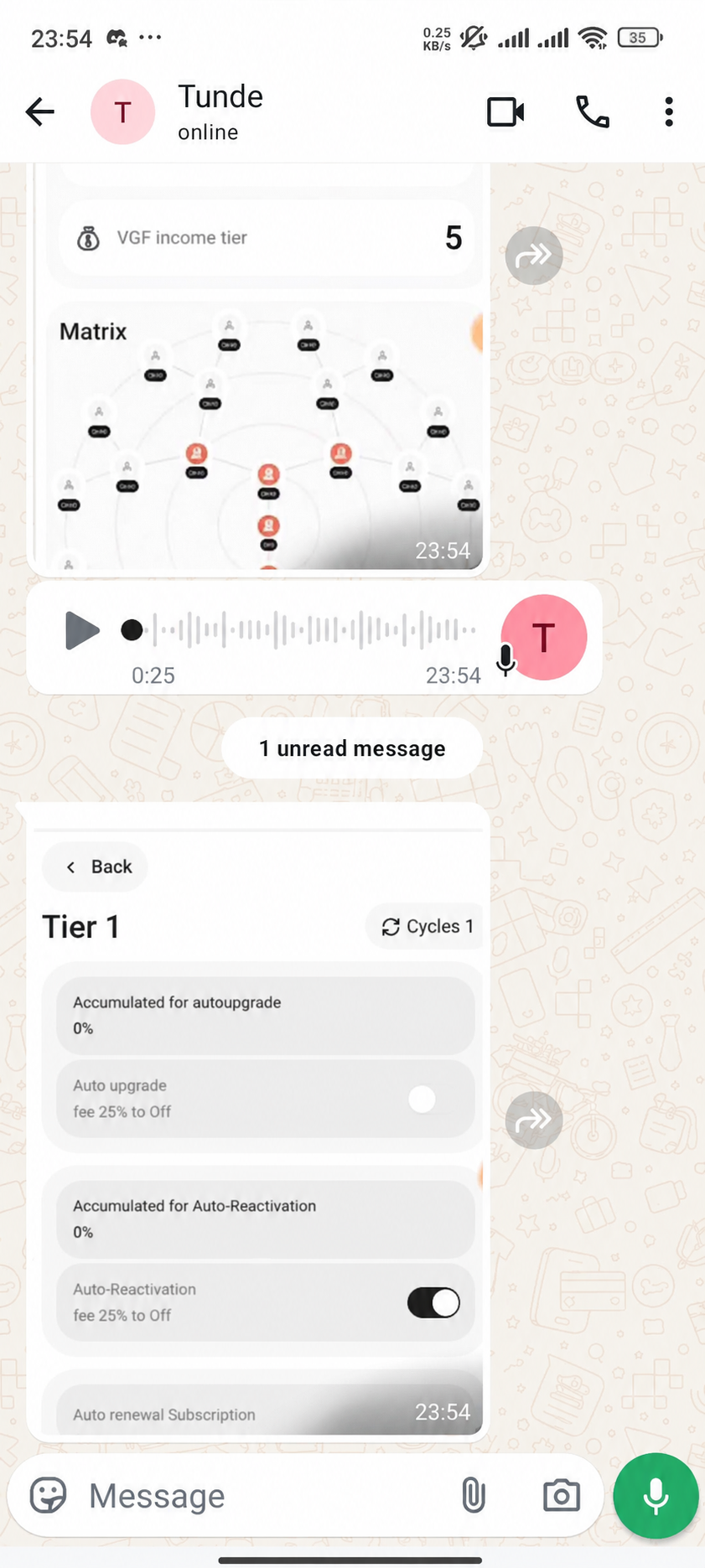
“Broooo, I just checked my dashboard. There is a whole new person sitting under me in the matrix. Tier 1. I did not invite anybody. Am I losing my spot? Did somebody hack my account? Wait”. There was a pause, the sound of him scrolling. “No, wait, he is connected to my upline, not to me. So is he mine or not? Call me back, I am panicking small, small.”
I did not call back away because, if I am being honest, I had the same moment three days earlier and just never said anything about it until I re-read the V-boost documents.
INTRODUCTION
I am writing this as someone who got genuinely confused the time I saw both terms, the referral structure and the matrix structure. Both involve people joining, positions being placed, and activity happening within a network. However, they serve different purposes inside V-Boost.
Understanding the difference is important because concepts such as compressionspillover,auto-upgrade, and auto-reactivation all interact with these structures in different ways, and both structures ultimately connect back to your Passport NFT, the single position that tracks your Tiers, activity, and rewards.
So if you have ever wondered, “wait, is my matrix downline the person as the one I invited?” “Can someone be connected to you in one structure but not the other?” Then this article is for you.
Main Question
This article answers a question:
What is the difference between the referral structure and the matrix structure in V-Boost?Along the way, we will also look at why understanding this distinction makes concepts like compression and spillover much easier to understand.
By the end, you should have an understanding of how both systems work together within the broader Vistory ecosystem.
What is the Referral Structure?
The referral structure in V-Boost is the simplest of the two to picture because it works the way most people already expect referral programs to work.
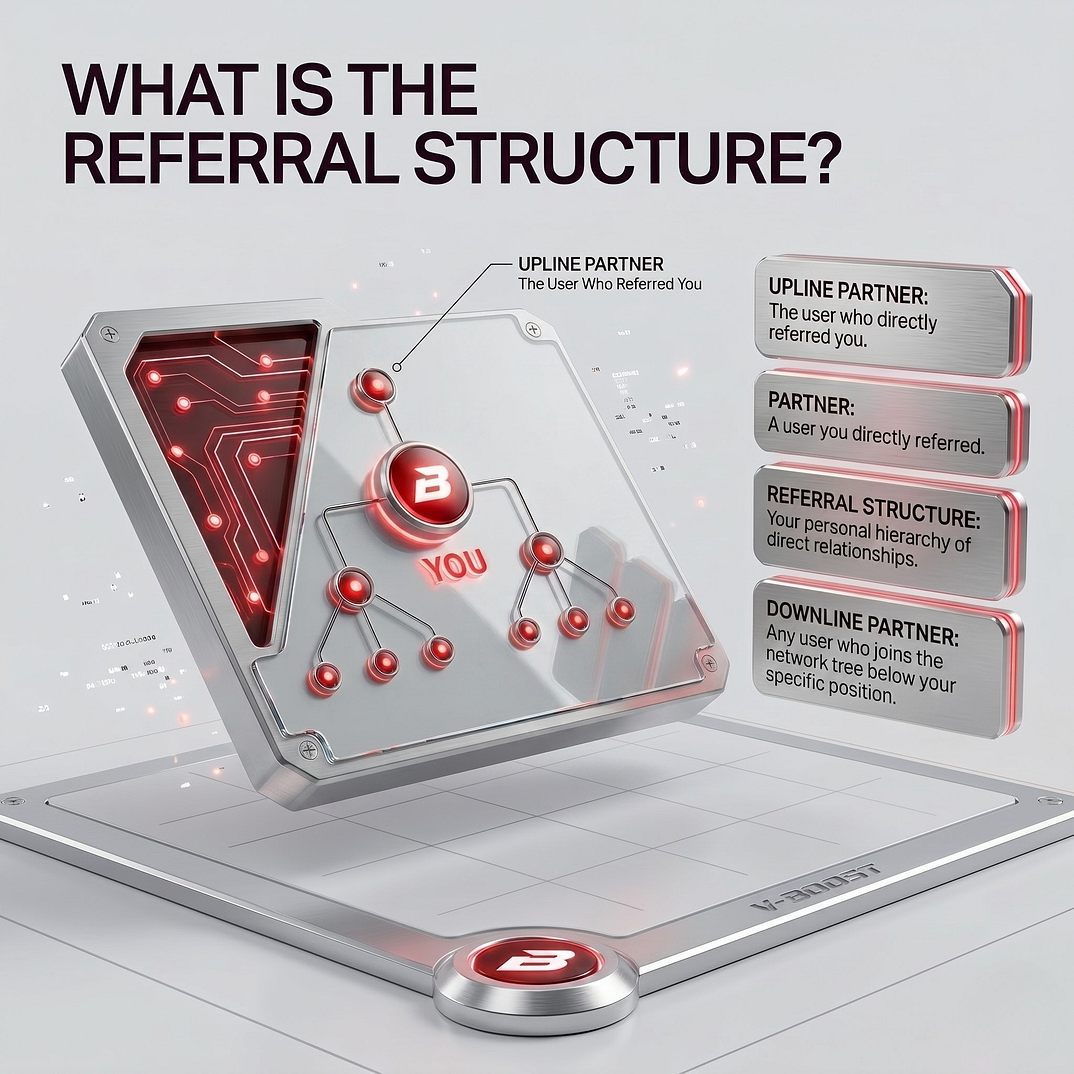
The referral structure is like your biological family tree.
Your Upline Partner is the person who directly invited you, and your Partner Downline is anyone you personally invited. This relationship is about who-invited-who. It is a personal chain.
If you invite three friends, those three friends are your Partners in the structure, full stop. That relationship does not change regardless of what happens inside the matrix.
For example, if you invite Paul, he becomes one of your First Line Partners. If Paul then invites Mary, she becomes one of your Second Line Partners connected to you through Paul. Not someone you invited directly. This only tracks who brought whom into the system.
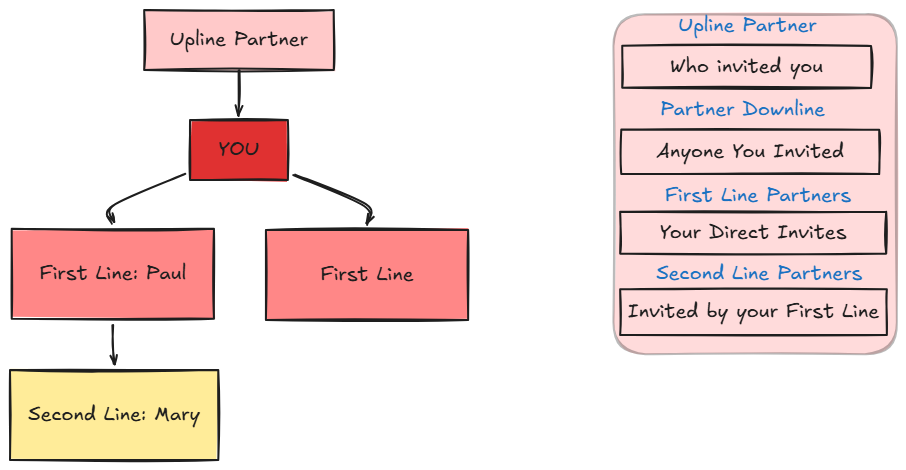
Your Upline Partner invited you. Your Partner Downline is anyone you invited directly. Going further out, those become your First Line and Second Line Partners.
What is the Matrix Structure?
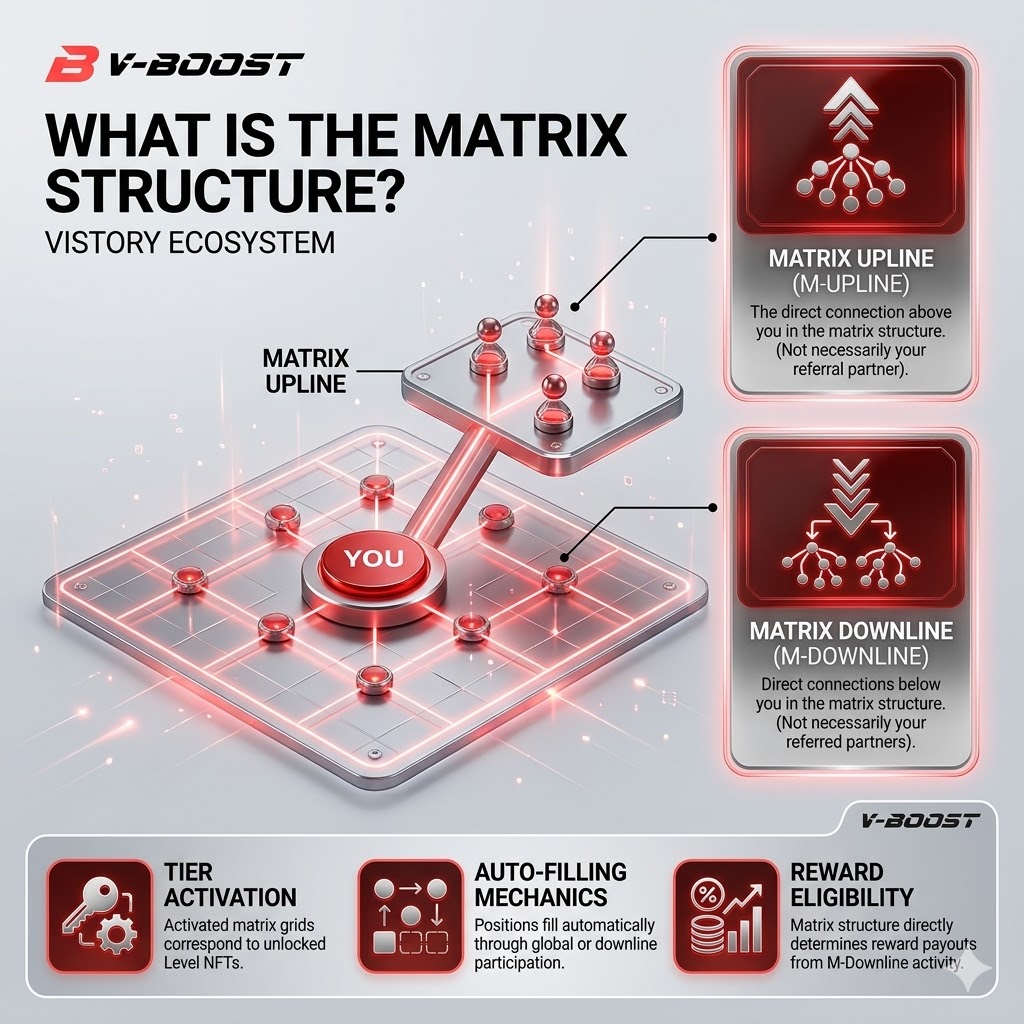
The matrix structure is something entirely different. It has nothing to do with who invited whom, and it serves a different purpose; it is about where your Tier position sits within V-Boost’s reward distribution structure.
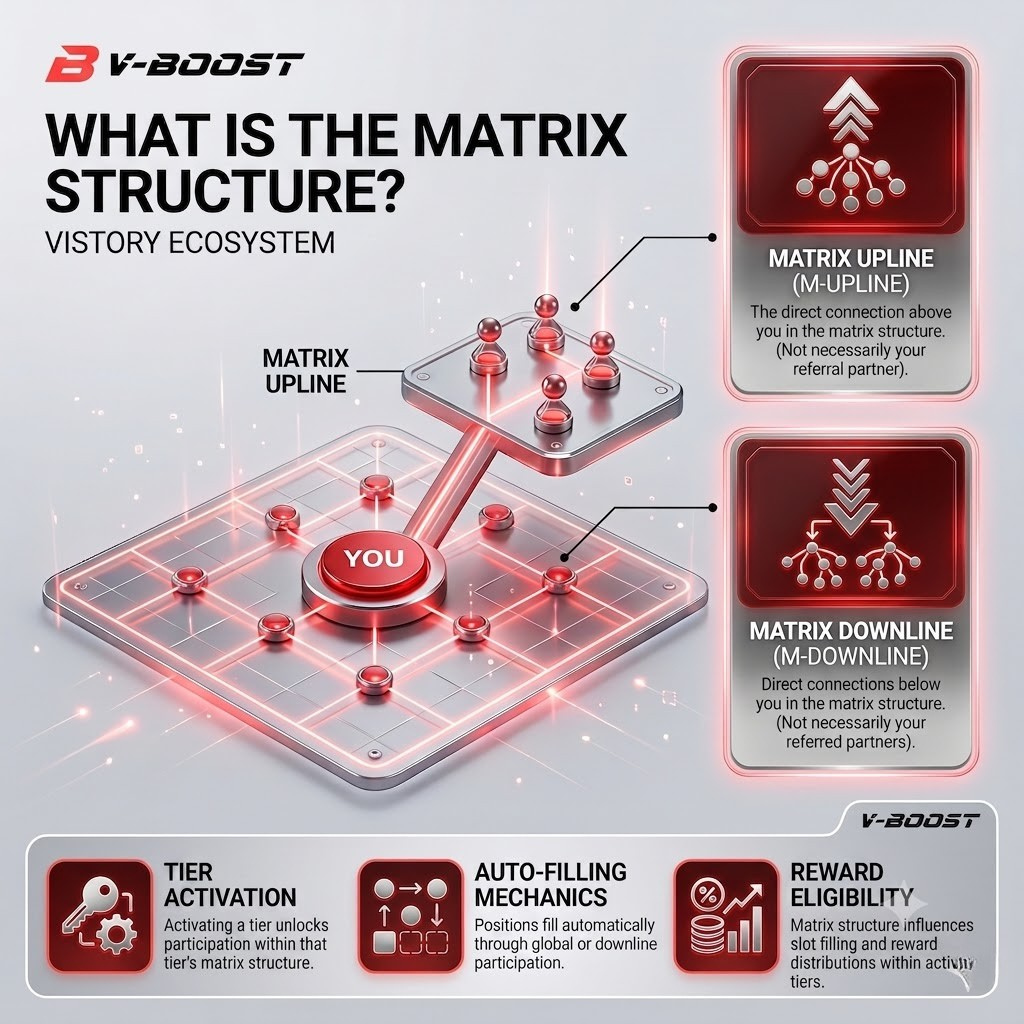
To put it simply: the matrix structure determines how positions are arranged within tiers. Think of it as a grid assigned to your Tier. As Tiers get more expensive, the grids get smaller, creating a “boost” effect of rewards. Tier 1 has an S30 grid. Tier 3 has an S6 grid. Tier 5 has an S2 grid.
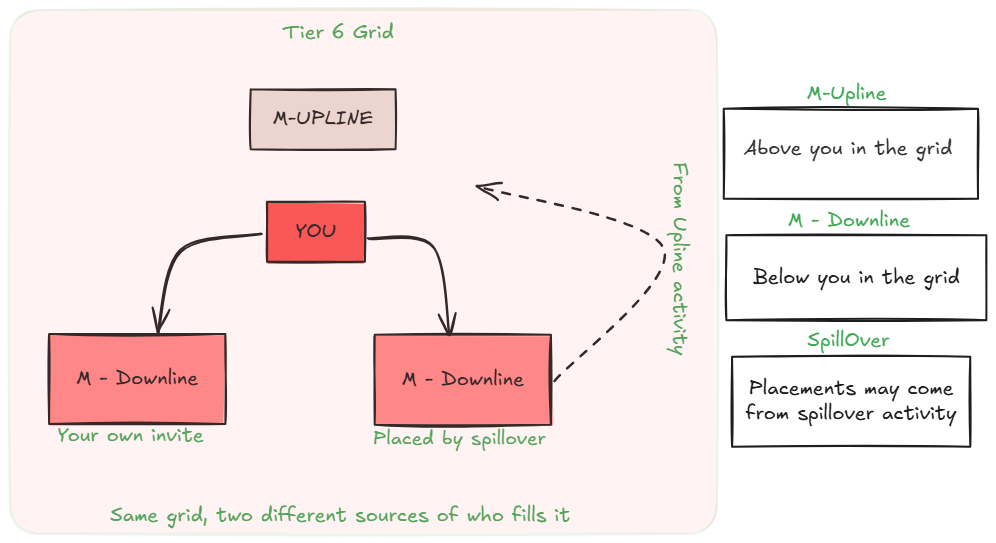
Your M-Upline sits above your grid position. Your M-Downline sits below it. Slots fill from your own invites or from spillover.
When you activate a tier, you take a placement within a grid. The participant positioned above you becomes your M-Upline, and those placed below you become your M-Downline.
Because these grids are connected, slots can be filled by your direct invites or through spillover.
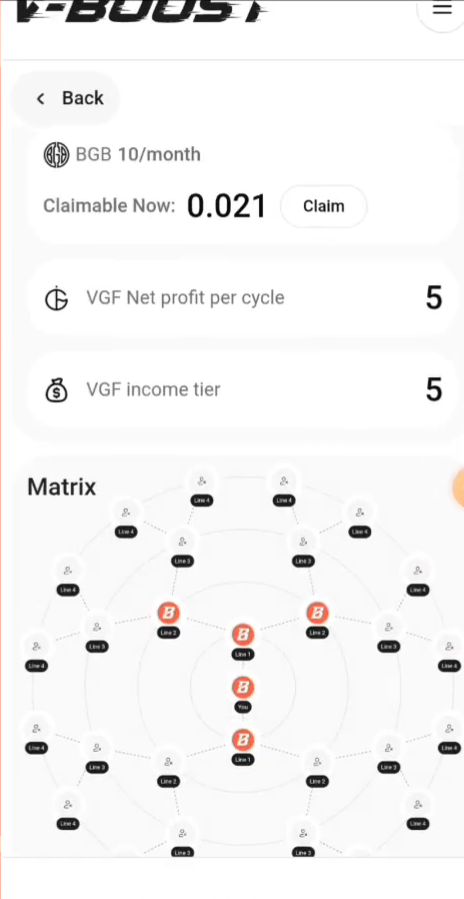
How Spillover Fits Into the Matrix Structure
This is another concept that beginners often hear about.
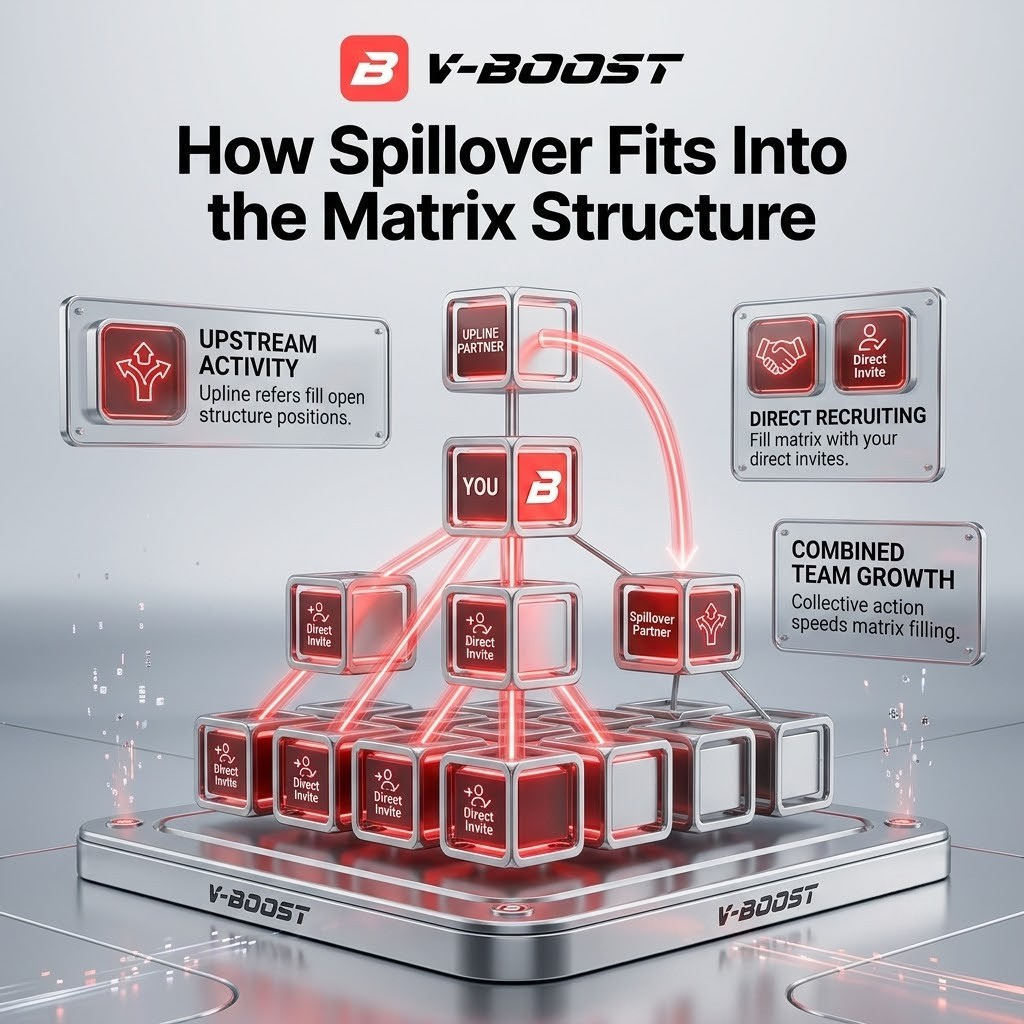
Spillover occurs when new participants are placed into your matrix by the actions of a partner above you or by downlines below you.
This placement directly dictates your payouts when an empty slot on your board is filled, whether by your recruit or a spillover user; the system automatically triggers a reward distribution directly to your wallet based on that tier’s formula.
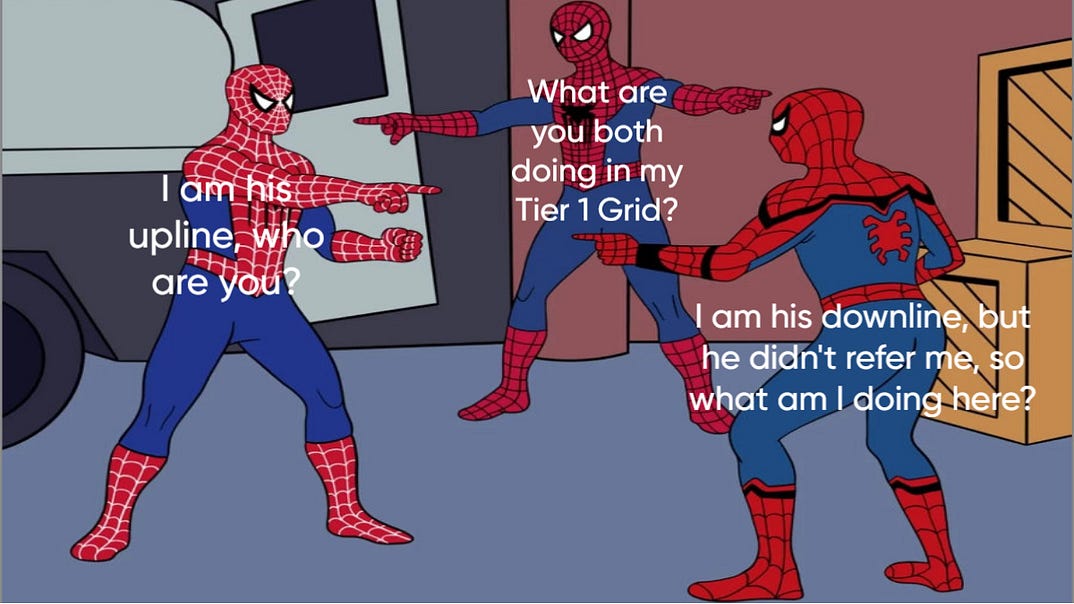
This is exactly what happened to Tunde. A participant can be your M-Downline inside a matrix without being your Partner in the referral structure. A stranger was placed into Tundes’ matrix through spillover, triggering an automated reward distribution from a user he never personally invited.
In short terms: the person sitting below you in your matrix might be someone a teammate invited, not someone you invited.. Someone you personally invited might end up placed in a completely different part of the matrix, not directly under you.
How Compression Connects the Two Structures
Compression is the bridge between your family tree (referrals) and your digital grids (matrix). It acts as an automated “button” when someone in your downline upgrades faster than the person who invited them.
Let’s go back to our example: You invited Paul, and Paul invited Mary.
- You activate up to Tier 6.
- Paul stops at Tier 1.
- Mary decides to jump and buy Tier 6.
When Mary pays for Tier 6, the system needs to place her into a Tier 6 matrix grid. It checks her inviter first. But Paul does not own Tier 6, so he has no slots to give her.
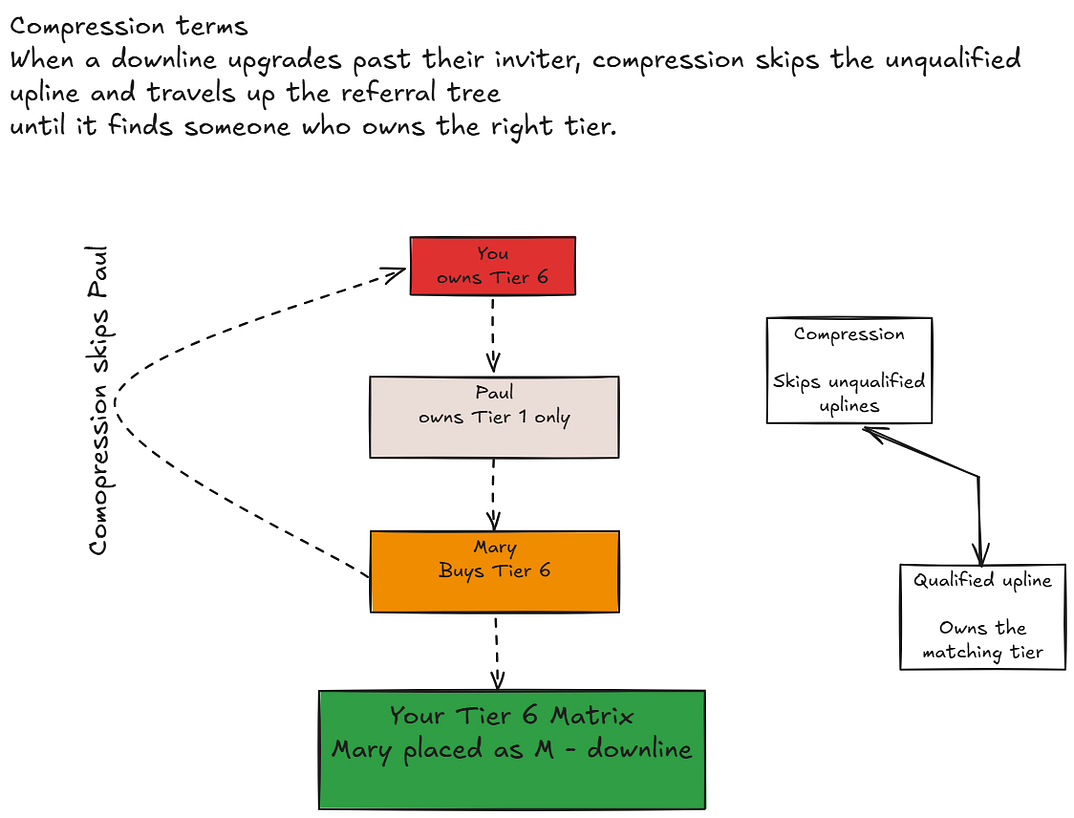
Instead of getting stuck, the system uses compression. It skips over Paul completely, travels up the tree, and finds you. Because you have a Tier 6 grid open, the system places Mary’s activation under you, allowing the placement to continue.
In short, the system travels up the structure to find the nearest qualified person on the matrix structure. If an inviter does not own the grid, compression skips them and passes the placement up to the next qualified person.
Why V-Boost Keeps These Separate
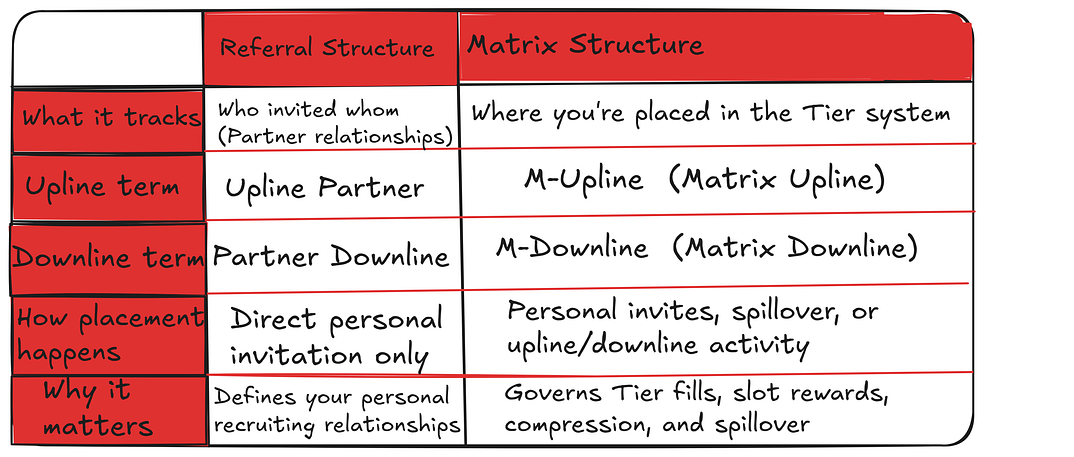
- The referral structure tracks personal relationships and rewards direct recruiting effort.
- The matrix structure governs how Tiers fill, how slot rewards distribute, and how mechanics like compression and spillover function.
One tracks relationships. The other organizes participation.
If these two systems were treated as identical, V-Boost’s matrix logic would not work properly. Compression specifically relies on moving rewards through the referral tree of where someone happens to sit in the matrix. That is what lets the system skip past an upline to find the nearest qualified one without needing to touch or reshuffle anyone’s actual matrix position.
Referral Structure vs Matrix Structure: Side-by-Side
My Takeaway As A Beginner
Once I separated these two ideas in my head, I realized that someone showing up in my matrix does not mean I get credit for recruiting them, and someone I recruit does not automatically land directly under me in the matrix either.
I did eventually call Tunde back. It took me two minutes to explain what had taken me three days of confusion to figure out on my own.
If you are new to V-Boost, my advice is simple: do not assume your matrix view and your referral view tell the story. Check both. Read the official terminology carefully before drawing conclusions about your team.
Before You Start
There is more to learn, including how Tiers, your Passport NFT, and VGF connect to both structures. You will also want to learn how active participation earns you BGB, how rewards interact with CES on marketplaces, and how a Voucher NFT can be used to cover activation costs.
As with digital ownership models in Web3 and crypto, understanding the underlying structure before you participate puts you in a much stronger position than getting a panicked voice note at midnight.
Frequently Asked Questions
- Are referral structure and matrix structure the thing? No. The referral structure tracks invitation relationships while the matrix structure organizes participation and placement activity.
- Does spillover come from referrals? Not necessarily. Spillover is primarily related to matrix movement than direct referrals.
- Why is compression important? Compression helps maintain movement when participants, at certain levels, do not have the required active tier.
This article is an educational explainer written from my perspective as part of the V-Boost community content initiative. It reflects my understanding of the publicly available V-Boost materials and is not financial advice.
Website: https://www.v-boost.topDiscord: https://discord.gg/v-boostTwitter / X: https://x.com/VBoostX
Telegram
Announcements Channel: https://t.me/v_boost_officialVistory Community Chat: https://t.me/vistory_chat