Revolut disclosed customer identity and Bitcoin transaction records after receiving a fake agency request, according to the reported event. The disclosure raises questions about how requests
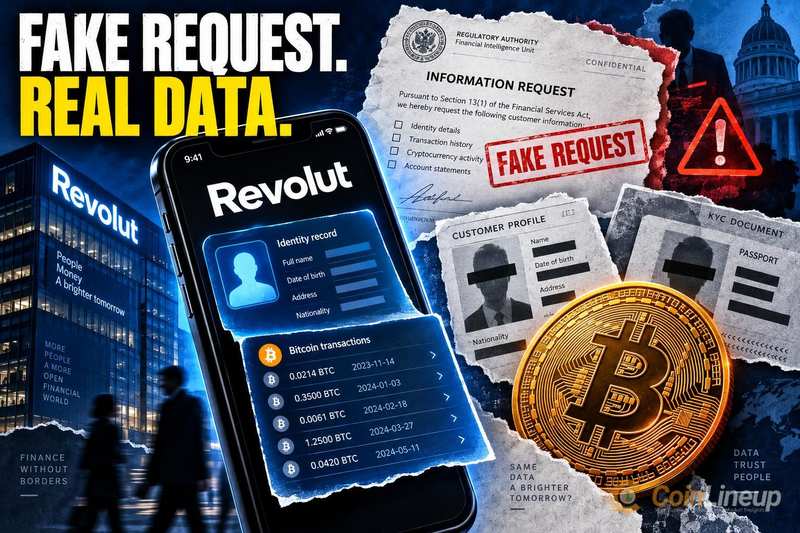
Revolut disclosed customer identity and Bitcoin transaction records after receiving a fake agency request, according to the reported event. The disclosure raises questions about how requests for sensitive financial data are verified before information is handed over.
The core facts are narrow. Revolut, the financial technology company, released two categories of records: identity information and Bitcoin transaction records. The release followed a request that turned out to be fake. For related coverage, see Bitcoin Suisse Plans to Cut Up to 60 Swiss Jobs.
Beyond that, the details are not established. The date, the location, the number of people affected, and the exact fields disclosed remain unverified. This article covers only what the headline supports. For related coverage, see Kevin Hassett Disclosed Up to $5M in Coinbase Shares.
What Revolut disclosed after the fake agency request
The reported event centers on two data types. The first is identity records, meaning information that identifies a specific customer. The second is Bitcoin transaction records, meaning the history of that customer's Bitcoin activity on the platform.
Important distinction: disclosing transaction records is not the same as losing funds. There is no evidence that any Bitcoin was stolen, that an account was compromised, or that Revolut's systems were hacked. The reported issue is the release of data, not the theft of money.
A closely related account of the same event appears in coverage of how Revolut shared customer records after a fake government request. Readers looking for the surrounding context can start there.
What is known about the fake agency request
The trigger was a request described as fake, meaning it appeared to come from an agency but did not. It arrived before the disclosure, then the records went out.
What is not known matters just as much. The specific agency, the identity of the requester, the communication channel used, and the verification steps Revolut applied are all unconfirmed. No specific procedural failure or legal finding has been established here.
So the honest framing is simple. Something posing as a legitimate authority asked for data, and the data was provided. How the impersonation worked, and how it was eventually caught, still require source confirmation.
Why identity and Bitcoin transaction records matter
Records that link a person to their transaction activity can be sensitive. If identity details sit next to a Bitcoin transaction history, they could reveal financial behavior tied to a named individual. That is a conditional risk, not a confirmed one, because the exact fields disclosed are unknown.
Another key point for everyday holders: transaction records are not private keys. Someone seeing your transaction history cannot spend your Bitcoin. Control of funds depends on private keys, which are a separate thing entirely.
Revolut has been expanding across crypto, including its move to roll out a euro stablecoin in the EU and its long wait for a U.S. bank charter. Against that backdrop, how it handles data requests is worth watching.
The practical takeaway for a regular crypto user is measured. The scope of exposure, Revolut's formal response, and any protective steps offered to customers are still open questions. Until those are answered by a verified source, treat the incident as a caution about data-request verification, not as proof of financial loss.
Additional source references: source document 1, source document 2.
Disclaimer: This article is for informational purposes only and does not constitute financial or investment advice. Cryptocurrency and digital asset markets carry significant risk. Always do your own research before making decisions.
Read original article on coinlineup.com