$Ripple just had the best regulatory week in its history, and $XRP spent it drifting back towards $1.30. On October 26, the Office of the Comptroller of the Currency gave final approval to Ri
$Ripple just had the best regulatory week in its history, and $XRP spent it drifting back towards $1.30. On October 26, the Office of the Comptroller of the Currency gave final approval to Ripple National Trust Bank. BNY added XRP and RLUSD to its custody platform. Moody’s handed RLUSD an investment-grade rating. And still the chart went the wrong way. That gap between headlines and price is the real story.
What is Ripple National Trust Bank actually allowed to do?
Not what most people think. A national trust bank is not a commercial bank. It cannot take your deposits, it cannot lend you money, and it will not launch a checking account. Its job is to safeguard and administer assets under federal supervision.
For Ripple that means two things. First, RNTB will manage the reserves backing the RLUSD stablecoin. Second, it can offer digital asset custody to institutions. RLUSD itself keeps being issued by Standard Custody & Trust Company under the New York Department of Financial Services, so the stablecoin now sits under both state and federal oversight.
The approval has been a long time coming. Ripple applied in July 2025, got conditional approval in December 2025, and then waited for the OCC’s April 1 rule that formally allowed national trust banks to run digital asset custody. Final sign-off closes that loop.
Why did BNY and Moody’s matter more than the charter?
The charter is the headline, but the surrounding moves tell you who Ripple is building for. BNY, the oldest bank in the United States, now custodies XRP and RLUSD for its institutional clients. Moody’s rating puts RLUSD in a category that treasury departments and funds can actually hold without a compliance headache. Add Aviva Investors tokenizing a sterling fund on the XRP Ledger the same week, and you get a picture of Ripple winning the institutional plumbing race.
Notice the pattern: every one of these wins is about RLUSD, custody and tokenization. None of them require anyone to buy XRP.
Why is XRP price falling despite the good news?
Three reasons, and none of them is a mystery.
The first is supply. On-chain data shows XRP whales now control around 68.5 percent of supply, the highest concentration since 2022, while roughly 6 billion tokens flowed onto exchanges over the past 30 days. Big holders are positioned, and some of them are using the news to sell into liquidity.
The second is macro. The Fed held rates at 3.75 to 4 percent on October 28, but two members voted for a hike and the statement called inflation “elevated”. That is not an environment in which altcoins get a free pass. Bitcoin itself gave back its post-Fed bounce.
The third is the one XRP holders least want to hear: the bank does not need the token. Ripple’s institutional business is increasingly a stablecoin and custody business. XRP still powers on-demand liquidity, but the headlines that moved this week do not create direct buy pressure for it.
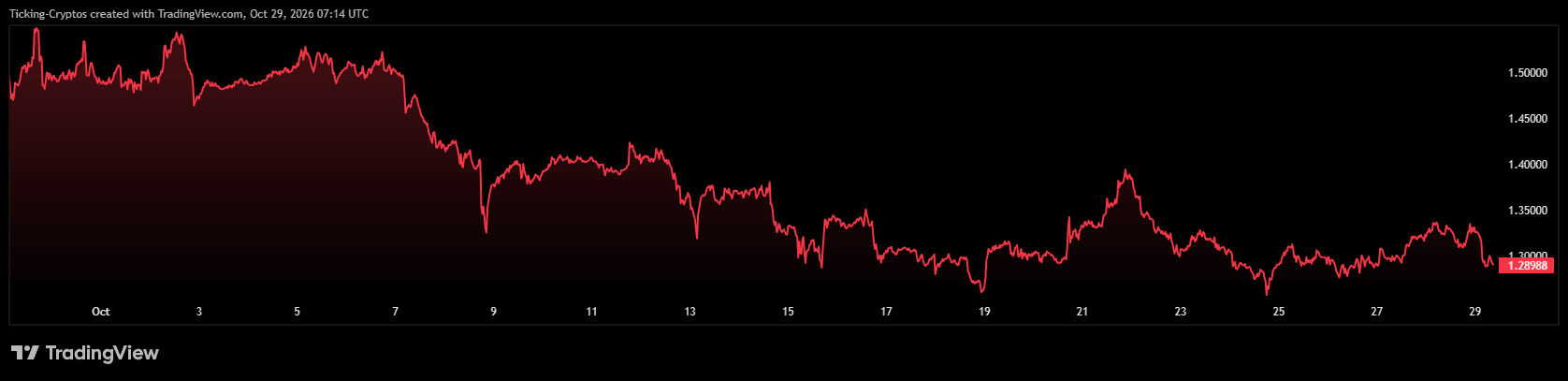
XRP/USD Chart
What does this mean for XRP going forward?
The bull case has not disappeared, it has just changed shape. If RLUSD becomes a serious institutional stablecoin, the XRP Ledger gains volume, developers and credibility, and XRP is the asset that secures and settles on that ledger. That is a slow burn, not a catalyst.
In the short term, the chart matters more than the charter. XRP needs to reclaim $1.50 to convince anyone the correction is over, and support sits closer to $1.20 if the broader market keeps bleeding. You can track the live move on the CryptoTicker XRP price page.