How Is Sirius Network Ecosystem Development Connecting SST With SRT? Sirius Network ecosystem development has a clearer shape now. Most points programs leave users guessing what their points
How Is Sirius Network Ecosystem Development Connecting SST With SRT?
Sirius Network ecosystem development has a clearer shape now. Most points programs leave users guessing what their points are actually for. The latest ecosystem development update answers part of that. SST records what a user contributes, and users who complete KYC can use those points to join future SRT and ecosystem allocations. This guide explains what that means, what is still undecided, and how to read the plan without hype.
Key Takeaways
SST records daily participation, genuine invites and community building. It stays inside the app as an off-chain record.
KYC is the gate. Verified users who meet the ecosystem requirements can use their accumulated SST for future SRT and ecosystem allocations.
Details are not final. Rules will come through official channels, and there is no fixed SST-to-SRT conversion rate.
What is Sirius Network
Sirius Network is a mobile-first contribution mining project. It needs no hardware and no purchase. A user downloads the app, opens an account with a Sirius ID, and joins each 24-hour cycle. Because the account starts with an ID rather than an email or phone number, identity is part of the design from day one.
The Sirius Network contribution points are called SST, short for Sirius Contribution Points. A second layer called Contribution Power weighs how valuable a user's activity is. SRT is the planned ecosystem token.
Source: official website.
Term
Meaning
Sirius ID
The account identity, used instead of email or phone
SST
Off-chain points that record contribution
Contribution Power
A weight on the quality of activity
Passport
Tracks identity and progress
SRT
The planned ecosystem token
One more point for clarity. This project is not Sirius Chain, which uses the XPX token. No source reviewed links the two.
How SST supports ecosystem development
SST measures three kinds of work: daily participation, inviting genuine users and building the community. That is why the model is called contribution mining. Rewards come from useful actions, not from running machines.
Referrals count too. A direct referral gives a 5% boost, but only when the invited person is eligible and active. Fake or empty accounts add nothing. This keeps the SST contribution ecosystem tied to real people.
Points also stay off-chain. The whitepaper keeps records such as the Sirius ID, referral links, Contribution Power and risk status inside the app. Only later steps, like SRT issuance, vesting and staking, run on the blockchain. This split keeps daily use light and leaves heavier actions for audited contracts.
Sirius Network KYC and SST eligibility
This is the biggest change in the update. Sirius Network KYC now sits between a user's points and what those points can be used for.
The SST points KYC requirement works like a checkpoint. Collecting points is open to everyone, but using them in future allocations needs a completed KYC plus any other ecosystem requirements. Sirius Network SST eligibility therefore depends on two things: what the user contributed, and whether the user is verified.
Sirius Network verified users are the ones who can take part. The exact requirements have not been published yet, so any detailed claim about them is a guess.
It also helps to know what KYC does not change. It does not turn into a payout, and it does not set a conversion rate. It only decides who can use itt once allocation rules arrive.
Sirius Passport and progress tracking
The Sirius Passport tracks identity and progress across six stages, P0 to P5. It is where verified status and contribution history meet, so points and identity grow together. Risk status is kept as an off-chain record alongside it.
From points to rewards: how SRT allocation works
Sirius Network SST are the record. SRT is what the ecosystem plans to give out for it, under rules. The official whitepaper says SST is not converted at a fixed ratio, so 1,000 points do not mean a set number of tokens.
Detail
What is planned
Standard
BEP-20
Network
BNB Smart Chain
Maximum supply
5,000,000,000
Structure
Five allocation segments
Release
Long-term vesting
The Sirius Network allocation is best seen as a seasonal pool shared by verified contributors, not a price tag on each point. The whitepaper sums up the idea in one short line: "Contribute First, Own Next, Build Together."
The whitepaper also lists what SRT is designed to do. Planned functions include access to missions and services, network roles such as validators and nodes, application services, digital rights, governance, and real-world asset use cases that come only after legal assessment. SRT earned through contribution mining is designed to unlock gradually through long-term vesting.
The SRT ecosystem allocation for current users is not live yet. Future ecosystem allocations will depend on announced rules, so every number should be treated as a plan.
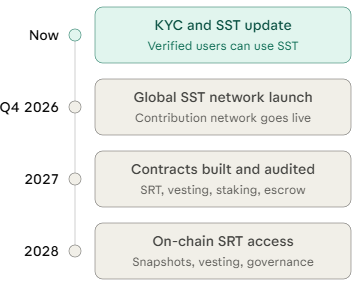
Sirius Network ecosystem development roadmap
The project calls every date a planning target, so these entries show intentions, not promises.
When
Planned milestone
Q4 2026
Global SST contribution network launches
2027
SST snapshot system, SRT, vesting, staking, mission escrow and governance contracts built, tested and audited
2028
Initial snapshots and vesting calculations, on-chain SRT access, audited staking and governance
The order matters. Contribution comes first, then snapshots and audits, and on-chain access comes last. Each step depends on the one before it, so a delay early on can move the later dates.
Beyond that, the whitepaper lists ten planned modules, such as Learn, Mission, Creator and Governance. These are what give SRT real uses over time.
Improving SST and SRT integration
The update says the platform will improve the link between SST and SRT step by step, widen where SRT can be used, and move both CEX and DEX trading ecosystems forward. That is a direction, not a launch. No listing, exchange name or date has been announced, so anyone quoting one is guessing.
For ordinary users, the practical meaning is simple. The rules for turning points into tokens are still being written, and the team has said further arrangements will come through official channels.
Staying safe while waiting
Routine SST-points do not automatically turn into USDT. Payment comes only from a mission that states its compensation. A mission that asks for payment before work begins deserves suspicion. Users should rely on official channels only and complete KYC only inside the official app. Anyone promising a fixed return should be treated with caution.
Final thoughts
Sirius Network ecosystem development is moving from collecting points to verifying people and sharing rewards by rules. The next real signals will be the published KYC requirements and the allocation terms. Until then, contributors are best served by staying active honestly and ignoring anyone who sells certainty.
Disclaimer: This article is for information only and is not financial, investment or legal advice. Details come from the Sirius Network whitepaper and website as reported in November 2026. Plans, dates and requirements may change. Crypto carries real risk, including loss of funds, so readers should do their own research and check official channels before acting.