SpaceX blew past Wall Street's third-quarter expectations on Tuesday, reporting its first profitable quarter since going public in June. The Elon Musk-led company earned $4.4 billion, or 35 c
SpaceX blew past Wall Street's third-quarter expectations on Tuesday, reporting its first profitable quarter since going public in June.
The Elon Musk-led company earned $4.4 billion, or 35 cents per diluted share, against a loss of $1.1 billion a year earlier.
Revenue more than doubled to $14.6 billion from $5.6 billion, beating the $12.7 billion analysts expected, according to Bloomberg consensus.
Adjusted EBITDA reached $8.8 billion, up 306% from a year ago and well ahead of the $6.59 billion estimate.
Capital expenditures totaled $19.6 billion, roughly in line with forecasts.
Elon Musk’s SpaceX IPO could trigger major corporate Bitcoin shift (2:23)
SPCX shares closed Tuesday down 0.11% at $147.79 and rose about 2% in after-hours trading following the release.
The swing to profit caps a bumpy start to life as a public company.
SpaceX's first report in August showed a $541 million second-quarter loss on $7.8 billion in revenue, and its $18.4 billion in quarterly capital spending, 80% of it aimed at AI, rattled Wall Street.
The listing itself was a record-breaker.
SpaceX priced 638.9 million Class A shares at $135 in an all-primary offering, raising roughly $85.7 billion at a $1.77 trillion valuation, the largest IPO on record. With only about 4.9% of the company floated, every lockup expiry moves the stock.
Shares opened at $150 in the June 12 Nasdaq debut, sank to $104.83 in early August days before the first lockup expired, then ripped higher once it did. Analysts came into Tuesday's report mostly bullish: Mizuho holds a $200 price target, RBC $225 and Cantor Fitzgerald $246.
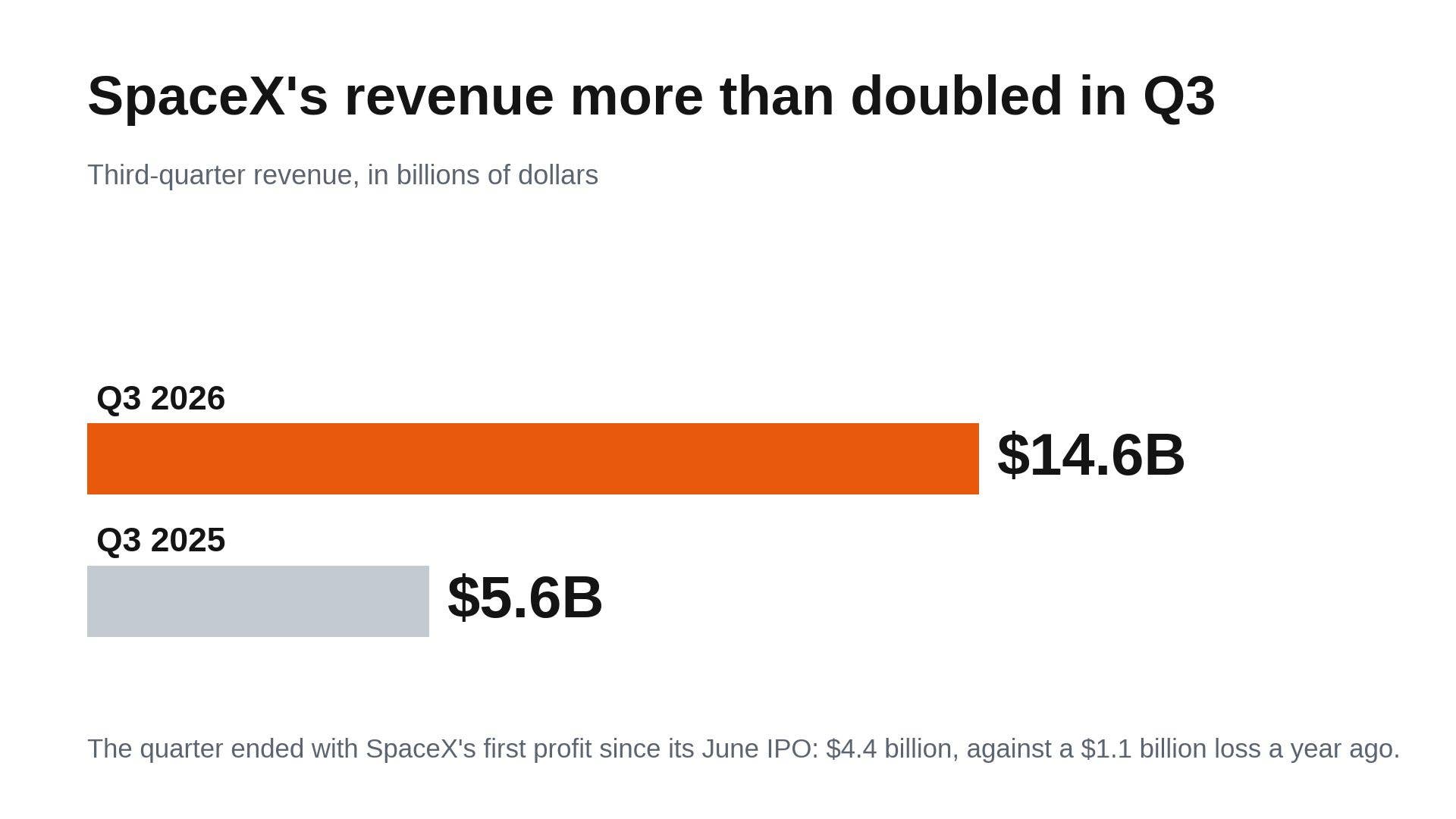 SpaceX's third-quarter revenue more than doubled to $14.6 billion, its first profitable quarter since going public. (Data: SpaceX Q3 2026 earnings release)
AI is now the biggest business
The Super Intelligence segment brought in $7.6 billion of revenue, up 830% from a year earlier, driven by new cloud services agreements, the August acquisition of coding platform Cursor and growing adoption of Grok.
The unit posted its first operating profit at $431 million.
The segment, created out of SpaceX's February merger with xAI, ended the quarter with 1.7 gigawatts of nameplate computing capacity.
Inside the company the AI arm goes by SpaceXSI, with the "SI" standing for Super Intelligence, President Trump's preferred term.
Anchor compute customers include Anthropic, at roughly $1.25 billion a month, and Google, at about $920 million a month, together about $26 billion a year.
Both agreements carry 90-day termination clauses, and Google only started paying in October.
Popular on TheStreet Roundtable:
SpaceX closed its $60 billion Cursor acquisition on Aug. 14. The deal added $608 million in revenue between closing and the end of the quarter.
Starlink's Connectivity segment grew revenue 69% year over year to $5.2 billion. The satellite service reached 13.6 million consumer subscribers after adding 1.6 million in the quarter, and now runs on more than 3,800 aircraft.
Starlink's consumer monthly ARPU improved 5% from the prior quarter to $69, while the Connectivity segment's operating income nearly doubled to $2.4 billion.
SpaceX is also pushing into mobile.
After the quarter ended, it agreed to acquire FCC licenses covering up to 14 megahertz of paired 800 MHz spectrum to advance its Starlink Mobile strategy, a deal expected to close in the first half of 2027. The FCC has separately approved SpaceX's plan for a 15,000-satellite constellation.
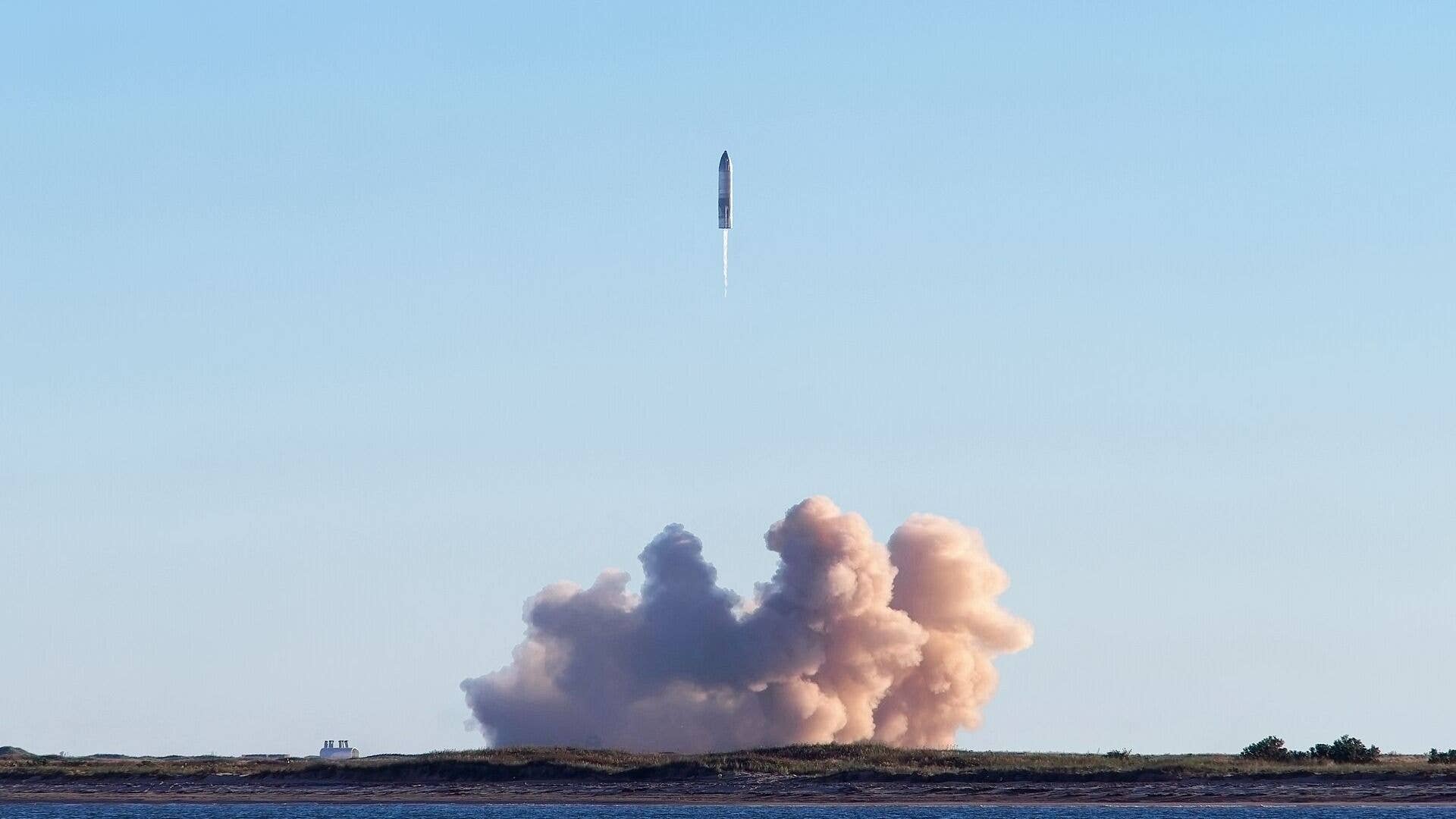
A SpaceX Starship prototype lifts off on a test flight over South Padre Island, Texas. (Photo: Forest Katsch, CC BY-SA 4.0)
The company also completed Starship's first revenue-generating mission, delivering 26 Starlink V3 satellites to orbit.
Starship remains the swing factor for the launch business, which lost $542 million on $962 million of revenue in the second quarter.
The Sept. 28 flight was Starship's first orbital mission, and SpaceX remains a critical launch provider for NASA and the Defense Department.
What the quarter did to its bitcoin
SpaceX's balance sheet shows digital assets worth $1.57 billion as of Sept. 30, up from $1.10 billion three months earlier.
The $475 million increase tracks bitcoin's rally across the quarter, when the coin climbed from around $58,600 to $83,554.
The company held 18,712 bitcoin as of its most recent disclosure in August, at a cost basis of $661 million. Tuesday's release did not update the coin count, but the Sept. 30 valuation implies the stash stayed largely intact through the quarter.
Even after the rebound, the position remains below the $1.64 billion recorded at the end of 2025. SpaceX booked a $64 million unrealized loss on digital assets across the first nine months of the year, the release shows.
Trending on TheStreet Roundtable:
Bitcoin traded near $82,500 on Tuesday afternoon, up modestly on the day.
Musk's $10.5 billion pledge: a share for every child
The report landed a day after Musk made a sweeping pledge on X: one of his own SpaceX shares for every child in America.
"Next year, I will give one of my SpaceX shares to every kid in America," he wrote on Monday. "This will be the first of many."
With about 72 million children under 18 in the U.S., per Census Bureau data, the giveaway would be worth roughly $10.5 billion at Friday's close of $146.03. Musk, the world's richest person with a net worth above $900 billion, owns about 4.8 billion SpaceX shares, an August SEC filing shows, rising to 6.4 billion shares, or 48.4% of the company, including unvested awards and options.
Musk offered no details on how the shares would be distributed. Altimeter Capital's Brad Gerstner, the Invest America and Trump Accounts founder, suggested they could go out through Trump accounts, calling it "the largest philanthropic gift in history."
The pledge came a day after Anthropic said it would commit 5% of its shares to a new public benefit fund. Musk's response on X:
"I recommend giving the shares directly to the public."
Musk has poured more than $276 million into Republican groups since July, including $158 million to the Senate Leadership Fund, making him the biggest known donor of the 2026 midterms.
How SpaceX stacks up against the rest of space
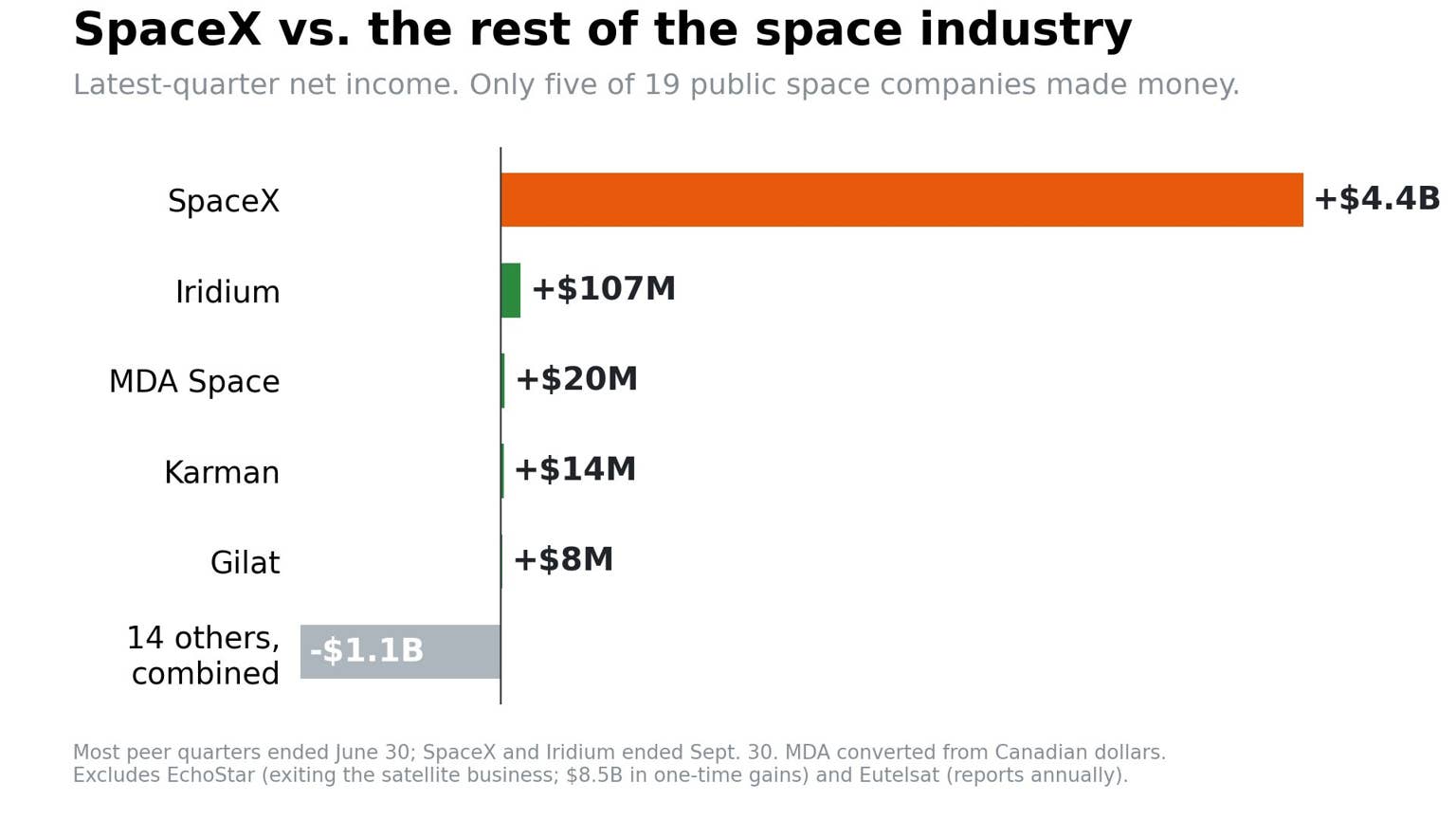
The quarter makes SpaceX an outlier in its own industry. Of 19 public space companies, only five made money in their latest reported quarter - and SpaceX's $4.4 billion profit is roughly 30 times the other four combined.
The other 18 companies combined for about $3.3 billion of revenue in their latest quarters, less than a quarter of SpaceX's top line. Most of those quarters ended June 30; SpaceX's ran through Sept. 30.
SpaceX's $4.4 billion is the largest quarterly profit from operations a space company has reported. EchoStar (Nasdaq: ECHO) is not counted among the 19 because it is exiting the satellite business. It posted a bigger number on paper in the second quarter, $8.46 billion, from one-time gains on spectrum sales.
Europe's Eutelsat (Euronext Paris: ETL), which reports annual results and is also not counted in the 19, lost 457 million euros over its full fiscal year. Jeff Bezos's Blue Origin, Musk's highest-profile private rival, does not disclose financial results.
Five of 19 public space companies made money in their latest quarter - and SpaceX earned about 30 times the other four combined. (Data: company earnings releases)
What comes next
Management hosts its earnings webcast at 4:30 p.m. ET, streamed on the company's official X account.
Investors will be listening for updates on cloud contract ramping, the 800 MHz spectrum deal SpaceX signed on Oct. 8 and share lock-up expirations that begin later this week.
Investors will also be listening for more on the AI buildout at a time when rival neoclouds are getting crushed: CoreWeave and Nebius are each down about 28% in October, and IREN has plunged roughly 35%.
SpaceX ended the quarter with $51.3 billion in cash and $38.6 billion in marketable securities.
Related: JPMorgan’s 31-year-old report embraces once-mocked asset