Some proofs should not require handing over the whole person. You only want to prove that you are an adult, but the other party asks for your full ID. You only want to prove that you passed K
Some proofs should not require handing over the whole person.
You only want to prove that you are an adult, but the other party asks for your full ID. You only want to prove that you passed KYC, but a platform wants to store your passport, address, photo, and other sensitive data. Over time, users are not just proving eligibility; they are copying their privacy everywhere.
Anonymous Credential tries to solve exactly this problem: I can prove that I am eligible, without necessarily revealing who I am.
What Is an Anonymous Credential?
An Anonymous Credential is a privacy-preserving digital credential. It allows a user to receive a credential from a trusted issuer, and later prove certain attributes or eligibility to other parties, while minimizing exposure of real identity and reducing linkability across different interactions.
Its biggest difference from a normal digital credential is this: a normal credential often answers “Who is this person?”
while an anonymous credential more often answers “Does this person satisfy the requirement?”
For example:
- “I am over 18.”
- “I passed verification by a KYC provider.”
- “I am an eligible member of a DAO.”
- “I am not from a restricted region.”
All of these can become use cases for anonymous credentials.
How Does It Work?
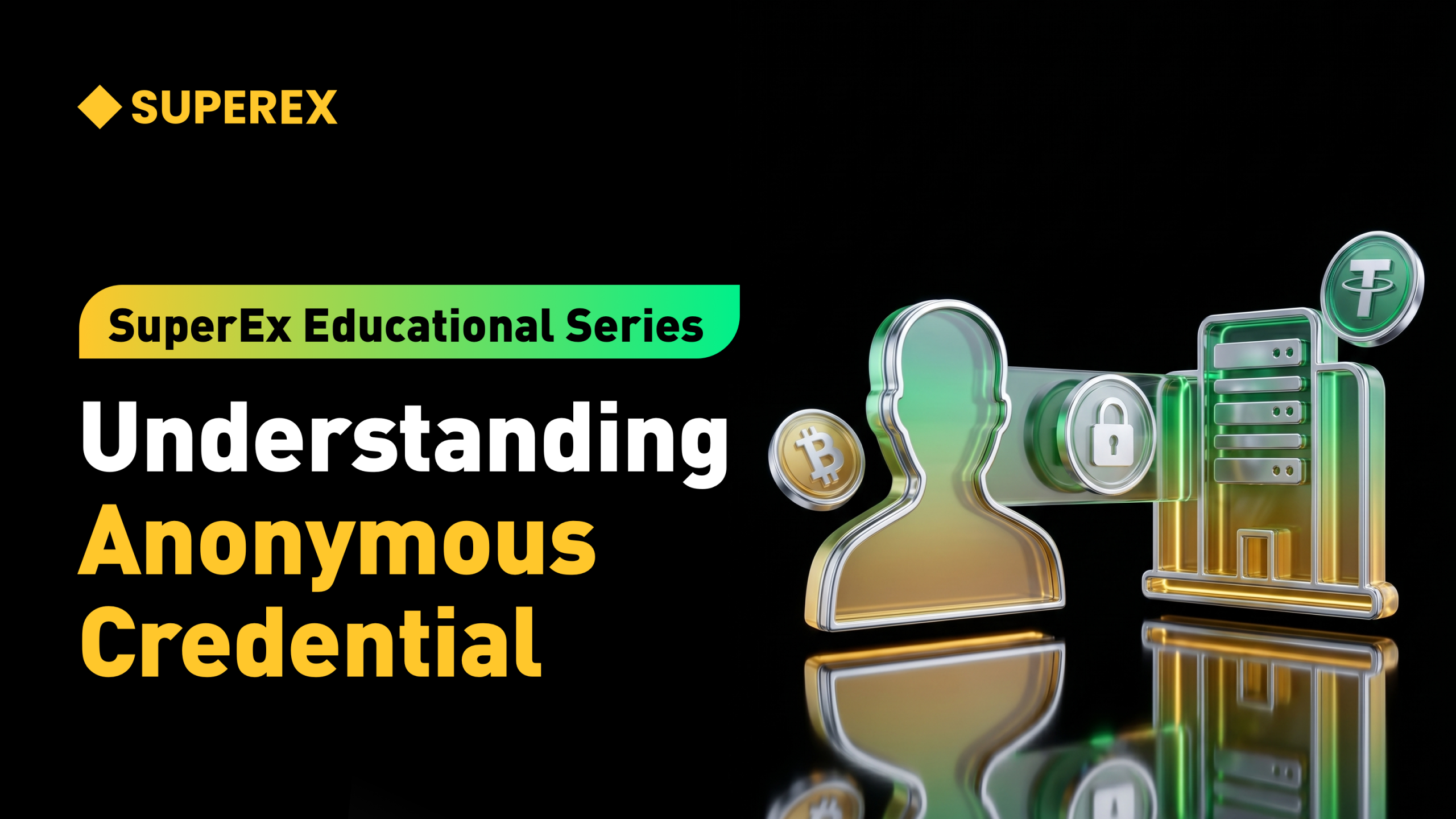
Anonymous credentials usually involve three roles: the Issuer, the Holder, and the Verifier.
- The Issuer is the credential issuer, such as a government agency, school, KYC provider, exchange, or DAO.
- The Holder is the user who holds the credential. The Verifier is the party that checks the proof, such as a DeFi protocol, exchange, event platform, voting system, or content community.
In the traditional process, the user gives full information to the verifier, and the verifier makes a judgment. With anonymous credentials, a trusted Issuer first checks the user’s eligibility and issues a credential. Later, when the user interacts with a Verifier, they do not reveal the full data. Instead, they generate a cryptographic proof showing that they hold a valid credential and satisfy a specific condition.
There are two key points here: first, the Verifier can check that the proof is valid; second, the Verifier does not necessarily learn the user’s real identity, and may not be able to link the user’s different presentations across platforms.
Why It Matters
In Web3, identity and privacy are often forced into opposition. Projects want to prevent Sybil attacks, support compliant access, manage regional risk, and build reputation systems. Users, meanwhile, do not want to hand over real identity, main wallets, asset records, and full behavior history.
Anonymous credentials offer a middle path: protocols can verify eligibility, while users can keep privacy.
This is important for Web3. Real mass adoption cannot rely only on complete transparency. If on-chain identity, financial activity, social relationships, and compliance records are all publicly linked, users become surrounded by data rather than empowered by it.
How It Differs from Normal Credentials
A normal credential is like an ID card full of information. Every time you show it, the other party may see your name, number, address, birthday, and issuer details.
An anonymous credential is more like a proof that answers only the question being asked. If someone asks whether you are an adult, you only answer “yes.” If someone asks whether you passed KYC, you only prove “passed.” If someone asks whether you can vote, you only prove “eligible.”
More importantly, a good anonymous credential system also aims for unlinkability. This means that when the same user presents credentials multiple times, verifiers should not easily know that those proofs came from the same person.
Technical Approaches
Anonymous credentials are not one single technology, but a family of cryptographic designs. Common techniques include blind signatures, CL signatures, BBS signatures, commitments, and zero-knowledge proofs.
The intuition behind blind signatures is that an Issuer can sign a credential without necessarily seeing all final signed details. The intuition behind zero-knowledge proofs is that a user can prove possession of a valid credential, or prove that an attribute satisfies a condition, without revealing the raw data.
BBS-style signature schemes are often used to support selective disclosure and unlinkable proofs. A user can generate different derived proofs from the original credential, reveal only necessary information each time, and reduce cross-context tracking risk.
A Simple Case
Suppose Alice wants to use a compliant DeFi product. The platform needs to confirm three things: she passed KYC, she is not from a restricted region, and she meets the age requirement.
The traditional approach might ask Alice to upload identity documents, proof of address, and full KYC records again. The platform can complete its review, but Alice’s sensitive data now has another copy somewhere.
With anonymous credentials, the KYC provider first verifies Alice and issues her an anonymous credential. When Alice uses the DeFi product, she submits a proof:
- “I hold a valid credential issued by a trusted provider.”
- “I meet the product’s access requirements.”
The platform can verify the proof, but does not need to know Alice’s name, ID number, or full address.
This is the core value of anonymous credentials: compliance verification and privacy protection no longer need to sacrifice each other.
Common Misunderstandings
The first misunderstanding is that anonymous credentials mean total anonymity.
Not necessarily. Anonymous credentials focus on minimal disclosure and reduced linkability. They do not always mean no accountability. Some systems include revocation, risk controls, or audit mechanisms under specific conditions.
The second misunderstanding is that anonymous credentials break compliance.
In fact, they can make compliance less dependent on centralized data storage. A platform can verify eligibility without storing large amounts of sensitive raw data.
The third misunderstanding is that using zero-knowledge proofs automatically makes everything safe.
The technology matters, but system design, wallet experience, revocation, metadata protection, and trust models matter too. Privacy is not a single feature; it is a full process.
Limitations
Anonymous credentials also have limitations. The first is revocation. If a user’s eligibility expires or is withdrawn, the system needs to revoke the credential without exposing the user’s identity, which is technically and practically difficult.
Second, metadata remains a risk. Even if the credential content is anonymous, timing, IP address, device fingerprint, wallet address, and transaction behavior can still link users.
Finally, there is an ecosystem barrier. Issuers, wallets, Verifiers, and protocols all need to support compatible standards. Otherwise, even a strong anonymous credential system can get stuck at the stage where nobody issues it, nobody verifies it, and users do not know how to use it.
Conclusion
The core value of Anonymous Credential is that users can prove eligibility without exposing full identity. It shifts identity from “who I am” to “what I can prove,” helping Web3 find a more practical balance between transparency and privacy.
For ordinary users, it means lower risk of data exposure. For protocols, it means better access control and compliance capability. For the Web3 ecosystem, it means identity systems can behave more like the real world: verifiable, authorized, and minimally disclosed, instead of exposing the whole person every time.