Tesla’s quarterly results far exceed the automotive industry framework. With every release, investors and analysts scrutinize a strategic indicator: the group’s bitcoin treasury. The second q
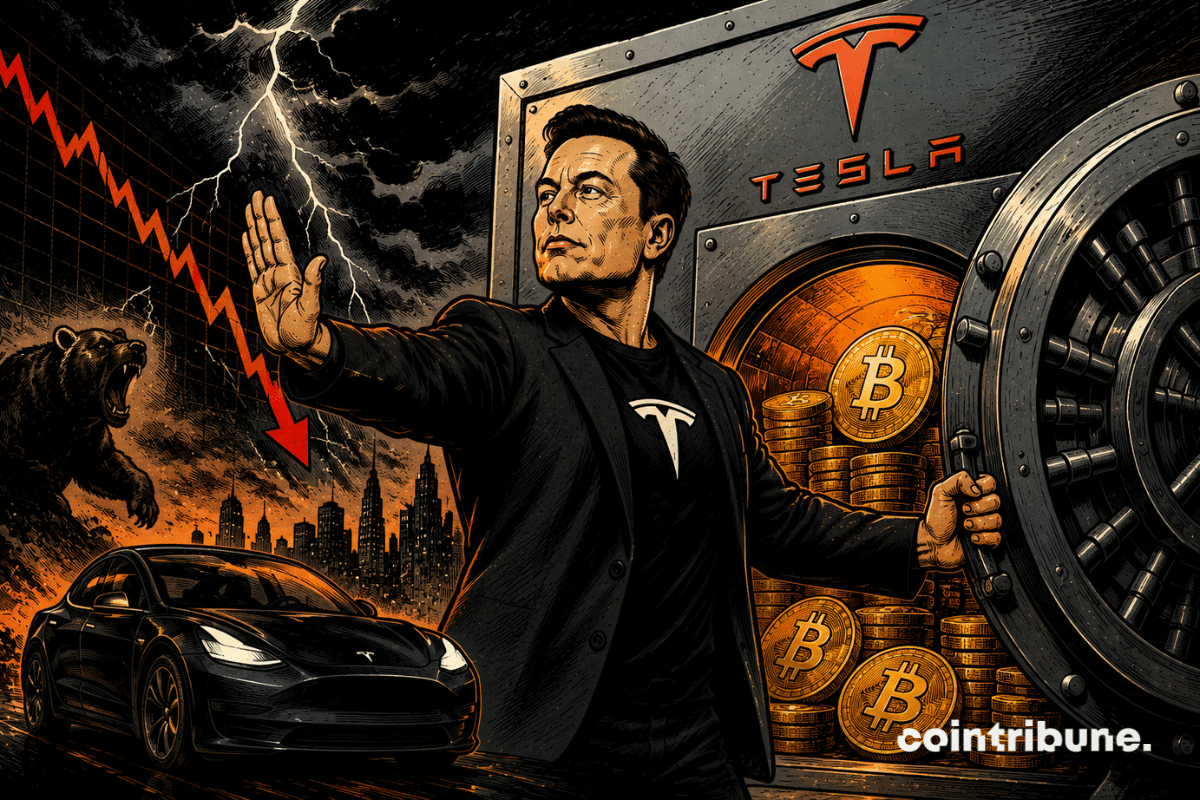
Tesla’s quarterly results far exceed the automotive industry framework. With every release, investors and analysts scrutinize a strategic indicator: the group’s bitcoin treasury. The second quarter accounts of the year confirm an assumed choice by Elon Musk: to keep all BTC holdings despite market volatility and its accounting effects. This status quo, far from trivial, sheds light on the growing role of bitcoin in the financial management of large companies and sends a signal closely followed by the entire crypto ecosystem.
In brief
- In the second quarter of 2026, Tesla keeps its reserve of 11,509 BTC intact, refusing to sell any fraction of its assets despite recent market volatility.
- Due to the temporary dip below $58,000 at the end of June, the group records a theoretical loss of value of $112 million, a purely technical depreciation that does not affect its actual treasury.
- Despite solid revenue of $28.2 billion, the manufacturer reports a negative free cash flow of -$1.1 billion but chooses this time to preserve its crypto treasury contrary to emergency arbitrages made in 2022.
- By absorbing this accounting charge without panic, Elon Musk’s firm confirms Bitcoin’s status as a long-term store of value for publicly traded giants.
An operational status quo in the face of accounting depreciation rules
The financial statements published by the Texas manufacturer for the second quarter of 2026 reveal perfect continuity in its portfolio management, marking nearly four years of transactional inactivity in the crypto market. The key data from the report are as follows :
- Strategic holdings maintained : 11,509 BTC kept on the balance sheet, with no purchases or sales during the quarter ;
- Recorded accounting charge : a post-tax impairment loss of $112 million on cryptos ;
- Bitcoin price variation : a 14% decrease over the period, falling from $83,000 in early April to $58,000 in late June, before rebounding to approximately $65,840.
This balance sheet entry is explained by accounting standards applicable to cryptos, which require publicly traded companies to recognize unrealized losses during market troughs within the reference period. It should be noted that this adjustment represents a purely accounting charge and does not cause any direct cash outflows.
The temporary drop of bitcoin below the $58,000 threshold in June set the mandatory depreciation level, without considering the subsequent price recovery. The passive holding strategy initiated after selling 75% of the initial position in 2022 remains unchanged, with the company maintaining exposure acquired during its founding $1.5 billion investment made in early 2021.
The overall financial statement and pressure on bitcoin treasury
Regarding its overall financial situation, Tesla’s second quarter paints a mixed picture where business performance shows signs of deviation from Wall Street forecasts. The company’s consolidated revenue reached $28.2 billion, exceeding average analyst expectations. Conversely, adjusted earnings per share stood at $0.33, below market estimates. Meanwhile, the manufacturer reported a negative free cash flow of $1.1 billion for the quarter, illustrating intensified industrial investments and pressures on automotive sector operating profitability.
In this context, the decision not to liquidate a fraction of the 11,509 BTC to generate immediate liquidity distinguishes current management from that observed during fiscal 2022. In previous years, financial management justified sales by the need to maximize cash positions amid operational uncertainties and plant closures. Thus, the current decision to absorb the $112 million charge without reducing the portfolio demonstrates that the crypto reserve is no longer treated as a simple short-term operational adjustment margin. Although Tesla’s exposure remains substantially lower than that of players dedicated to aggressive accumulation like Michael Saylor’s Strategy, the company retains a leading rank among publicly traded bitcoin holders.
Your 1st cryptos with BitMartThis link uses an affiliate program.The maturity of corporate reserves facing market cycles
The attitude observed at Tesla sends a remarkable maturity signal for all institutional investors and financial management teams in the sector. By accepting the accounting loss without panic, the group implicitly validates bitcoin’s role as a long-term strategic reserve capable of enduring the volatility inherent in market cycles.
This measured but firm approach consolidates crypto credibility within Standard & Poor’s 500 companies, demonstrating that a quarterly price decrease does not invalidate the company’s initial investment thesis.
Future developments will largely depend on the crypto market’s ability to maintain its positive momentum during the third quarter, which could neutralize the visual impact of this charge in upcoming reports. Over time, the stabilization of the Texas manufacturer’s operational results may encourage other industrial players to structure their treasuries according to hybrid models. Such a choice would sustainably strengthen the integration of cryptos into the traditional financial economy, transforming simple balance-sheet experiments into permanent pillars of corporate risk management.