Tether and sister exchange Bitfinex are the two unnamed crypto firms at the center of a US forfeiture case against Capstone Ltd, people familiar with the matter told the Financial Times. Fede
Tether and sister exchange Bitfinex are the two unnamed crypto firms at the center of a US forfeiture case against Capstone Ltd, people familiar with the matter told the Financial Times.
Federal prosecutors in California froze about $84.2 million in Capstone’s name, saying the payments group moved money without a license.
A Wells Fargo line sent out $337 million, the complaint says
The civil forfeiture complaint, filed July 15 in the Eastern District of California, names neither company. It only cites a crypto company, an affiliated exchange, and a bank in Dominica.
Prosecutors say Capstone’s Wells Fargo business account, not counting Treasury purchases, disbursed $337 million between March and December 2025.
The complaint alleges almost two-thirds of that money seems to have gone to hundreds of recipients, mostly outside the US, on behalf of the two crypto firms.
Court records show the seized property consists of five pieces. The biggest is $79.11 million in a Wells Fargo Securities account, followed by $2.06 million at JPMorgan Chase, $1.86 million at Wells Fargo Bank, and about 1.18 million USDT shared between two wallets.
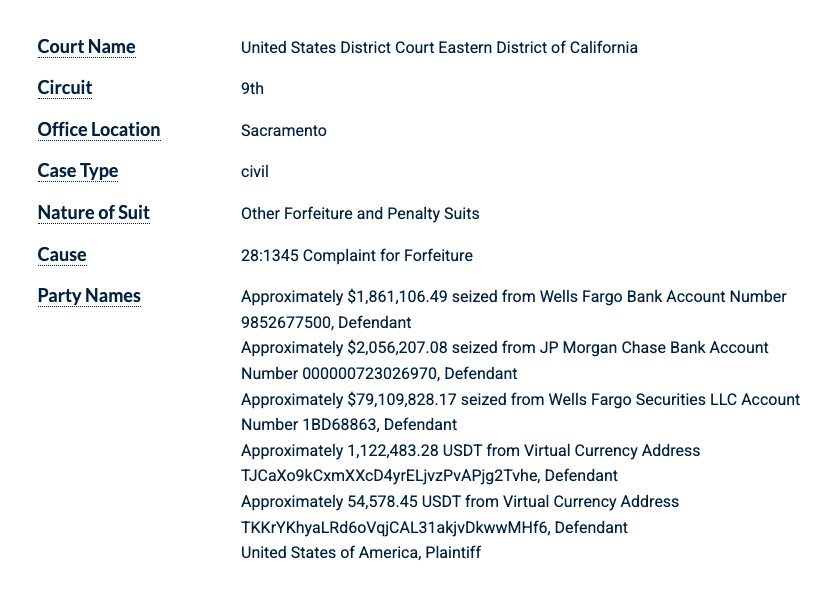
Property listed in US v. Approx. $79,109,828.17 seized from Wells Fargo, E.D. Cal. 2 26-cv-02476, via GovInfo.
Capstone presented itself to banks as an IT services company, prosecutors allege. It was incorporated in Montana, the only US state that doesn’t license money transmitters.
The complaint also connects Capstone to another scam where fraudsters posing as FBI agents pressed elderly victims for payments, which were converted to USDT within a day or so. The fraud strand involves one account with just over $2 million in it.
There’s nothing to suggest Tether, Bitfinex, or EQIBank knew about it.
Capstone, which denies any wrongdoing, plans to file a motion to dismiss, its lawyer said.
EQIBank says the seizure took 80% of its money
Tether and Bitfinex reached Capstone through EQIBank, a Dominica-licensed digital bank. Both said they are EQIBank clients, had no knowledge of the conduct alleged against Capstone, and retain limited assets there.
Tether put its exposure at “less than 0.034% of the assets of the group,” a spokesperson said.
The bank said it learned on April 2 that about 80% of its monetary assets, held through Capstone, had been frozen, according to a court motion filed June 29. Its officials spent about three hours on April 16 on a call with Justice Department lawyers, with no US counsel present.
EQIBank was then placed under enhanced supervision by Dominica’s financial regulator, which warned of further action, including potential liquidation, the motion said. On July 16, District Judge Dale A. Drozd turned down the bank’s attempt to recover the money.
Earlier this month, Cryptopolitan reported that two Thai businessmen filed a lawsuit against Tether for freezing 42.4 million USDT, allegedly at the verbal request of a US Homeland Security agent.
Don’t just read crypto news. Understand it. Subscribe to our newsletter. It's free.
