The failure of the CLARITY Act in the Senate on Tuesday leaves digital asset firms doing what they have done for most of a decade, which is building without knowing which regulator will event
The failure of the CLARITY Act in the Senate on Tuesday leaves digital asset firms doing what they have done for most of a decade, which is building without knowing which regulator will eventually knock.
Executives across trading infrastructure, tokenization and payments described the outcome as a setback rather than a reversal, and argued that the sharpest cost falls not on crypto-native companies but on the banks and institutions still waiting for a rulebook before they commit capital.
The Senate held a cloture vote at 2:15 p.m. ET on the Digital Asset Market Clarity Act, the procedural step needed to end debate and move to the bill itself. Sixty votes were required and the motion did not get there. Majority Leader John Thune had filed cloture on Aug. 8 to set up the vote, giving both sides five weeks to find the numbers.
The arithmetic was always tight. Republicans hold 53 seats, so passage needed at least seven Democrats or independents even with the full conference on board, and that was never assured. Senator John Cornyn was still weighing his vote days beforehand, and Senator Susan Collins was among those raising concerns for community banks.
The bill would have settled the question the industry has asked longest. The CFTC would have taken oversight of spot trading in tokens treated as digital commodities, while the SEC kept authority over tokens that remain investment contracts, alongside registration requirements, exchange and broker standards, treatment of decentralized finance and a set of ethics provisions.
Nothing is repealed by Tuesday's result, since the House passed its version in 2025 and that text stands. What the failure does is stall Senate consideration inside a window that is nearly shut. The House cancelled its voting weeks of 21 and 28 September and is expected to leave Washington after 17 September, leaving roughly four legislative days before attention turns to the midterms. Prediction markets had already cut the odds of the bill becoming law this year to around 18%, from about 90% in February.
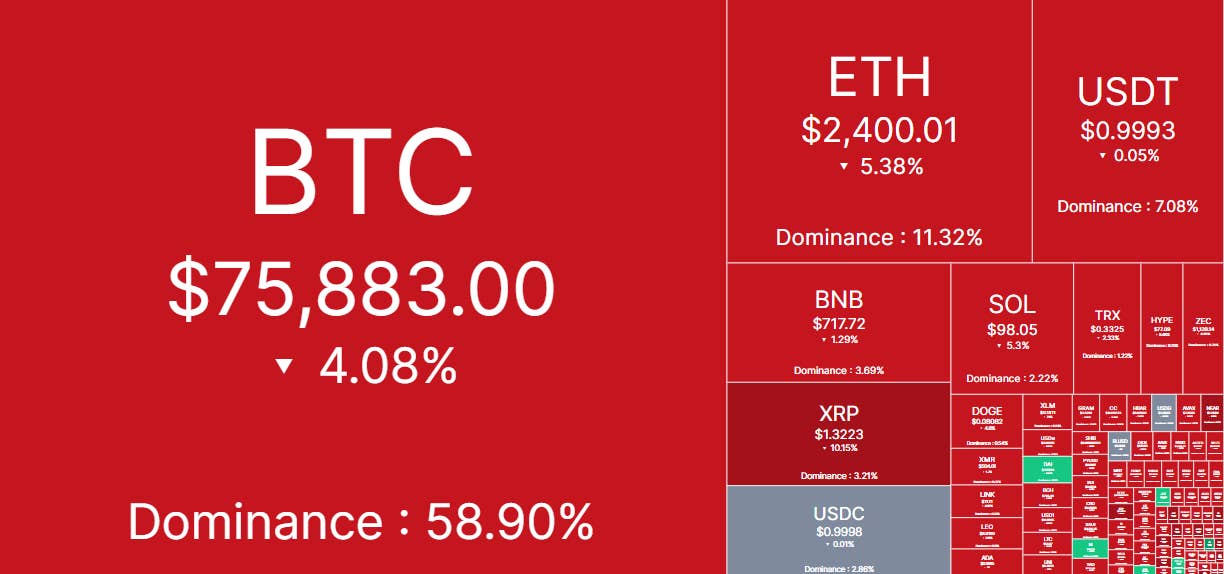
Markets took it badly. Bitcoin (BTC) touched almost $79,530 overnight before sliding to around $77,400, down roughly 3%, and drifted lower as the vote went against the bill.
A Setback, And Not A Fatal One
Industry reaction settled quickly on the same word.
Vladimir Tikhomirov, founder of Theorem and co-founder of Algebra, called the decision not to advance the bill a setback, particularly given how little time is left on the calendar. He stopped short of reading it as a verdict on the market, noting that prices remain far more sensitive to interest rates, dollar liquidity and macro conditions than to any single vote in Washington.
Bernardo Brites, co-founder and chief executive of Trace Finance, put it more bluntly. "The failure of the CLARITY Act is a huge setback for our industry, though not a fatal one," he said. "For years, crypto companies have operated in a legal gray zone, with regulators taking a rule by enforcement, knee-jerk approach that punished innovation instead of guiding it. Unfortunately, that era isn't over."
Also Read: Iran Sold Oil, Chinese Firms Took The Crypto, Now The DOJ Wants $61M
The bill would have delivered the one thing builders have consistently asked for, he argued, which is a clear line between the SEC's remit and the CFTC's. Without it, digital commodities remain without a defined home, stablecoin rules stay disconnected from the progress made under the GENIUS Act, and founders are left guessing whether raising capital or listing a token invites a lawsuit.
"For founders and builders, that means continuing to operate on hope instead of rules," he said. "It also means institutional volumes stay on the sidelines longer than they need to, and the bigger wave of incumbent participation the market is waiting for gets pushed further out."
The Gap Shows Up In Secondary Markets
Tikhomirov's concern runs to a corner of the market that rarely features in the political debate. Tokenized real-world assets, he said, are left without a template for what happens after issuance.
"There's still nothing that could be a regulatory blueprint for how these assets can be traded, how liquidity is formed around them, and how investors can actually exit their positions," he said.
He was clear that regulators have other routes, since the SEC, the CFTC and others can keep writing rules independently of Congress. The risk he flags is a patchwork instead of a framework, in which tokenization keeps advancing while the compliant secondary-market plumbing around it takes far longer to arrive.
The Case For Passing Something Imperfect
Eric Barbier, chief executive of Triple-A, made the argument that has trailed the bill through every round of amendments.
"While the debate about the pros and cons of the CLARITY Act will rumble on with its failure to pass today's vote, I'm still a firm believer that imperfect regulation is better than no regulation at all," he said.
His case rests on what a framework does to corporate risk committees rather than to token prices. "A regulatory framework, such as the CLARITY Act, can have a catalyzing effect of infusing large U.S. enterprises and institutions with genuine confidence to finally participate in the digital assets space with assurance, where before they likely actively avoided this market."
Barbier pointed to the stablecoin legislation already on the books as evidence. "We've seen a similar scenario play out regarding the passage of the GENIUS Act, as the creation of regulatory guardrails has spurred faster adoption of stablecoin payment options amongst large companies, as well as building consumer trust in this form of payment."
He framed the vote as a domestic problem rather than an industry one, noting that progress across the EU, the UK, the UAE and Singapore keeps building momentum toward regulatory harmonisation and, eventually, institutional adoption, whatever Congress does next.
Brites reached the same conclusion from another direction. Banks will adopt stablecoins and blockchain rails will underpin modern finance with or without a US statute, he said, but every delay is a missed chance for the country to cement a lead it currently holds by default.
Read Next: Google DeepMind Launches WeatherNext 3 For Wind And Solar Grid Operators