Introduction Every crypto cycle has one defining moment. A moment when fear reaches its peak, investors capitulate, and the majority becomes convinced that the market has one more major crash
Introduction
Every crypto cycle has one defining moment.
A moment when fear reaches its peak, investors capitulate, and the majority becomes convinced that the market has one more major crash ahead.
Ironically, history shows that these moments often mark the beginning—not the end—of a new bull market.
Following months of uncertainty, heavy liquidations, macroeconomic concerns, and widespread bearish sentiment, the cryptocurrency market is beginning to tell a different story.
Bitcoin is reclaiming key price levels.
Altcoins are showing renewed strength.
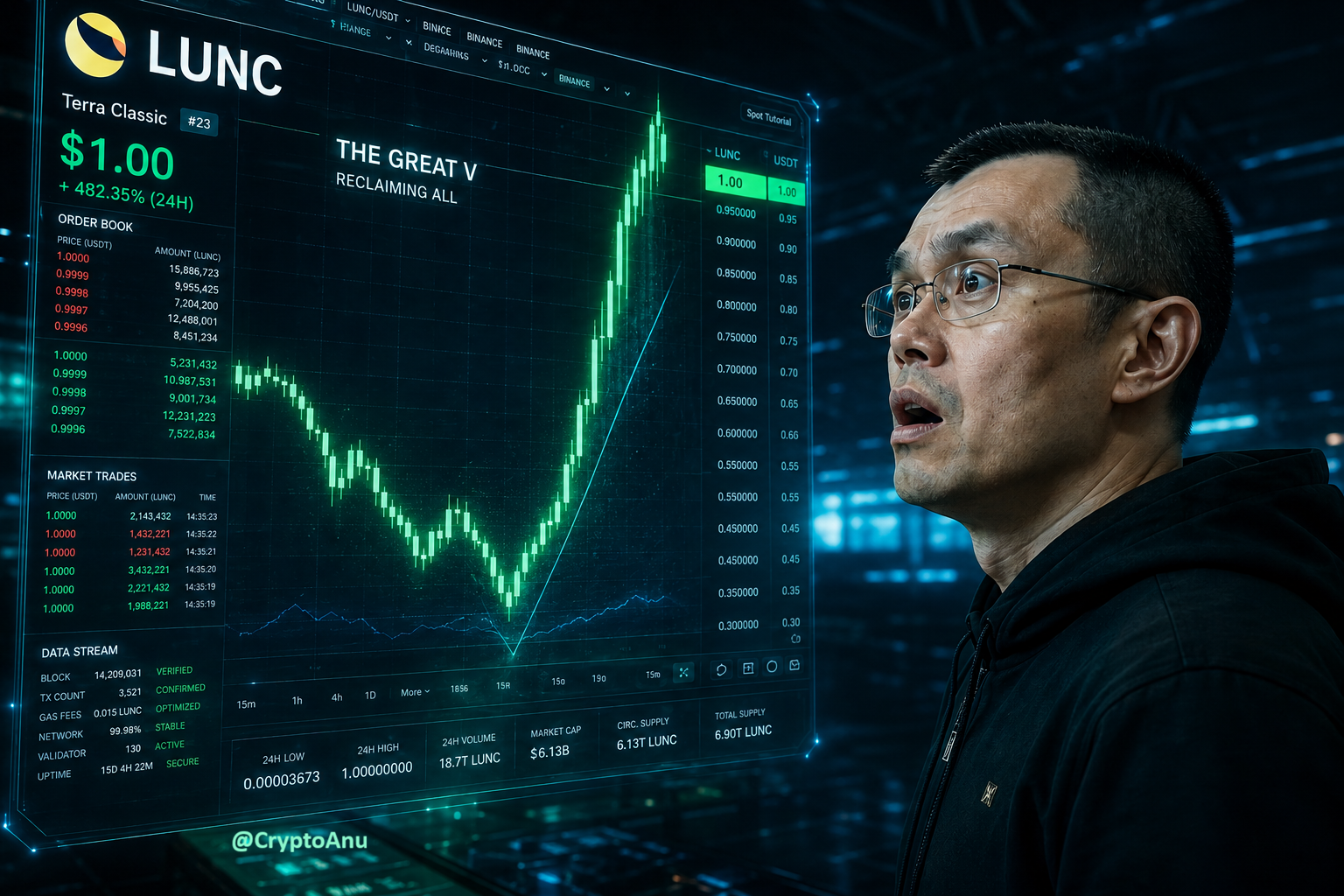
And Terra Luna Classic (LUNC) has emerged as one of the strongest-performing assets during the latest recovery.
While no one can predict the future with certainty, several important signals suggest that the recent correction may have largely run its course.
Bull Markets Always Begin With Disbelief
One of the greatest misconceptions among new investors is that bull markets begin when everyone becomes bullish.
History suggests the exact opposite.
Bull markets usually begin when:
- Fear is still widespread.
- News headlines remain negative.
- Analysts continue predicting lower prices.
- Retail investors hesitate to re-enter the market.
Markets move before public opinion changes.
By the time television headlines announce that a bull market has begun, much of the strongest appreciation has already occurred.
This psychological pattern has repeated itself across every major crypto cycle.
Bitcoin Is Leading Again
Bitcoin continues to serve as the foundation of the digital asset market.
Whenever Bitcoin establishes a strong upward trend, confidence gradually returns to the broader ecosystem.
Historically, the flow of capital follows a familiar sequence:
Bitcoin attracts new investment first.
Large-cap altcoins follow.
Finally, liquidity expands into higher-beta assets and community-driven ecosystems.
This capital rotation has been observed during multiple market cycles and remains one of the defining characteristics of crypto bull markets.
LUNC's Performance Is Turning Heads
Among the strongest performers during the recent recovery has been Terra Luna Classic.
Following years of consolidation and negative sentiment after the 2022 collapse, LUNC has recently outperformed much of the broader altcoin market.
This move is significant for several reasons.
First, strong relative performance often attracts new market attention.
Second, increased trading volume improves liquidity and strengthens market participation.
Third, renewed interest encourages discussion around the ecosystem's ongoing development, governance improvements, and burn initiatives.
While price alone does not determine long-term success, market leadership often begins with assets that outperform during the earliest stages of a new cycle.
Why Market Psychology Matters
Financial markets are ultimately driven by human behavior.
Fear and greed remain the two dominant emotions.
During corrections:
- Investors sell out of panic.
- Confidence disappears.
- Long-term opportunities are frequently overlooked.
During recoveries:
- Early buyers quietly accumulate.
- Confidence slowly rebuilds.
- Momentum begins attracting additional participants.
Eventually, widespread optimism replaces skepticism.
Ironically, that is often when markets become significantly more risky.
Understanding this cycle helps investors avoid making emotionally driven decisions.
Technical Structure Is Improving
Beyond sentiment, technical market structure has also begun to improve.
Several developments suggest strengthening momentum:
- Higher highs are beginning to form.
- Trading volume has increased.
- Buyers continue defending key support levels.
- Long-term consolidation structures are approaching breakout zones.
Although short-term pullbacks remain possible, these characteristics are consistent with markets transitioning from accumulation toward expansion.
Liquidity Is Returning
Bull markets require more than optimistic headlines.
They require liquidity.
Recent price action suggests that capital is gradually returning to digital assets.
As confidence improves:
- Trading activity increases.
- New participants enter the market.
- Existing investors become more willing to deploy capital.
Liquidity creates momentum.
Momentum creates narratives.
Narratives attract additional liquidity.
This feedback loop has historically fueled every major crypto bull market.
Why LUNC Could Benefit
Terra Luna Classic occupies a unique position within the cryptocurrency ecosystem.
Unlike newer projects, LUNC already possesses:
- One of crypto's most passionate communities.
- Active governance participation.
- Ongoing token burn mechanisms.
- Continuous ecosystem development.
Should broader market conditions continue improving, assets with established communities often receive renewed attention as investors search for higher-growth opportunities beyond Bitcoin.
While no outcome is guaranteed, improving market sentiment could create favorable conditions for continued ecosystem growth.
Risks Still Exist
Despite the improving outlook, investors should remain realistic.
Bull markets rarely move in straight lines.
Temporary corrections, profit-taking, macroeconomic uncertainty, and unexpected geopolitical events can all produce significant volatility.
Healthy markets experience both advances and pullbacks.
Long-term trends are determined by overall market structure rather than individual trading days.
The Bigger Picture
Perhaps the most important takeaway is this:
The correction may not be remembered as the end of the previous cycle.
It may instead be remembered as the foundation of the next one.
Every historic crypto bull market has emerged from periods of maximum uncertainty.
Every cycle has rewarded those willing to look beyond short-term fear.
Whether this proves to be the beginning of another major expansion remains to be seen.
But the combination of improving technical structure, returning liquidity, strengthening institutional participation, and renewed optimism suggests that the market may once again be entering a new chapter.