The Treehouse airdrop for Season 2 expires on November 25, 2026, at 07:00 UTC, which is 8 a.m. in Central Europe. Anyone who was eligible at the April 25 snapshot and has not yet collected th
The Treehouse airdrop for Season 2 expires on November 25, 2026, at 07:00 UTC, which is 8 a.m. in Central Europe. Anyone who was eligible at the April 25 snapshot and has not yet collected their TREE tokens can do so until then through the Gaia Foundation's claim portal. After that, all unclaimed allocations revert to the project's treasury. The good news for latecomers: vesting has been complete since October 26, so anyone claiming now receives the full allocation. The bad news for those who clicked once in the spring: there is only a single claim, and it ended their vesting on the spot.
The airdrop is a typical case of a DeFi reward that few retail investors have on their radar. It involves tokens on the Ethereum blockchain, a claim portal on a different domain, gas fees and the question of how tax authorities treat such income. This guide puts the deadline in context, works through the vesting maths and shows where you can trade TREE against the euro on an exchange licensed under MiCA. An overview of current campaigns is in our airdrop section.
Treehouse airdrop Season 2: deadline, amount and claim portal at a glance
According to Treehouse's announcement, a total of 23.1 million TREE was distributed for GoNuts Season 2 from the pool reserved for future airdrops. The key dates are collected on the key information page of the project documentation:
Event
Date
Time (UTC)
Season 2 snapshot
April 25, 2026
02:00
Claim opens, 20 percent unlocked
April 29, 2026
07:00
Linear vesting complete
October 26, 2026
07:00
Claim window closes
November 25, 2026
07:00
The claim runs through gaiafoundation.xyz, which also serves as the airdrop checker. There you select Season 2, connect the wallet you used for GoNuts and see your allocation along with the unlocked share. The contract uses a Merkle proof to check whether your address is on the list. A Merkle proof is a short cryptographic confirmation that an entry belongs to a large list, without the entire list having to sit on the blockchain. The interface generates it automatically; you do not have to calculate anything yourself.
For a sense of scale: on Saturday evening TREE traded at about $0.028, or €0.025, according to CoinGecko, with a market capitalisation of around $4.3 million. The entire Season 2 distribution is therefore worth roughly $0.6 million. For individual wallets the amounts are mostly small, but for governance participants and NFT holders they are meaningful.
What is Treehouse and what is the TREE token for?
Treehouse describes itself as a fixed-income layer for DeFi. The project issues so-called tAssets such as tETH, tokens that bundle staking yields on Ethereum and are also meant to earn from interest-rate differentials. Its second pillar is Decentralized Offered Rates, or DOR. This is a benchmark rate for crypto markets, similar to Euribor for banks: several participants, known as panelists, submit forecasts for the Ethereum staking rate, from which an average is derived.
TREE is the governance and utility token of this system. Holders vote on improvement proposals and can delegate their tokens to panelists. In return, Treehouse says it distributes 300,000 TREE a month to panelists and delegators, with the reward depending on how accurate the forecasts are. The token is a standard ERC-20 token on Ethereum mainnet with a total supply of one billion, of which around 156 million are in circulation according to CoinGecko. The project documentation also includes a white paper drawn up under the EU's MiCA regulation, which is mandatory for crypto assets offered to the public in the EU.
Who gets TREE from GoNuts Season 2? Snapshot, Nuts and minimum allocation
GoNuts is Treehouse's points programme. Users who held tAssets, provided liquidity to TREE pools on Uniswap, Balancer or Blackhole, took part in campaigns or completed weekly tasks collected "Nuts". Badges brought fixed bonus points, and depending on the level reached in the "Stages of the Tree" programme, the total was multiplied by a factor.
The threshold was 500 Nuts at the April 25 snapshot. Every eligible wallet receives at least 100 TREE; above that, the allocation rises in proportion to the user's contribution. Two additional pools are considerably larger:
- Governance: anyone who voted at least once via Snapshot on a Treehouse improvement proposal during Season 2 receives an extra 10,000 TREE.
- NFT holders: every Treehouse Squirrel Council (TSC) NFT held in the wallet at the snapshot brings another 10,000 TREE.
At the weekend's price, the minimum allocation of 100 TREE is worth about €2.50 and a governance bonus of 10,000 TREE about €250. Treehouse says it also applied a Sybil filter. This means weeding out groups of wallets that evidently belong to one person and only farmed points. Anyone who sees no allocation in the portal despite being active may have been caught by it.
Two restrictions from the documentation matter. Each wallet has its own allocation, and nothing can be combined. And the claim must come from exactly the eligible wallet, which is also where the TREE arrive. Anyone who ran their GoNuts activity through an exchange deposit address will generally not be able to reach the tokens, because they cannot sign a transaction there.
Vesting in the Treehouse airdrop: why the first claim is also the last
Vesting means that allocated tokens are unlocked step by step over a fixed period. In Season 2, 20 percent was available from April 29, and the remaining 80 percent was released linearly over 180 days, with no initial lock-up. The catch lies in one sentence of the announcement: every claim ends vesting immediately, and a second claim is not possible. Anyone who collects early forfeits the portion not yet unlocked.
The model rewards patience and punishes impatience for good. Anyone who took the first 20 percent in May to sell quickly gets nothing more. The remaining 80 percent flows back to the project. For those who have not clicked at all, by contrast, the situation is simple: since 07:00 UTC on October 26 the entire allocation has been unlocked. A claim now brings 100 percent; waiting until November 25 gains nothing except the risk of missing the deadline.
Season 2 should not be confused with the Vested Program from GoNuts Season 1. There, a so-called Treasury Bonus grew linearly for as long as the base allocation was left untouched, and according to Treehouse it could be collected until October 27, 2026. That deadline has passed; for November 25, only Season 2 counts.
Worked example: how much TREE does a claim bring after vesting ends?
The calculation follows the formula in the documentation: 20 percent immediately, plus 80 percent multiplied by the number of days elapsed divided by 180. For an example allocation of 10,000 TREE, that gives:
Date of claim
Days since start
Unlocked
Paid out
Forfeited
April 29, 2026
0
20%
2,000 TREE
8,000 TREE
July 28, 2026
90
60%
6,000 TREE
4,000 TREE
from October 26, 2026
180
100%
10,000 TREE
0 TREE
after November 25, 2026
over 210
window closed
0 TREE
10,000 TREE
At the current price of about €0.025, the 10,000 TREE would be worth around €250. Anyone who claimed at the end of July holds 6,000 TREE, about €150, and has given away 4,000 TREE. The documentation works through its own example: a wallet with a governance vote and two Squirrel NFTs comes to 39,580 TREE, 30,000 of them from the two bonus pools alone. The conversion rate from Nuts to TREE used in that example is expressly chosen for illustration only.
Phishing in the airdrop claim: Gaia portal, contract address and signature
The fact that the claim takes place not on treehouse.finance but on gaiafoundation.xyz is a classic opening for scammers. Anyone searching for the portal shortly before a deadline can easily land on a copycat site with a similar address. Open the portal only via the links in the official Treehouse documentation or blog, never via search-engine ads, direct messages or replies under posts on X.
Treehouse names three features that give a fake away:
- The team never contacts anyone by direct message to prompt a claim or to "verify" a wallet. Any such message is a scam.
- The claim is a normal transaction that calls the claim function of the distribution contract. A signature that transfers tokens or grants an unlimited approval is not part of it.
- The contract addresses are published: the airdrop contract is at 0x0bE45e75797155078417d1a0c32c8B8926403c87, the TREE token at 0x77146784315ba81904d654466968e3a7c196d1f3. If your wallet shows a different destination address before you sign, cancel.
How to spot an email's genuine sender domain is explained in our guide to phishing emails. If you take part in airdrops regularly, use a separate wallet without a meaningful balance. That way an approval granted by mistake does less damage.
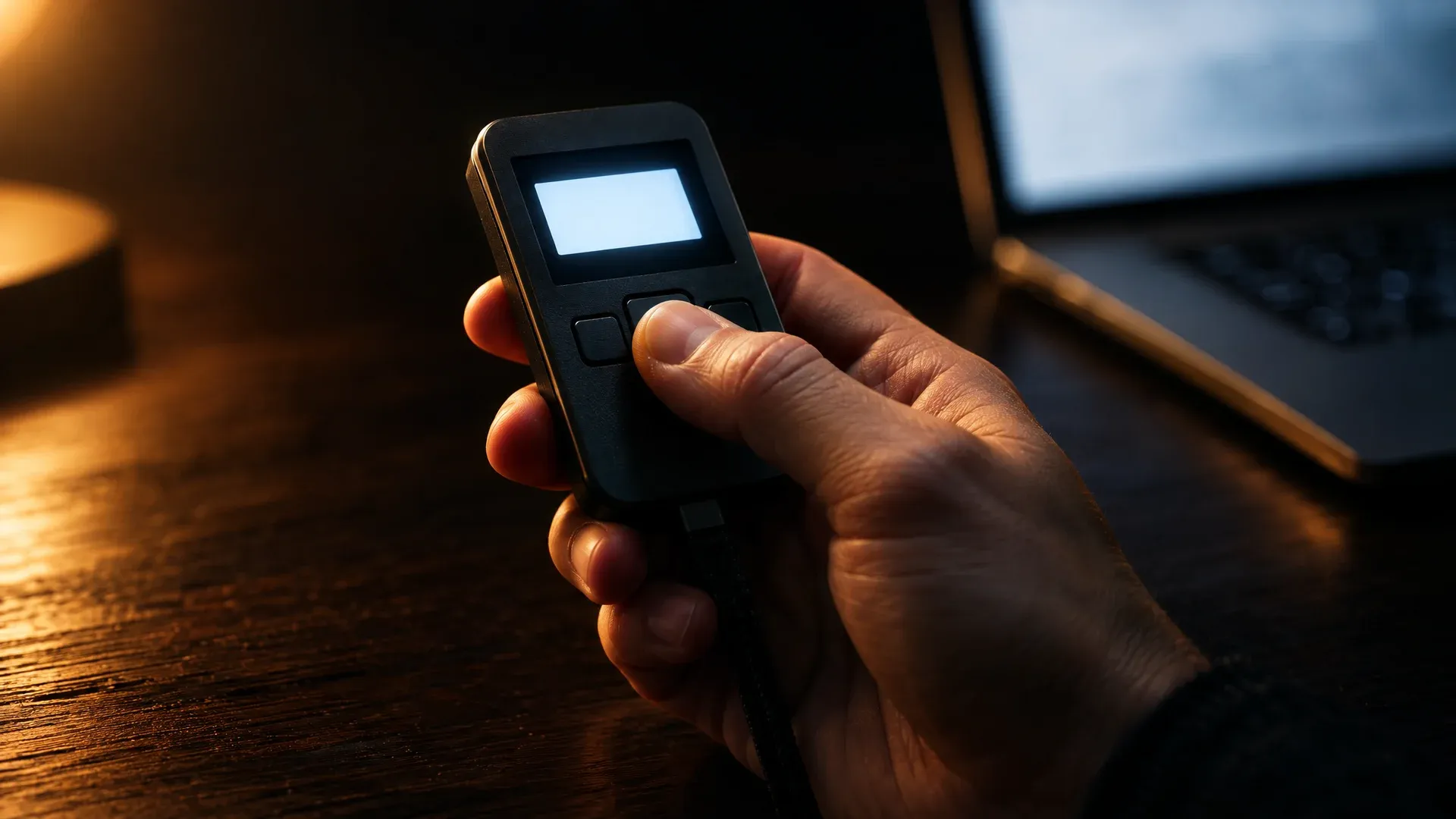
On a hardware wallet you can see, before confirming, which contract the claim really goes to.
Gas fees and wallet: claiming on Ethereum mainnet
The airdrop runs exclusively on Ethereum mainnet. You therefore need some ETH in the eligible wallet to pay the gas fee. Gas is the computation fee that every transaction on Ethereum costs, and it varies with network load. At the weekend the network was quiet, with the gas price at around 0.2 gwei. A claim then costs only cents. Under heavy load it can be many times more, and with 100 TREE worth €2.50 the claim may then not be worth it at all.
According to the documentation, any Ethereum wallet that can sign transactions will work. Hardware wallets such as Ledger and Trezor and multisig wallets from Safe are named explicitly. Claiming with a hardware wallet means confirming the transaction on the device, where you see the destination address; that is the best protection against a fake portal. An overview of devices is at the end of this guide. If you have not used the wallet for a long time, check beforehand that your recovery phrase is to hand; how to store it safely is covered in our piece on the seed phrase.
After the claim, the TREE are freely transferable. You can hold them in the wallet, delegate them to panelists or send them to an exchange to sell. Principles that apply to every airdrop deadline are summarised in our guide claiming an airdrop: entitlement and deadline.
Trading TREE in the EU: which MiCA-licensed exchanges list the token
If you do not want to hold your TREE, you need an exchange that lists the token. According to CoinGecko's trading pairs, TREE trades against the euro on Bitvavo and Kraken. Both providers hold a licence as crypto-asset service providers under MiCA, Bitvavo through the Dutch financial regulator AFM. That licence allows them to offer their services across the EU. Coinbase lists TREE against the US dollar. Whether the pair is enabled in your EU account is shown in the app.
TREE's largest volumes are on Asian exchanges such as Upbit and on Binance. Binance currently has no MiCA licence in the EU and has announced to customers in several EU countries that their accounts will be closed at the end of the year. For investors in the EU, a regulated platform is the obvious choice; which ones they are and what they cost is shown in our comparison of regulated crypto exchanges.
When depositing, make sure you choose the right network. TREE also trades on BNB Chain, but the airdrop arrives as an ERC-20 token on Ethereum. A deposit over the wrong network can be lost. With daily volume of just over $2 million across all exchanges, the market is also thin. Anyone selling larger amounts should use limit orders to avoid being filled below value.
Tax rules for airdrop income differ from country to country. Anyone who receives several airdrops, staking rewards and sales in a year quickly loses track; a tax tool that reads in wallet addresses and exchange accounts records the value of each inflow automatically, as our comparison of crypto tax tools shows.
TREE price and risk: about 98 percent below the record high
Anyone treating their allocation as an investment should know the price history. According to CoinGecko, TREE reached a record high of $1.36 on July 29, 2025, shortly after trading began. At the weekend the price was around $0.028, about 98 percent lower. In the past 24 hours alone the token lost just over 8 percent, in line with the broad decline in the crypto market. With a market value of about $4.3 million, TREE ranks 1,663rd on CoinGecko.
Then there is supply: of one billion TREE, only a small share is in circulation, and further unlocks from the team, investor and ecosystem pools will follow under the project's schedule. Small tokens with thin trading swing sharply, and a total loss is possible. Whether holding, delegating or selling makes sense depends solely on your own assessment of the project. We do not publish a price prediction for TREE.
Treehouse claim: until 07:00 UTC on November 25 there is time for the full allocation
Anyone who has not claimed yet now receives 100 percent of their Season 2 allocation. Anyone who has already claimed once can do nothing more. For everyone else, three steps before 07:00 UTC on November 25 are enough:
- Prepare the wallet: open the eligible wallet, have some ETH ready for gas and, if possible, confirm the claim on a device from our hardware wallet comparison. Open the portal only via the official documentation.
- Hold or sell: after the claim, decide whether to keep your TREE. For a sale in euros, a platform from our comparison of the best crypto exchanges with a MiCA licence and ERC-20 deposits is suitable.
- Record the inflow: note the date, amount and euro value at the time of the claim and log it in one of the crypto tax tools, so that your tax records are complete.
(As of November 15, 2026. This article is not investment advice. Prices and fee structures change; check the terms with the provider before you buy.)