Tether CEO Paolo Ardoino said on X on August 23 that several developing economies now rely heavily on USDT for domestic and foreign trade. Independent 2025 research backs that up in Venezuela
- Tether CEO Paolo Ardoino said on X on August 23 that several developing economies now rely heavily on USDT for domestic and foreign trade.
- Independent 2025 research backs that up in Venezuela and Argentina, where stablecoins already dominate crypto activity.
- The same research found Turkey’s 2025 crypto boom was driven by speculative altcoin trading rather than stablecoin use, with transactions under $1,000 shrinking 2.3 percent.
Tether CEO Paolo Ardoino wrote on X on August 23 that “several developing Countries’s economies are heavily relying on USDT, for both internal and foreign commerce” and called Tether’s “mission of financial inclusion” more important than ever. His post names no country. The pattern holds up in two of the places most commonly attached to it since, and the same kind of data he would be leaning on contradicts it in a third.
Coverage of the post since has attached four countries to it: Venezuela, Argentina, Bolivia and Turkey, though none of it links back to a version of Ardoino’s post that actually names them.
Where the Claim Checks Out
Argentina is the clearer case. Chainalysis’s 2025 Global Adoption Index ranks the country 20th worldwide, and its own regional research found stablecoins made up more than half of exchange purchases there between July 2022 and June 2025, against inflation the IMF projects at 30.4 percent for 2026. Tether has also put money directly into that market, leading a $14 million round in April for Belo, an Argentine crypto wallet with more than 3 million users.
Venezuela ranks higher, 18th globally, with $44.6 billion in crypto exchange volume over that same three-year stretch, per the same regional data. Its 2026 inflation rate, 387.4 percent by the IMF’s estimate, is more than twelve times Turkey’s or Argentina’s, which is closer to what “heavily relying” on a dollar substitute actually looks like in practice. That pace has kept accelerating: Venezuela’s Binance P2P USDT trading hit $1.39 billion in the month to mid-July alone.
Bolivia Is Still Just a Proposal
Bolivia: Boliviano vs. US Dollar
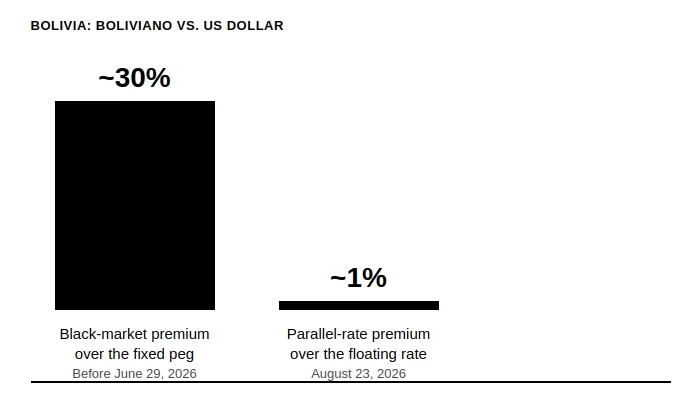
Bolivia is the weakest of the four. Economy Minister Jose Gabriel Espinoza said in July that the government is studying whether USDT could circulate alongside the boliviano, but Bolivia has not granted it legal-tender status or set a timeline for a decision. The pressure that made a dollar substitute attractive has already eased on its own: the government floated the boliviano on June 29, ending a 15-year peg at 6.96 per dollar and settling near 9.73, and the black-market premium that once ran as high as 30 percent has narrowed to roughly 1 percent since. Its crypto exchange volume over the same period measured, $14.8 billion, is the smallest of the four by a wide margin.
Turkey Is the Exception the Data Itself Flags
Turkey ranks highest of the three in that global index, 14th, and its overall crypto volume, nearly $200 billion in 2025, is the largest in the Middle East and North Africa. Turkey’s own inflation, near 28.6 percent by the IMF’s estimate, would seem to make it fertile ground for the same dollar-substitution pattern. But the regional report on it found the growth was built on speculation, not stablecoin use: altcoin trading volume more than tripled, from about $50 million to over $240 million by mid-2025, overtaking the stablecoin volume that had previously dominated Turkish trading. Retail transactions under $1,000, the size that would show ordinary people using USDT the way Ardoino described, actually contracted 2.3 percent over that period.
Ardoino’s tweet came about ten days after Tether completed its first outside audit, by KPMG, which reported a reserve cushion that had halved from the prior quarter. Tether says its user base passed 650 million this year, but a separate review of on-chain wallet data found 77.4 percent of USDT wallets hold less than $1,000, concentrated in Venezuela, Bolivia and parts of Africa. That pattern fits people turning to USDT because their own currency is failing, not because they chose it the way Ardoino’s “financial inclusion” framing suggests. Whether Turkey’s dip proves temporary, and whether Bolivia’s review produces an actual policy, will show up in the next round of country-level data before it shows up in another tweet.

 (@paoloardoino)