Two Thai businessmen have sued Tether in a New York federal court, alleging the world's largest stablecoin issuer froze wallets holding roughly 42.4 million USDT months before U.S. authoritie
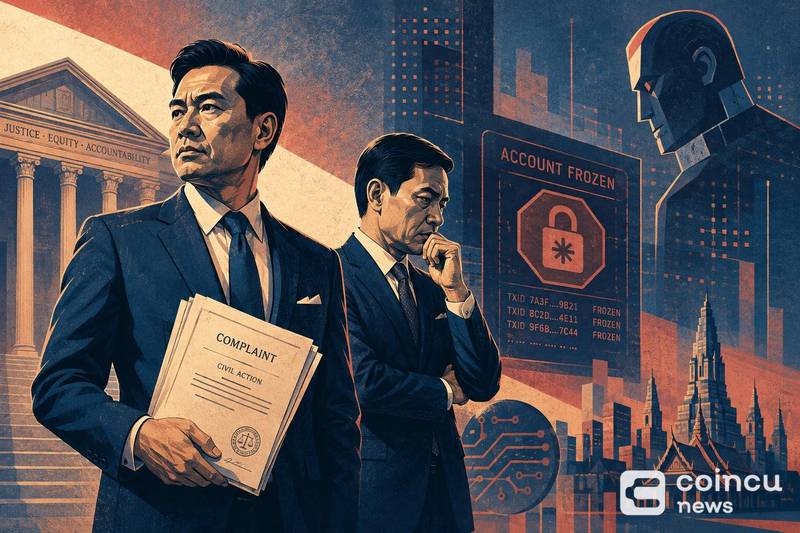
Two Thai businessmen have sued Tether in a New York federal court, alleging the world's largest stablecoin issuer froze wallets holding roughly 42.4 million USDT months before U.S. authorities obtained any seizure warrant, a case that puts issuer-level blacklist power at the center of an asset-forfeiture fight.
Two Thai businessmen sue Tether over a disputed wallet freeze
Nutthawat Rukthammachalern and Natthawat Kasamvilas filed a complaint on August 31, 2026 in the U.S. District Court for the Southern District of New York against four Tether entities, Tether Holdings, Tether International, Tether Operations, and Tether Investments, according to the filed complaint. For related coverage, see Tether Invests $20M in Argentine Digital Bank Uala.
The complaint alleges Tether froze the plaintiffs' Ethereum addresses on October 30, 2025, and says the balances across those addresses totaled 42,417,785.62 USDT at the time of the freeze. The plaintiffs frame the timing itself, not just the freeze, as the core grievance. For related coverage, see Why Is Zcash (ZEC) Price Surging Today? ETF Catalyst Explained.
Frozen balance alleged in complaint 42,417,785.62 USDT The complaint says the frozen balances across the plaintiffs' addresses totaled 42,417,785.62 USDT.
At USDT's $1.00 peg, the complaint values the disputed balance at $42,417,785.62, a figure the plaintiffs use to quantify their claimed loss of access. The suit echoes an earlier action in which a Thai businessman challenged Tether over the same $42.4 million freeze.
Dollar value at the $1 peg $42,417,785.62 At USDT's stated $1.00 peg, the complaint equates the disputed balance to $42.4 million.
These are allegations, not adjudicated facts. No court has ruled on the timeline, the ownership of the tokens, or whether the freeze was lawful, and the caveats below reflect that the underlying claims remain disputed.
Why the freeze-before-warrant timeline drives the case
The plaintiffs say the U.S. government obtained a seizure warrant on February 19, 2026 in Eastern District of North Carolina case 5:26-MJ-1267-JG, roughly 16 weeks after the alleged October 30, 2025 freeze, and that the warrant sought to burn the frozen USDT and reissue an equivalent amount to a government-controlled wallet, per the complaint.
That gap is the legal trigger. The plaintiffs contend Tether acted on an informal U.S. government request and froze the tokens before any warrant, court order, or legal process was directed to the company, according to the filed complaint, a sequence whose legality has not been adjudicated.
The plaintiffs also say they acquired the USDT through secondary-market business transactions and had no direct relationship with Tether, according to the complaint, though ownership and the underlying factual claims remain disputed. USDT's role as a dominant cross-border settlement asset makes the question of who can restrict self-custodied balances, and when, consequential well beyond these two holders.
A freeze is not a judgment. It restricts token movement while questions of title and forfeiture are litigated, which is precisely why the plaintiffs argue that access was cut off before due process attached, an argument that, if it advances, tests the boundary between compliance cooperation and premature seizure.
How Tether's blacklist power gets scrutinized in court
Tether, like other centralized issuers, can freeze USDT held in any address by blacklisting it at the contract level, a capability it has used repeatedly in coordination with law enforcement. In an April 23, 2026 post, the company said it works with more than 340 law enforcement agencies in 65 countries and had helped freeze over $4.4 billion in assets.
That enforcement posture is not new: Tether has frozen USDT tied to wallets linked to Iran's central bank and routinely acts on sanctions and criminal referrals. CEO Paolo Ardoino has framed the cooperation in blunt terms.
USD₮ is not a safe haven for illicit activity. — Paolo Ardoino, Tether
The contested point is not whether Tether can freeze tokens, but whether doing so on an informal request, ahead of formal process, exposes the issuer to liability. Tether called the lawsuit a baseless attempt to interfere with its work alongside global law enforcement, including the Department of Justice, in comments to CoinDesk.
The complaint also advances a specific New York jurisdiction theory, tying the case to the state through Cantor Fitzgerald's custody of Tether's Treasury reserves, and argues Tether continued earning reserve income on the frozen tokens, an unjust-enrichment framing that sharpens the standard blacklist-power question.
What the seizure that followed involved
On February 24, 2026, the U.S. Attorney's Office for the Eastern District of North Carolina announced the seizure of over $61 million worth of Tether tied to addresses that investigators alleged were associated with laundering proceeds from pig-butchering scams.
Federal investigators say the seized funds were connected to those scam proceeds, though the announcement cites no final court adjudication of that characterization. The relationship between that $61 million enforcement action and the plaintiffs' 42.4 million USDT is central to how a court will read intent and timing.
What the dispute means for USDT holders and issuers
USDT anchors a large share of crypto trading and settlement, with a market capitalization of about $183.4 billion as of September 3, 2026, and the token held its peg at $0.999999 through the filing. A single lawsuit does not change that scale or force any platform-level policy shift.
For traders and holders, the case sharpens a known counterparty reality: tokens in self-custody can still be immobilized by the issuer, and recovery may hinge on litigation rather than on private keys. That issuer risk is structural to centralized stablecoins, independent of how this specific suit resolves.
For policy watchers, the value of the case is in whether a court engages the freeze-before-warrant question directly, at a moment when stablecoin issuers are being pulled deeper into law-enforcement workflows. The broader tension mirrors debates seen across regulated venues, including Coinbase's push into U.S. single-stock perpetual contracts, where the perimeter of permissible issuer and platform action is still being drawn.
FAQ about the Tether lawsuit and the 42.4 million USDT freeze
Who are the Thai businessmen suing Tether? Nutthawat Rukthammachalern and Natthawat Kasamvilas, who filed the complaint on August 31, 2026 in the Southern District of New York against four Tether entities, per the court filing.
What does the "alleged early freeze" mean? The plaintiffs allege Tether froze their addresses on October 30, 2025, before the government obtained its February 19, 2026 seizure warrant, so they argue access was cut off ahead of any legal process served on Tether. The claim is unadjudicated.
Can Tether freeze USDT? Yes. As a centralized issuer, Tether can blacklist any address at the contract level, and it says it has helped freeze more than $4.4 billion in assets with law enforcement worldwide.
What are the next likely legal steps? Tether is expected to respond to the SDNY complaint, and the court will weigh the New York jurisdiction theory and the freeze-timing claims. Watch the docket for Tether's answer or a motion to dismiss, and for any consolidation with the related EDNC forfeiture proceeding.
Disclaimer: This article is for informational purposes only and does not constitute financial or investment advice. Cryptocurrency and digital asset markets carry significant risk. Always do your own research before making decisions.
The post Two Thai Businessmen Sue Tether Over Alleged Early Freeze was initially published on Coincu.