Key Takeaways PATH started trading at $16.24, down from its previous closing price of $18.22, and slid further to approximately $15.66 following the earnings release Second-quarter revenue re
Key Takeaways
- PATH started trading at $16.24, down from its previous closing price of $18.22, and slid further to approximately $15.66 following the earnings release
- Second-quarter revenue reached $410.3 million, representing a 13.3% year-over-year increase and surpassing the Street estimate of $397.8 million
- Billings came in slightly below expectations at $375.5 million, with growth rates trailing behind other AI-focused software companies
- The company increased its fiscal 2027 revenue projection to $1.789-$1.794 billion
- Wall Street consensus stands at “Hold” with an average price target of $15.73; CEO Daniel Dines recently offloaded more than $22 million worth of shares
Shares of UiPath (PATH) tumbled more than 16% on September 4 following the release of second-quarter fiscal 2027 results that, while beating revenue projections, fell short of investor expectations for a company positioned in the AI automation space.
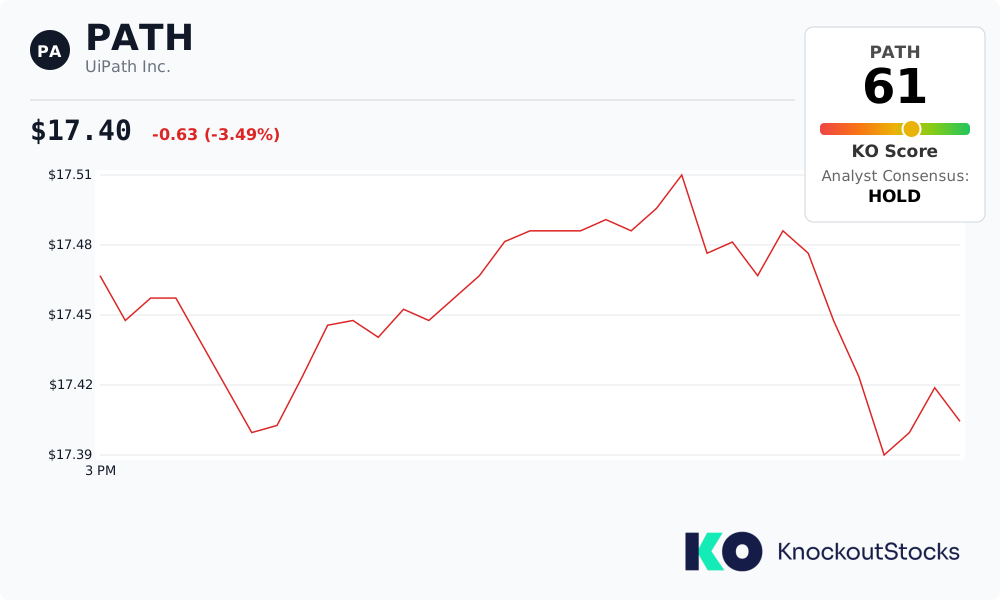 UiPath Inc., PATH
Trading commenced at $16.24, marking a significant decline from the previous session’s close of $18.22, with shares eventually settling around $15.12. This pricing positions PATH approximately 21.6% beneath its 52-week peak of $19.29, which was recorded in December 2025.
The company delivered quarterly revenue of $410.3 million, marking a 13.3% year-over-year expansion and exceeding analyst projections of $397.8 million. Non-GAAP earnings per share of $0.15 aligned with consensus forecasts.
However, billings figures disappointed at $375.5 million, falling marginally short of expectations. Company leadership attributed this to extended sales cycles as corporate clients evaluate traditional automation platforms against emerging AI-powered alternatives.
CEO Daniel Dines emphasized that 18 of the company’s 20 largest transactions this quarter incorporated AI components, positioning UiPath as a participant in—rather than a casualty of—the enterprise AI revolution. Nevertheless, market participants remained unconvinced.
Expansion Rate Trails AI-Era Benchmarks
Annual recurring revenue expanded 12% to reach $1.938 billion, while UiPath delivered its fourth consecutive quarter of GAAP profitability. The automation software provider also elevated its full-year revenue forecast to $1.789-$1.794 billion and projected approximately $445 million in non-GAAP operating income.
Third-quarter guidance calling for $440 million to $445 million in revenue slightly exceeded consensus estimates, yet investors had anticipated more substantial projections following the stock’s approximately 9% advance just over a week prior.
The fundamental issue is clear: growth in the 12-13% range appears underwhelming when compared to faster-expanding AI software competitors, and uncertainty persists regarding whether artificial intelligence will ultimately erode demand for conventional automation platforms.
Newly appointed CFO Hitesh Ramani addressed these concerns, stating that UiPath is adopting a “prudent approach” to guidance in light of macroeconomic uncertainty and evolving customer adoption dynamics.
Wall Street Maintains Cautious Stance
Analyst responses were restrained. BMO Capital Markets increased its price objective from $13 to $18 while maintaining a Market Perform designation. Wells Fargo adjusted its target from $13 to $15 with an Equal Weight rating. Royal Bank of Canada shifted from $15 to $17 while retaining Sector Perform. DA Davidson lifted its target from $12 to $16 at Neutral, and TD Cowen moved from $13 to $16 with a Hold rating.
Among 19 analysts tracking the stock, 16 assign it a Hold rating, two recommend Buy, and one advises Sell. The average price target stands at $15.73.
Contributing to the cautious sentiment, CEO Daniel Dines divested 1.4 million shares on August 19 at an average price of $16.07, a sale valued at over $22.5 million. He retains ownership of more than 26 million shares.
Institutional stakeholders including State Street, Morgan Stanley, and AQR Capital have all expanded their holdings in recent quarters. Institutional ownership now comprises 62.5% of outstanding shares.
PATH has declined 4.8% year to date, and investors who purchased $1,000 of the stock five years ago would currently hold approximately $242.
The post UiPath (PATH) Stock Plunges 16%: Should Investors Buy the Dip After Q2 Earnings? appeared first on Blockonomi.