The United Nations Development Programme (UNDP) is moving from blockchain pilots to a wider rollout of blockchain-based payments after signing a new agreement with the Stellar Development Fou
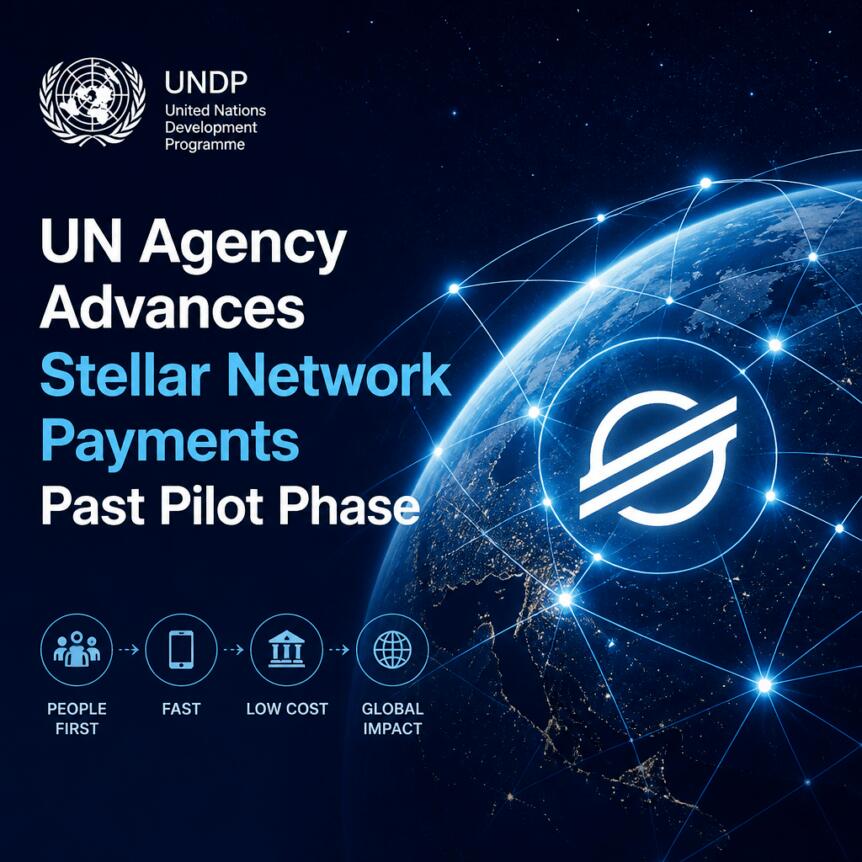
The United Nations Development Programme (UNDP) is moving from blockchain pilots to a wider rollout of blockchain-based payments after signing a new agreement with the Stellar Development Foundation. The initiative builds on 16 months of testing in multiple countries and aims to define how UNDP country offices can use blockchain payments across a broader set of development and humanitarian programs.
According to UNDP, the new phase will focus on creating a repeatable process that offices can apply, following pilot projects in Haiti, Syria, Kenya, Guatemala and The Gambia, with additional work reported in Colombia and Papua New Guinea. UNDP said the pilots generated measurable outcomes that helped justify the next step.
Key takeaways
- UNDP has signed an agreement with the Stellar Development Foundation to expand blockchain-based payment usage across programs beyond initial pilots.
- Pilot results cited by UNDP include lower distribution costs in Syria and continued payments during a cellular network outage in Haiti.
- The next phase is intended to standardize how UNDP country offices adopt blockchain payments across a wider range of activities.
- The move reflects a broader push to modernize cross-border and aid-related payments in regions with limited access to traditional banking.
From pilot projects to a scaled deployment
UNDP’s agreement with the Stellar Development Foundation follows research and pilot deployments conducted over 16 months. UNDP said it is now preparing a framework that country offices can use to deploy blockchain payments more systematically, rather than treating the technology as a one-off trial.
UNDP’s announcement points to the operational lessons it claims to have learned during implementation. In Syria, the agency cited a Cash for Work program where payments recorded onchain reportedly reduced distribution costs from 10% to 2%. Separately, a pilot in Haiti continued processing payments during a cellular network outage, an issue that often disrupts delivery in areas where connectivity is unreliable.
For investors, builders, and aid technologists, this matters because it signals how a major public-sector organization is thinking about blockchain not just as a theoretical tool, but as payment infrastructure that must work under real-world constraints—cost pressure, network interruptions, and uneven access to financial rails.
Why blockchain payments are gaining attention
Blockchain payment networks—particularly those designed to handle stable-value digital assets—have increasingly been promoted as a way to improve cross-border transfers and remittances. The core appeal in emerging markets is straightforward: stablecoins and blockchain rails can potentially reduce friction and access barriers where traditional banking is limited.
UNDP’s decision to expand use of blockchain-based payments adds another data point to a trend already visible in the private sector, where stablecoin infrastructure is being pushed to serve remittance corridors and underbanked populations. It also distinguishes this development from many early “experiments,” since UNDP is explicitly describing a move toward broader integration into ongoing program operations.
UNDP’s roadmap further links payments to a wider set of potential public-good applications of distributed ledger technology, indicating that the agency is not limiting its view to transfers alone.
Connection to UNDP’s broader blockchain strategy
The expanded payments agreement comes after UNDP launched a Blockchain Advisory Group earlier this year. In a move designed to guide the agency’s use of blockchain across development programming, UNDP said the group was unveiled at the Proof of Talk conference in Paris, France.
UNDP indicated that, beyond digital payments, the advisory group will examine how blockchain could support digital public infrastructure and help improve public-sector systems. That matters because it suggests a longer-term internal strategy: payments are one tangible starting point, but the agency appears to be assessing broader use cases where auditability, verifiability, and system resilience may be valuable.
Stablecoins, remittances, and the push for digital access
UNDP’s emphasis on blockchain-based payments aligns with a wider market narrative: remittances remain a major source of household income in many regions, and stablecoin-based systems are increasingly positioned as a way to make those transfers faster and more accessible. In that context, broader corporate activity around stablecoins is becoming more frequent.
Earlier coverage noted that Ripple acquired an equity stake in African fintech Flutterwave as part of efforts to expand the use of its RLUSD stablecoin and the XRPLedger across Africa. Separately, Latin America has also drawn attention from stablecoin-linked initiatives aimed at payment corridors across countries including Argentina, Bolivia, Colombia and Venezuela.
These developments are occurring alongside remarks from public-policy leaders. In January, former UN under-secretary-general Vera Songwe told the World Economic Forum annual meeting that stablecoins are becoming “more important than aid” in some developing economies by offering a route to digital financial services where traditional banking remains out of reach. Songwe also said that, with a smartphone, people may gain access to stablecoins—framing them as potentially reducing exposure to inflation volatility in environments where that risk affects daily finances.
While UNDP’s announcement does not resolve debates about stablecoins’ regulatory status, long-term viability, or country-specific risks, it does underline that public institutions are actively exploring how blockchain rails can complement or replace parts of legacy payment workflows—especially for cash distribution and time-sensitive transfers.
Readers should watch how UNDP’s “process” for country offices is implemented in practice—whether blockchain payments become a standard operational option across more programs, and how the approach performs under local infrastructure constraints such as connectivity, verification requirements, and partner onboarding.
This article was originally published as UN Agency Advances Stellar Network Payments Past Pilot Phase on Crypto Breaking News – your trusted source for crypto news, Bitcoin news, and blockchain updates.