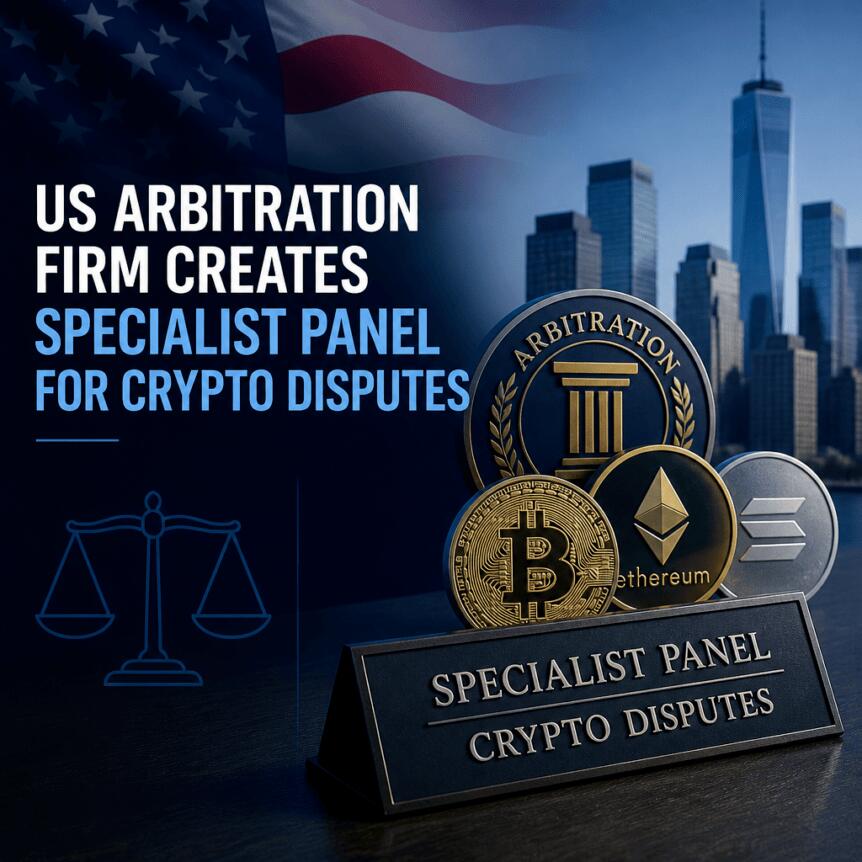
The American Arbitration Association (AAA), one of the largest providers of private dispute resolution services worldwide, has introduced a specialist panel tailored to blockchain and digital
The American Arbitration Association (AAA), one of the largest providers of private dispute resolution services worldwide, has introduced a specialist panel tailored to blockchain and digital-asset disputes. The initiative is aimed at helping companies resolve disagreements that increasingly arise from automated and decentralized commercial systems, where both legal interpretation and technical detail matter.
In a statement released on Wednesday, the AAA said its new Web3 Panel brings together arbitrators with backgrounds spanning law, technology, academia, litigation, and digital-asset businesses. The move reflects growing demand for dispute resolution frameworks that can handle the intricacies of smart contracts, on-chain records, and cross-border enforcement.
Key takeaways
- The AAA has launched a dedicated Web3 Panel for blockchain and digital-asset arbitration cases.
- The panel targets disputes linked to automated and decentralized commercial arrangements, including contract interpretation and governance disagreements.
- Arbitrators are drawn from a mix of legal, technical, academic, and industry backgrounds to address complex crypto-specific issues.
- The AAA panel is not a regulator: arbitration still depends on the parties agreeing to submit their dispute privately.
Why a specialist arbitration panel is gaining attention
As blockchain-based systems move from experimental use toward everyday commercial activity, the types of disputes companies face have also changed. The AAA describes the panel as designed for disagreements that emerge when agreements are executed through automated or decentralized processes rather than conventional workflows.
Those disputes can involve interpretation of contractual terms, how governance mechanisms should be applied, and questions around asset control. They may also touch cybersecurity incidents, the reliability or meaning of transaction records, and enforcement challenges when parties and assets are located across different jurisdictions.
For investors and operators, the practical importance is straightforward: when the legal stakes include technical behavior that is difficult for a typical court process to interpret quickly, specialized arbitration can reduce friction. It can also help standardize expectations around how evidence—such as on-chain logs—should be understood and applied to the facts of a commercial disagreement.
What kinds of disputes the AAA says the panel will handle
The AAA’s Web3 Panel is positioned to cover a wide range of issues that appear in modern crypto-adjacent contracting and operations. According to the AAA, the scope includes disputes connected to:
- Contract interpretation in highly automated environments, where “what the code does” can be central to the dispute.
- Governance and control questions, including disagreements about how decentralized mechanisms should function.
- Cybersecurity and incident-related failures, which may require both legal assessment and technical understanding.
- Transaction records, where parties may dispute what is recorded on-chain and how that record should be treated.
- Cross-border enforcement, where outcomes may depend on how arbitral awards are recognized and enforced in different countries.
The AAA also highlights a category of emerging commercial behavior it calls “agentic commerce,” where software or artificial intelligence systems may initiate or execute agreements with limited human involvement. As such systems gain capability, the legal questions often shift from standard performance disputes to issues like authorization, responsibility, and how obligations were formed when execution happens with minimal direct human participation.
This focus matters because it signals arbitration providers are preparing for a legal environment where counterparties may be dealing less with traditional “human-to-human” contracting and more with systems acting as participants—raising new questions for risk, documentation, and accountability.
Panel composition and the “technical plus legal” pitch
In outlining the rationale for the panel, the AAA pointed to the unusual combination of legal and technical factors in Web3 disputes. Eric Dill, the AAA’s senior vice president and head of panel relations, said: “Web3 disputes involve familiar commercial questions in a highly technical environment.”
The initial membership includes lawyers specializing in digital-asset and technology disputes, University of Pennsylvania law professor David Hoffman, and Rich Widmann, Google Cloud’s global head of Web3 strategy. The AAA said the panel brings together arbitrators with experience across multiple relevant domains, including academia and litigation, rather than limiting expertise to strictly legal or purely technical backgrounds.
For companies considering arbitration clauses in their contracts, this kind of mixed expertise can be a differentiator. Arbitration outcomes often hinge on how accurately decision-makers can interpret technical evidence and translate it into enforceable legal findings. A panel intended to include that dual competency may be attractive for parties that want more than generic commercial arbitration—especially in disputes where blockchain mechanics and smart-contract behavior are central to the timeline and the facts.
No regulatory power—arbitration still requires party consent
Despite the mainstream profile of the AAA and the breadth of the panel’s scope, the organization’s Web3 Panel does not change the regulatory landscape for crypto. The AAA panel does not grant it authority over the crypto industry, and arbitration generally operates only if both parties agree to submit their dispute to a private arbitrator.
This distinction is important for anyone evaluating the significance of the announcement. The AAA is building procedural and expertise infrastructure, not a new regulator. The practical takeaway is that organizations planning for disputes may increasingly look to arbitration frameworks that anticipate Web3-specific complexities—by adding arbitration clauses that reference appropriate panel structures, or by selecting arbitrators with relevant experience once a dispute arises.
Earlier coverage from Cointelegraph has explored how agentic commerce is pushing the need for a “legal layer” around autonomous transactions, and the AAA’s emphasis on agentic commerce aligns with that broader trend: as automation becomes more capable, dispute-resolution processes may need to evolve in parallel.
What to watch next
With the AAA’s Web3 Panel now live, the key question is how quickly companies incorporate specialist arbitration into real-world contracts—and how frequently parties select this panel for disputes. Observers should also watch whether the panel’s early cases, once they emerge through arbitration processes, reflect the types of conflicts the AAA highlighted: governance, cybersecurity, on-chain records, and authorization in agentic systems.
This article was originally published as US Arbitration Firm Creates Specialist Panel for Crypto Disputes on Crypto Breaking News – your trusted source for crypto news, Bitcoin news, and blockchain updates.