A U.S. Senate investigation has reportedly identified Tether's USDT as a potential liquidity channel for Iranian shadow banking networks, according to unconfirmed reports, raising the prospec
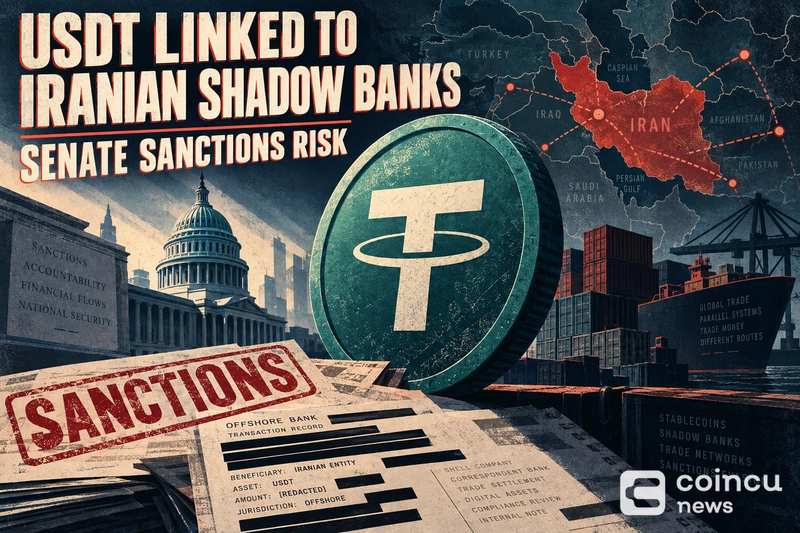
A U.S. Senate investigation has reportedly identified Tether's USDT as a potential liquidity channel for Iranian shadow banking networks, according to unconfirmed reports, raising the prospect of heightened sanctions scrutiny for virtual asset service providers operating across Gulf markets.
The allegation, which has not been accompanied by a published Senate committee report or official press release as of October 7, 2026, centers on USDT's utility as a dollar-pegged settlement instrument that can move across blockchain networks without the correspondent banking controls that typically flag Iran-linked counterparties. Because the claim originates from a single reported source and has not been independently corroborated by primary documentation, compliance officers should treat the specific findings as unverified until the relevant Senate committee publishes its record. For related coverage, see Abstract to Shut Down Dec. 15, 2026: Users Urged to Move Assets.
Why a Dollar-Pegged Stablecoin Can Become a Sanctions-Evasion Layer
USDT functions as the dominant stablecoin by circulating supply, with its distribution across multiple blockchains tracked publicly via DeFiLlama's stablecoin dashboard. Its settlement finality is near-instant and its liquidity is deep enough to absorb large OTC conversions, properties that make it attractive for any party seeking to move dollar-equivalent value across jurisdictions without engaging a licensed fiat on-ramp. For related coverage, see Kalshi's 15-Minute Gold Market Tops Ethereum in Contracts.
The Senate investigation's framing, per unconfirmed reports, is not that all USDT activity is illicit but that the stablecoin's structure can serve as an intermediary layer between sanctioned entities and dollar liquidity when on-ramp and off-ramp counterparties fail to screen wallet addresses against OFAC designation lists. Blockchain transactions are pseudonymous, not anonymous: wallet addresses and token flows are publicly visible on-chain, but effective sanctions enforcement requires that exchanges and VASPs map those addresses to real-world identities before settlement. For related coverage, see Ethereum Spot ETFs See $202M Outflows in Six-Day Streak.
Where that KYC step is absent or inadequately implemented, a sanctioned counterparty can convert local currency into USDT through an unscreened intermediary and subsequently off-ramp through a second VASP in a different jurisdiction, a pattern regulators have flagged in prior enforcement actions unrelated to Iran.
Gulf VASPs Face the Sharpest Secondary-Sanctions Exposure
Virtual asset service providers licensed in the UAE, Bahrain, and Saudi Arabia operate under frameworks that overlap with U.S. secondary-sanctions reach: any VASP that processes a transaction ultimately traceable to a designated Iranian entity risks losing access to dollar clearing and correspondent banking, even if the VASP itself is not a U.S. person. The CFTC's recent emphasis on federally regulated crypto platforms as the preferred venue for leveraged trading signals a broader U.S. regulatory posture in which offshore platforms are expected to match U.S.-equivalent compliance standards or face market-access consequences.
Practical exposure for Gulf VASPs spans four categories: direct OFAC designation risk if the VASP knowingly facilitates a sanctioned transaction; correspondent banking termination if a U.S. dollar-clearing bank determines the VASP's controls are insufficient; licensing risk in home jurisdictions that have MoUs with U.S. regulators; and reputational risk that depresses institutional counterparty relationships. Any VASP settling significant USDT volumes without real-time wallet screening against the SDN list is exposed on at least the first two dimensions.
What Compliance Teams Should Watch as the Investigation Develops
The next concrete trigger is publication of any Senate committee report, staff memorandum, or hearing transcript that names specific transaction patterns, VASPs, or wallet clusters. Until primary documentation is public, compliance teams cannot calibrate their risk posture to the Senate investigation's actual perimeter.
Tether maintains a blocklist mechanism that can render flagged USDT unspendable at the contract level, a control that reduces but does not eliminate the risk that intermediaries obscure the ultimate beneficial owner before Tether receives a freeze request. How aggressively U.S. authorities choose to extend secondary-sanctions pressure to Gulf VASPs will depend on whether the Senate's findings are referred to OFAC, FinCEN, or DOJ for action, a question that a single unconfirmed report cannot yet answer. The UK's parallel push for digitally native government bonds illustrates how sovereign-level digital asset initiatives are forcing regulators globally to sharpen compliance standards across the entire stablecoin settlement stack.
FAQ: USDT, Iranian Shadow Banking, and Gulf VASP Sanctions Risk
What did the U.S. Senate investigation allegedly allege about USDT?
Per unconfirmed reports, Senate investigators identified USDT as a liquidity channel that Iran-linked shadow banking networks may have used to access dollar-equivalent value while bypassing traditional correspondent banking controls. No primary Senate document has been publicly released as of October 7, 2026 to confirm the specific allegations.
Does the finding mean all USDT activity is sanctioned or illicit?
No. The alleged concern is structural: USDT's liquidity and cross-chain portability can be exploited by sanctioned parties when VASPs fail to screen counterparties adequately. The vast majority of USDT volume is unrelated to Iran-linked entities.
Why are Gulf VASPs specifically exposed?
Geographic proximity to Iran, high USDT settlement volumes, and operating under jurisdictions where U.S. secondary-sanctions reach is well-established all compound exposure. Regulators in Abu Dhabi and Dubai have strengthened AML frameworks, but the Senate investigation, if confirmed, would raise the bar for what adequate controls look like.
What controls can VASPs strengthen while facts and guidance evolve?
Real-time OFAC SDN list screening at the wallet level, enhanced due diligence on high-value USDT inflows and outflows, documented escalation procedures for flagged addresses, and direct engagement with home-jurisdiction regulators are the baseline steps. VASPs should consult qualified sanctions counsel once primary-source documentation from the Senate investigation is available.
Disclaimer: This article is for informational purposes only and does not constitute financial or investment advice. All claims attributed to a U.S. Senate investigation are unverified as of publication and should be confirmed against primary official sources before acting on them.
Disclaimer: This article is for informational purposes only and does not constitute financial or investment advice. Cryptocurrency and digital asset markets carry significant risk. Always do your own research before making decisions.
The post USDT Linked to Iranian Shadow Banks: Senate Sanctions Risk was initially published on Coincu.