Uzbekistan has moved its Uzbekistan HUMO stablecoin from paper into a supervised payment pilot, with the National Agency of Perspective Projects (NAPP) and the country's Central Bank testing
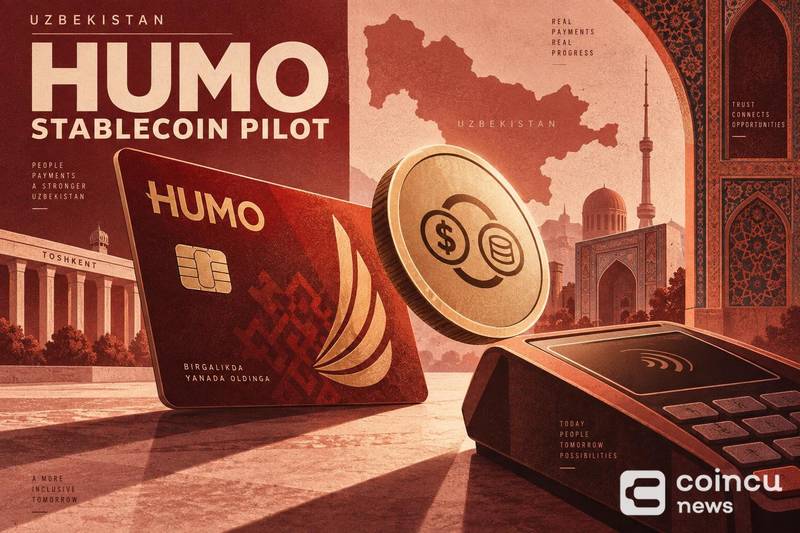
Uzbekistan has moved its Uzbekistan HUMO stablecoin from paper into a supervised payment pilot, with the National Agency of Perspective Projects (NAPP) and the country's Central Bank testing a soum-referenced token backed by government securities under a special regulatory regime, according to reporting dated 7 September 2026 that frames the launch as a controlled trial rather than a nationwide rollout.
What the launch actually confirms
HUMO is presented as a stablecoin issued for a payment pilot supervised jointly by NAPP and the Central Bank of Uzbekistan, per UzDaily's account of the announcement, which attributes the initiative to a special legal regime rather than to a general-purpose currency launch. For related coverage, see PolyNext Awards & Conference Dubai 2026: Advancing the Global Dialogue on Plastic Recycling and Circularity.
The issuer is a corporate entity, not the central bank: NAPP's official registry lists HUMO Digital LLC as the issuer of HUMO, with taxpayer identification number 312161506, according to the agency's stablecoin registry. That distinction matters because a corporate issuer under supervision is legally different from a sovereign or central-bank digital currency. For related coverage, see Arab Global Crypto Exchange (AGCX) to Launch on September 10 with AED Support and Zero Platform Fees on Crypto Transfers.
HUMO Digital entered the special regime on 2 September 2026 with Central Bank approval, per UzDaily's reading of NAPP's participant register, ahead of the payment pilot's public framing five days later.
This is a distinct step beyond Uzbekistan's earlier moves, which approved regulations for issuing and circulating crypto assets and later allowed the first licensed crypto companies to provide services. The HUMO pilot applies that framework to a domestically issued payment token for the first time.
The government-securities backing, and what it does not mean
The distinctive claim is the collateral model. HUMO's filed whitepaper, version 1.0 dated 22 July 2026, specifies full backing by Uzbekistan government bonds recorded at the Central Securities Depository and blocked by the Central Bank, establishing a stated collateral design rather than an independently audited snapshot of current holdings.
Government-bond backing is not a sovereign guarantee, and it is not central-bank issuance. The registry names a private issuer, and the fetched documentation describes a supervised pilot; there is no independent reserve attestation, current collateral valuation, or circulating-supply figure in the available evidence, so audited coverage cannot be stated.
The whitepaper also sets a nominal parity: issuance and redemption at a ratio of one HUMO to one Uzbek soum, according to the filed document.
HUMO’s stated soum peg
1 HUMO = 1 UZS
Nominal issuance and redemption ratio stated in HUMO’s whitepaper, version 1.0, dated 22 July 2026. Secondary-market prices may temporarily differ from this peg; the filing is not an independent reserve attestation. Source: HUMO whitepaper filed with NAPP.
Holders should note two constraints the filing states plainly, which neither pilot news report explains: HUMO ownership confers no interest or periodic investment payment, and the whitepaper warns that secondary-market prices may temporarily diverge from the nominal peg. Government-bond collateral therefore does not turn HUMO into an interest-bearing bond investment, nor does it guarantee price stability on any secondary market.
Redemption rights run against the issuer, not the state; the whitepaper frames tokenholders as holding a redemption claim against HUMO Digital while bearing market, collateral, and operational risk, per the filed document.
Who is involved, and the technical rails
Asterium JSC is named as a project partner holding crypto-depository, crypto-exchange, and crypto-shop licenses, per UzDaily, and the whitepaper identifies Asterium as the technology developer behind HUMO's blockchain.
That blockchain is Mirasmanda, described in the filing as the EVM-compatible network for issuing, recording, circulating, and redeeming HUMO. Uzbekistan's earlier work with international bodies, including an OSCE program training local law-enforcement officers on crypto investigations, signals the compliance context into which this infrastructure is being introduced.
The legal scaffolding, as cited in the whitepaper, rests on Presidential Resolution PQ-359 of 27 November 2025 and a special-regime regulation registered as No. 3818 on 15 April 2026, though the operative texts of both were not directly read and UzDaily refers to the resolution as PP-359, leaving exact scope and any amendments unverified.
What the pilot still needs to clarify for payments
On scale, the available numbers describe readiness, not results: UzDaily reports that more than 20 businesses are ready to participate as merchants and that the planned implementation period runs up to three years, figures that measure intent and duration rather than completed payment volume.
No participant roster, consumer eligibility rules, geographic coverage, or access channels have been disclosed, so where and by whom HUMO can actually be spent remains unknown from the fetched evidence.
Equally unresolved are the payment mechanics: fees, transaction limits, and settlement arrangements are not specified, and there is no completed transaction count, settlement value, or live-usage data to demonstrate speed, cost, cross-border capability, or adoption. The pilot announces intent to test payments for goods, works, and services; it does not yet evidence them.
Industry framing ahead of the launch
The policy approach echoes views aired before the launch. At the 25 August 2026 Silk Road Finance and Technology Forum in Tashkent, Wallet in Telegram Chief Operating Officer Pavel Khristolyubov advocated testing regulatory approaches through sandboxes and collecting data before imposing strict rules, and expressed hope that stablecoins could support last-mile payments, per UzDaily's 26 August account. The remarks predate the HUMO announcement and are a paraphrase, not a reaction to it.
What to watch next
The near-term signals worth tracking are documentary and quantitative. Watch for attributable issuer or authority disclosures confirming the pilot's legal status against the enacted texts of PQ-359 and regulation No. 3818, neither of which has been read in full.
Reserve disclosures, an independent collateral valuation, and a circulating-supply figure would move HUMO's backing from a stated design toward verifiable coverage, while participation data and documented payment results would test whether merchant readiness converts into live usage.
Whether the pilot expands beyond its supervised scope, and on what timetable, is unresolved rather than an announced plan; the up-to-three-year window is a ceiling for testing, not a rollout commitment.
FAQ: Uzbekistan's HUMO stablecoin payment pilot
What is the Uzbekistan HUMO stablecoin? HUMO is a soum-referenced stablecoin issued by HUMO Digital LLC for a supervised payment pilot run with NAPP and the Central Bank, per the registry and UzDaily reporting; several operational details still require source confirmation.
What reportedly backs HUMO? The filed whitepaper states full backing by Uzbekistan government bonds held at the Central Securities Depository and blocked by the Central Bank, but no independent reserve attestation or current valuation was available.
Is HUMO guaranteed by the government? No. The issuer is a private company, and the documentation describes government-security collateral under supervision, which is not the same as a sovereign guarantee or central-bank issuance.
Who can use HUMO during the pilot? More than 20 businesses are reported ready as merchants, but consumer eligibility, geographic coverage, and access channels were not disclosed.
Disclaimer: This article is for informational purposes only and does not constitute financial or investment advice. Cryptocurrency and digital asset markets carry significant risk. Always do your own research before making decisions.
The post Uzbekistan HUMO Stablecoin Payment Pilot Launched was initially published on Coincu.