What Actually Happens When You Connect a Wallet to a DEX? The word "connect" is doing a lot of quiet, misleading work in that button. It sounds like handing something over. What it actually d
What Actually Happens When You Connect a Wallet to a DEX?
The word "connect" is doing a lot of quiet, misleading work in that button. It sounds like handing something over. What it actually does is closer to introducing yourself — and the gap between those two ideas is worth closing before your first swap, not after something goes wrong.
I've watched people hesitate right at the "Connect Wallet" button more than at any other step in DeFi, and I get why. The word itself sounds irreversible, like plugging a cable into something you can't unplug. Meanwhile actually signing a transaction — the step that genuinely moves your assets — often gets clicked through faster than the connection step that came before it, precisely backwards from where the real risk sits.
My take: People are nervous about the wrong step. Connecting a wallet is close to the safest action in the entire flow. Signing is where the actual stakes live, and it usually gets less scrutiny than the button people are more anxious about.
🧩 Connection Is Not a Transaction
Here's the distinction that matters most: connecting a wallet to a DEX is not itself a blockchain transaction. Nothing gets broadcast to the network, nothing costs gas, and critically, nothing about it involves your seed phrase leaving your device or being shared with the application at any point.

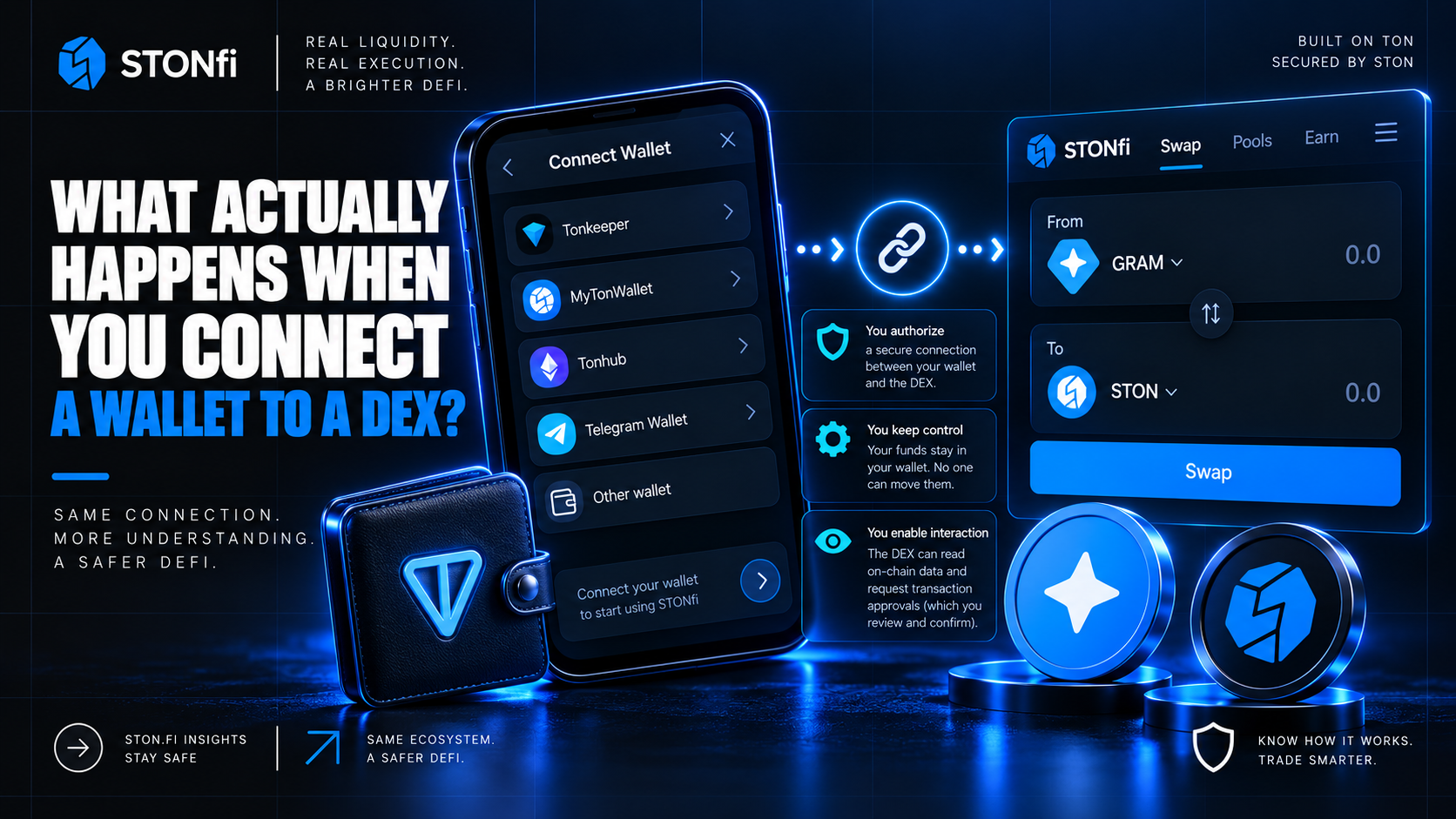
What actually happens is closer to an introduction. Through a standard like TON Connect, your wallet and the DEX's interface establish a session — the app learns your wallet address and can see your public on-chain activity, the same information anyone could look up on an explorer anyway, since it's all public by design. In exchange, the app can now propose transactions for your wallet to consider. It cannot execute anything on its own. Every single action still requires you to separately review and sign it, each time, in your own wallet.
That's the whole picture of what "connect" means. No custody changes hands. No spending permission is granted. No private key material moves anywhere. The button's dramatic-sounding name doesn't match how mechanically small the action actually is.
🔻 What the Application Can Actually See
Since your wallet address becomes visible to the connected application, it's worth being precise about what that does and doesn't expose. The app can see your address, and from that, anything publicly attached to it — token balances, past transaction history, other DeFi positions you hold. All of that was already public on-chain before you connected anything; the DEX interface is just the first party to conveniently display it back to you in its own UI.

What the app cannot see or access: your seed phrase, your private keys, any wallet you haven't explicitly connected, or the ability to move funds without your active, per-transaction approval. The connection is read access to public information plus the ability to request actions — never the ability to take them unilaterally.
🎯 Where the Actual Decision Point Lives
If connection isn't the risky step, signing is where your actual judgment gets exercised, every single time. Each time a DEX wants you to do something — swap, approve a token, provide liquidity — it constructs a proposed transaction and sends it to your wallet for review. Your wallet displays what that transaction actually does, and only your explicit signature turns the proposal into something that actually executes on-chain.
This is genuinely the moment that matters, and it's the one people tend to rush through fastest, especially once they've used an app a few times and the popups start to feel routine. A transaction request that looks slightly different from what you expected — a different recipient, a different amount, a permission that seems broader than the action you asked for — is worth actually reading, every time, not just the first time.
My take: Familiarity is the enemy here. The tenth time you use an app, the signature popup looks exactly like the first nine, so it gets the same fast, half-read click. That's precisely the moment attackers count on — not your first cautious use of an app, but your hundredth casual one.
📉 Why This Distinction Matters More Than It Sounds
The reason this is worth taking seriously isn't abstract. A huge share of DeFi phishing specifically exploits the confusion between these two steps. A malicious site can present something that looks exactly like a routine connection request, but is actually structured to request a transaction signature disguised as a connection — or present a genuine connection, then follow it with a transaction request quietly asking for far more permission than the user thinks they're granting.
Understanding that connection itself is inert and low-risk means you can direct your actual attention to where it belongs: every subsequent signature request, read individually, regardless of how many times you've clicked through a similar-looking popup before. The connection step earning your relaxed trust is fine. Every signature request earning that same relaxed trust is where things go wrong.
🌊 Disconnecting Doesn't Undo What You've Already Signed
One more distinction worth being clear on: disconnecting a wallet from a site ends the session — the app stops being able to see your address or propose new transactions — but it has no effect on anything you already signed while connected. If you approved a token spend last week and disconnect today, that approval is still active; disconnection is a session-level action, not a permissions-level one. The two need to be managed separately, and conflating them is a common source of false confidence — assuming a disconnected wallet is also a "clean" wallet with no lingering permissions.
🔍 A Practical Way to Think About the Whole Flow
Treat connection as answering "who am I talking to," and treat every subsequent signature request as answering "what exactly am I authorizing, right now, for how much." The first question is asked once per session and costs you nothing to answer. The second question gets asked repeatedly and deserves fresh attention every single time, no matter how many times you've answered a similar-looking version of it before.
A simple habit that actually helps: before signing anything, glance at what the wallet popup says the transaction actually does — which contract, which asset, how much — rather than just recognizing the shape of the popup and clicking through on pattern recognition. It takes a few extra seconds and it's the single biggest difference between careful DeFi use and the kind of casual clicking that eventually goes wrong.
🧭 Where STONfi Actually Sits on Top of This

This isn't a hypothetical flow — it's exactly what happens every time someone opens STONfi, and it's worth being specific about how it maps onto the platform itself.
- STONfi uses TON Connect for wallet connection, the same standard described above — connecting your wallet to STONfi shares your address and public activity, and nothing more. Your seed phrase never touches STONfi's interface at any point in that process.
- Every swap, every liquidity deposit, and every farming action on STONfi is proposed by the interface and only executes after your own wallet signature. STONfi's front-end can construct a transaction and show you the details, but it has no ability to execute anything unilaterally, connected or not.
- STONfi's design is explicitly built so the underlying smart contracts keep working even if the front-end interface itself goes down — a direct consequence of the connection model never having handed over custody in the first place. There's no scenario where STONfi's servers being unavailable means your funds are somehow inaccessible or at risk, because STONfi was never holding them.
- Transaction previews on STONfi exist specifically to support the "read before you sign" habit described above — showing the actual swap details, minimum received, and fees before you confirm, rather than asking you to trust a popup you're clicking through on pattern recognition.
- Disconnecting your wallet from STONfi ends the session but doesn't touch any approvals you've previously granted to STONfi's contracts. If you want to fully review what permissions you've granted over time, that's a separate check worth doing periodically, independent of whether you're currently connected.
🧭 Conclusion
Connecting a wallet to a DEX is a much smaller, much safer action than its name suggests — it's an introduction, not a handover, and it grants visibility into public information rather than control over private assets. The actual decision point, every single time, is the signature request that follows: read what it says, not just what it looks like, especially once an app has become familiar enough that the popups start to blur together. Getting this distinction right is less about any single platform's design and more about a habit that travels with you across every DEX and every wallet you'll ever use.
❓ Frequently Asked Questions
Does connecting my wallet share my seed phrase with the app?No. Wallet connection never involves your seed phrase or private keys leaving your device. It shares your public address and whatever activity is already visible on-chain.
Can a DEX move my funds just because my wallet is connected?No. Connection only allows the app to propose transactions. Every transaction still requires your own explicit signature to actually execute.
If I disconnect my wallet, are all my previous approvals revoked too?No. Disconnecting ends the current session but has no effect on token approvals or other permissions granted in earlier transactions. Those need to be reviewed and revoked separately.
Is it safe to stay connected to an app I use regularly?Staying connected is low-risk by itself. The actual risk sits in each individual signature request, which deserves the same scrutiny whether it's your first or hundredth interaction with the app.
Disclosure: Official STONfi Ambassador.