What stops, what keeps running, and what you need to do with your liquidity position. When a fixed-period STON.fi farm reaches its end, the extra farming incentive stops being generated under
What stops, what keeps running, and what you need to do with your liquidity position.
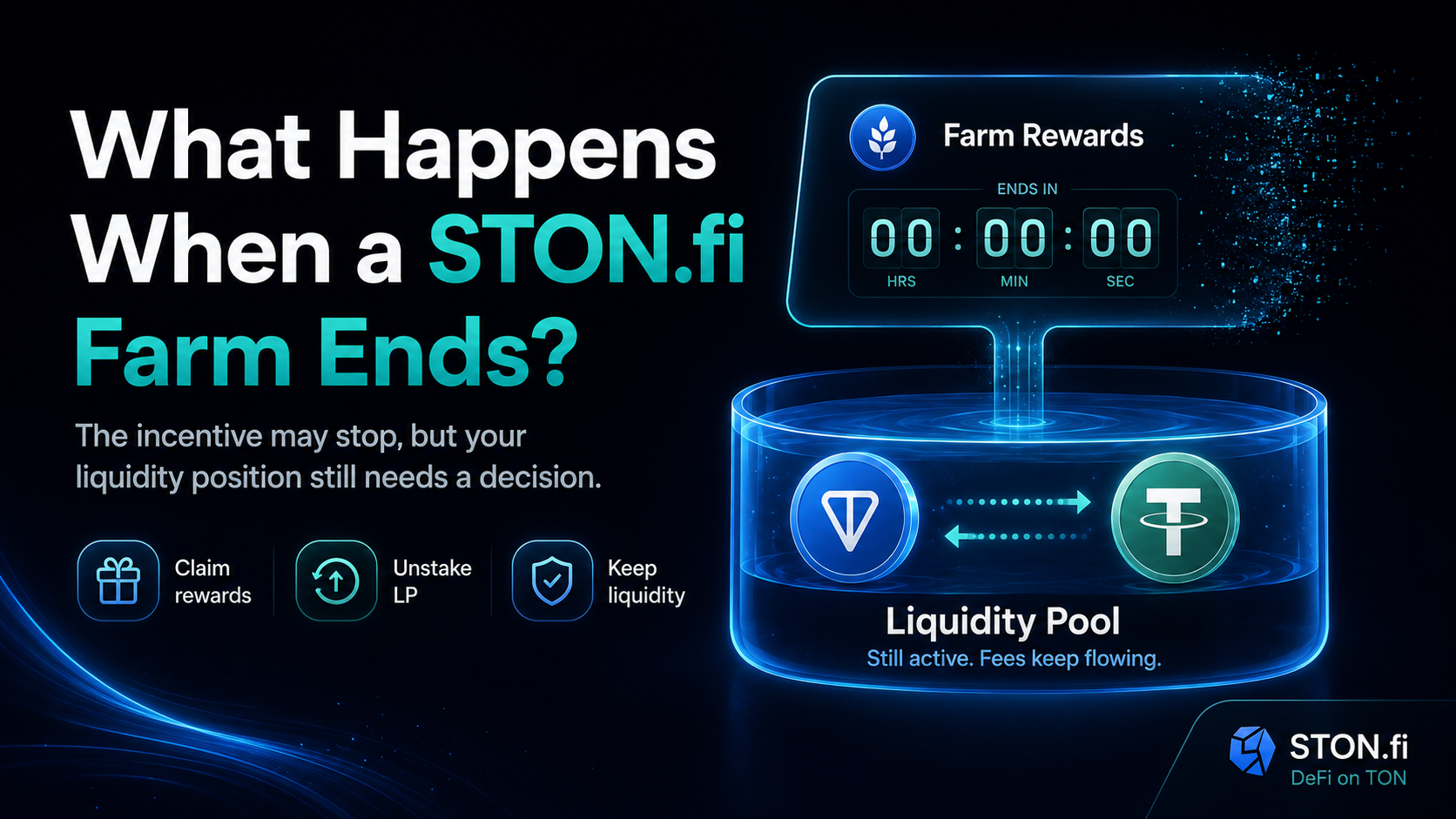
When a fixed-period STON.fi farm reaches its end, the extra farming incentive stops being generated under that reward schedule. Your liquidity does not automatically disappear, and the end of the farm is not the same thing as withdrawing from the liquidity pool. Farming is an additional reward layer built on top of liquidity provision: you provide liquidity, receive LP tokens, and stake those LP tokens in a farm for extra rewards.
That distinction matters because a farm can finish while your underlying liquidity position still exists. From there, you decide whether to claim rewards, unstake your LP tokens, keep providing liquidity without farm incentives, or remove liquidity from the pool.
A farm ending is not the same as a pool ending

The easiest mistake to make is treating the farm and the liquidity pool as one product.
They are connected, but they perform different jobs.
A STON.fi liquidity pool contains assets that traders use for swaps. When you provide liquidity, you receive LP tokens representing your position. Liquidity providers can earn a share of trading fees generated by that pool.
Farming adds another layer. You stake those LP tokens in a farming smart contract and receive additional incentives allocated to that farm. STON.fi describes farming specifically as an extra incentive for liquidity providers beyond trading fees.
So your position can have two distinct reward sources:
- Pool rewards: trading fees generated by swap activity.
- Farm rewards: additional tokens distributed by the farming program.
When a fixed farm ends, it is the second layer that reaches the end of its scheduled reward period.
The pool itself does not need to close.
This is why seeing a farming countdown reach zero should not be interpreted as "my liquidity is gone" or "the trading pair no longer exists."
Fixed-period farms and ongoing farms behave differently

Not every STON.fi farm has the same lifecycle.
The current STON.fi guide distinguishes between fixed-period farms and ongoing farms. Fixed-period farms run for a limited period with a predefined reward pool. Ongoing farms do not have a fixed end date and continue while the farm remains funded.
That gives you two different situations.
Fixed-period farm
You may see a defined remaining duration or end date. Rewards are distributed during that program window. Once that schedule finishes, you should no longer treat the displayed farming APR or previous reward rate as an ongoing source of income.
Ongoing farm
There is no predetermined final date. Rewards can continue as long as the program remains funded. "Ongoing" does not mean the economics can never change. It means there is no fixed expiration date built into the current farming period.
Before entering any farm, therefore, check more than the headline APR. Look at whether the farm has an end date, whether there is a lock-up, which token is used for rewards, and how much time remains.
A very high farming APR with only a short reward window is a different opportunity from a lower incentive that can continue for much longer.
What actually happens when the reward period reaches zero?

Think of the end of a STON.fi farm as the expiration of an incentive program, not the destruction of your position.
The practical sequence is roughly:
- You previously supplied liquidity and received LP tokens.
- Those LP tokens were placed into a farm.
- The farming smart contract distributed rewards while the reward program was active.
- The fixed farming period reaches its end.
- Additional rewards from that completed schedule stop being the active incentive.
- Your farm position still has to be managed through the available claim and unstake operations.
STON.fi's developer documentation treats claiming and unstaking as explicit operations. Claim Rewards harvests rewards from the Farm NFT, while Unstake returns the staked LP tokens from the farm position to the owner's wallet.
In other words, the end date itself should not be confused with an automatic withdrawal.
STON.fi does not document "farm expiration" as an automatic process that burns your LP position and sends the underlying pool assets to your wallet. Instead, its farming architecture exposes separate actions for claiming rewards and unstaking LP tokens.
That is an important operational distinction.
Farm ends: the incentive schedule reaches its endpoint.
Unstake: you retrieve LP tokens from the farming contract.
Withdraw liquidity: you use the LP position to exit the underlying liquidity pool and receive the corresponding pool assets.
Those are three different events.
What happens to rewards you already earned?
Rewards that were accumulated during your participation should not be confused with future rewards that would have been generated if the farm continued.
STON.fi exposes a dedicated Claim Rewards operation for farm positions, and its public information explains that farming rewards are calculated through smart contracts and can be claimed through the interface.
So when a farm finishes, check the position rather than assuming one of two extremes:
- that everything was automatically transferred to your wallet;
- that all unclaimed rewards disappeared because the timer reached zero.
The safer workflow is to open your position, review the reward balance shown by STON.fi, and use the available Claim Rewards action where applicable.
Remember that claiming is an on-chain operation. Keep some TON available for network fees before you start managing an ended farm.
There is also a Farm NFT associated with position tracking in the current farming architecture. STON.fi documents a separate operation for destroying an already unstaked Farm NFT and recovering the associated storage handling. That cleanup step is different from claiming rewards or unstaking the LP tokens themselves.
Your liquidity can keep working after farming stops

Suppose you provided liquidity to Token A/TON and then placed the LP tokens into a three-week farm.
During those three weeks, your economic position may include both:
- exposure to the pool's trading fees;
- the additional farm incentive.
Now imagine the farming period ends.
If you do not remove liquidity from the underlying pool, you still have a liquidity position. Farming was an extra incentive attached to that position, not the mechanism that created the pool itself.
STON.fi's DEX documentation separates these functions explicitly: liquidity providers deposit assets and earn trading fees, while LP token holders can additionally stake those LP tokens in farms for more yield.
That means the economics of your position change when the farm ends.
Before:
pool fees + farming rewards
After the farming incentive ends:
pool fees, assuming your liquidity remains in the pool
This can materially change the attractiveness of the position.
A pool that looked appealing with an additional farming incentive may look much less attractive without it. On the other hand, a high-volume pool may still be useful to you because trading activity can continue generating fees.
Do not decide based on the old farm APR. Re-evaluate the liquidity position on its own merits.
Not necessarily.
The correct decision depends on what you wanted from the position in the first place.
If you entered primarily for farming rewards, the end of the incentive is a natural time to reconsider the position. If you already wanted long-term exposure to that liquidity pool, there may be no reason to remove liquidity solely because the farm ended.
Ask four questions:
- Is the underlying token pair still one you want to hold?
- Is the pool generating enough trading activity to justify remaining an LP?
- Has the balance between expected fees and impermanent loss changed?
- Is there another farm you are considering, and does moving liquidity actually improve the risk and reward profile?
Do not automatically jump from an ended farm into whichever new farm shows the highest APR.
Farm APR can change as liquidity enters or leaves, token prices move, and reward distributions evolve. STON.fi also warns that the underlying liquidity remains exposed to pool dynamics, including impermanent loss.
The farm ending removes one incentive. It does not remove the market risks attached to the LP position.
If you want to exit completely, there are two layers to unwind

Stopping farming and withdrawing liquidity are not identical actions.
If your LP tokens are still in the farming contract, you first need to manage that farming position. STON.fi provides an Unstake operation that returns the staked LP tokens to the owner's wallet.
Once you control the LP position again, removing the underlying liquidity is a separate DEX operation. In STON.fi v2, withdrawing liquidity involves burning LP tokens so the corresponding underlying pool assets can be released.
Conceptually, the full exit looks like this:
Farm position → unstake LP tokens → liquidity position → withdraw liquidity → underlying assets
You may not need to complete the whole sequence.
For example, you could unstake LP tokens from an ended farm but continue holding the liquidity position. Or you could later use an eligible LP position in another farming program if one exists and its conditions suit you.
Also check whether your farm has a lock-up. STON.fi notes that lock-up conditions can vary between farms, so the reward end date and the rules governing when LP tokens can be unstaked should be reviewed separately.
A practical end-of-farm checklist

When you notice that a STON.fi farm has ended or is close to ending, avoid treating the countdown as an automatic exit signal.
Check the position methodically:
- Confirm the farm status. Make sure the fixed reward period has actually ended.
- Review earned rewards. Check what the interface shows before initiating transactions.
- Claim where appropriate. Use the farm's reward claim flow for accumulated rewards.
- Check the lock-up. Farm duration and unstaking restrictions are separate conditions.
- Decide whether you still want the LP position. The underlying pool may continue operating.
- Unstake if needed. This returns LP tokens from the farm contract.
- Withdraw liquidity only if you want to leave the pool. That is a separate action.
- Keep TON for network fees. Claiming, unstaking, and withdrawing are on-chain operations.
The biggest practical lesson is simple: a farm ending changes the reward structure, not automatically the ownership or existence of your liquidity position.
Treat the end date as a decision point.
Look at what has stopped, what is still active, and whether the remaining liquidity position still fits your strategy.
Frequently Asked Questions
Does STON.fi automatically withdraw my liquidity when a farm ends?
No automatic liquidity withdrawal is described in STON.fi's farming documentation. Farming, unstaking, and withdrawing liquidity are separate operations. STON.fi provides an explicit Unstake action for returning LP tokens from a Farm NFT, while withdrawing the underlying pool assets requires a separate liquidity withdrawal process.
Do farming rewards continue after the end date?
A fixed-period farm has a limited reward period, so you should not expect the completed incentive schedule to continue generating rewards indefinitely. STON.fi separately supports ongoing farms, which have no fixed end date and continue while they are funded. Always check the current farm status rather than relying on an old APR figure.
Do I lose rewards if I forget to claim before the countdown reaches zero?
The farm ending does not itself perform the claim action. STON.fi provides a separate Claim Rewards operation for earned farming rewards. After a farm ends, open your position and check the rewards displayed by the current interface, then use the available claim function where applicable.
What happens to my LP tokens after farming ends?
The LP tokens are the representation of your liquidity position, while the farm is the additional incentive layer. STON.fi provides a separate Unstake operation for returning LP tokens from the farm contract to the owner's wallet. The farm reaching its reward endpoint should therefore not be treated as the same event as withdrawing the underlying pool assets.
Can I keep earning trading fees after the farm ends?
Yes, if your liquidity remains in the underlying pool, the liquidity position is separate from the farming incentive. STON.fi describes liquidity provision as earning a share of trading fees and farming as additional yield obtained by staking the LP tokens. Actual fee income depends on pool activity and the applicable pool rules.
Is an ongoing farm permanent?
Not in the sense of a guaranteed perpetual reward. STON.fi defines ongoing farms as farms without a fixed end date whose rewards continue while the farm remains funded. Conditions can therefore evolve. Check the current STON.fi interface and official information before treating an ongoing reward rate as a long-term assumption.
Only if the new position makes sense after considering the full risk and reward profile. Compare the token pair, remaining farm duration, reward asset, lock-up conditions, pool activity, and impermanent loss exposure. A higher visible farming APR alone does not necessarily make a new farm better than keeping your existing liquidity position.
What should I do first when my STON.fi farm ends?
Open the farm position and check its current status, earned rewards, and any lock-up conditions. Claim rewards where appropriate, then decide whether you want to keep the underlying liquidity position. If not, unstake the LP tokens first and then use the separate liquidity withdrawal process to exit the pool.
Sources and Further Reading
- STON.fi Ultimate Guide, What is farming? - Explains LP-token farming, farm rewards, fixed-period farms, ongoing farms, lock-ups, and farm duration
- STON.fi Developer Documentation, Farm - Overview of the farming lifecycle, Farm NFTs, reward claiming, and unstaking operations
- STON.fi Developer Documentation, Claim Rewards - Technical documentation for claiming accumulated rewards from a Farm NFT
- STON.fi Developer Documentation, Unstake from Farm - Documents how staked LP tokens are returned from a farming position to the owner's wallet
- STON.fi Developer Documentation, Destroy Farm NFT - Explains cleanup of an unstaked farming position and destruction of its Farm NFT
- STON.fi Developer Documentation, DEX Overview - Separates liquidity provision, trading-fee income, and farming as distinct protocol functions
- STON.fi Developer Documentation, Burn LP Tokens v2 - Describes withdrawing underlying assets from a liquidity pool by burning LP tokens
- STON.fi Blog, 3 ways to get rewards on STON.fi - Current explanation of farming, LP-token rewards, farm lock-ups, and campaign-based incentives