RWA Perpetual Trading: How Real-World Assets Trade On-Chain RWA perpetual trading allows traders to bet on the price of real-world assets like gold, oil, stocks, and currencies. The bets are
RWA Perpetual Trading: How Real-World Assets Trade On-Chain
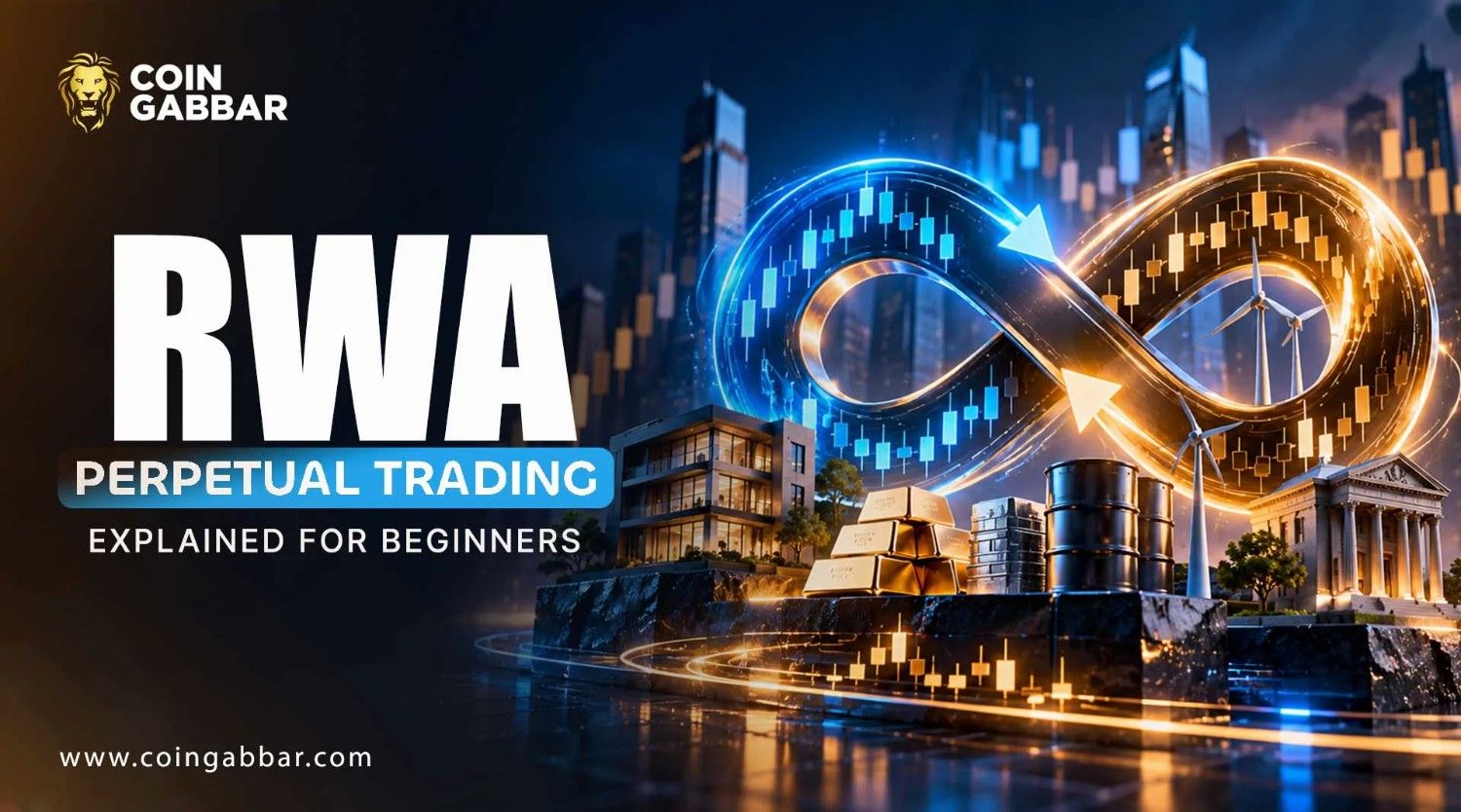
RWA perpetual trading allows traders to bet on the price of real-world assets like gold, oil, stocks, and currencies. The bets are placed through on-chain contracts that have no end date. The trader never owns the asset. What the trader holds is a contract that moves with the asset’s price, and it stays open as long as there is enough margin behind it.
What started as a small experiment now holds billions of dollars in open positions. On October 15, 2026, Ripple joined the space with a product built for institutions. Below is a plain look at how the market works, what is driving its growth, what Ripple launched, and where the risks sit.
Key Takeaways
A perpetual contract has no expiry date and only follows the price of an asset.
Market tracker data from October 2026, shows about $19.5 billion in open interest.
Ripple Prime launched RWA perpetual swaps for institutional clients on October 15, 2026.
The product is a leveraged derivative, and oracle errors, thin liquidity, and unclear rules remain real risks.
How Does RWA Perpetual Trading Work?
A perpetual contract is a derivative, which simply means its value depends on some other price. A normal futures contract ends on a set date. A perpetual does not.
To stop the contract price from drifting away from the real market price, platforms use something called a funding rate.
It is a small payment that moves between traders every so often. When the contract trades above the real price, the traders betting on a rise pay the ones betting on a fall. When it trades below, the direction reverses.
The real price itself comes from oracles, which are price feeds. The platform relies on them for funding, margin checks, and liquidations.
Traders put up margin, usually a stablecoin, and use it to open a position larger than the deposit. That is leverage. It makes gains bigger, and it makes losses bigger too. If the losses eat too far into the margin, the platform shuts the position on its own. This is called liquidation.
How Are RWA Perpetuals Different From Tokenized Assets?
Most RWA perpetuals are synthetic and settled in cash. A trader gets exposure to the price and nothing else. There is no ownership, no custody, and no right to redeem the real asset.
Tokenized assets are built differently. They are issued under legal and custody rules that connect the token to an actual asset or a claim on it.
Perpetuals do have clear advantages. Trading runs all day and night, even on weekends when stock and commodity exchanges are shut. Going short is as easy as going long. New markets can also be listed much faster than legally structured tokens.
The catch is that a perpetual gives no claim on the asset. It works as a trading tool. It does not work as a way to own gold or a share of a company.
Why Is RWA Perpetual Trading Growing So Fast?
The main reason is demand for markets that never close. Tracker data checked on October 26, 2026, shows about $19.5 billion in open interest, which is the total value of positions still open. These sit across 3,584 markets at 34 venues. Trading volume over the past 30 days came close to $854 billion.
July 2026 set a record at $460 billion in volume, according to industry data. Public equities hold the biggest slice of open interest at roughly $8.9 billion. Precious metals come next at $5 billion, and oil has $1.9 billion.
Several things sit behind these numbers. Traders want access to stocks and metals outside normal hours. New contracts can be listed quickly. And large financial firms have started to pay attention.
What Did Ripple Launch in RWA Perpetual Markets?
On October 15, 2026, Ripple Prime, the prime brokerage arm of Ripple, announced RWA perpetual swaps for institutional clients. The service covers more than 100 reference markets across equities, equity indices, ETFs, metals, energy, and foreign exchange.
Ripple Prime acts as the main counterparty. Each swap follows a perpetual futures contract listed by trade.xyz on Hyperliquid, a decentralized derivatives exchange. Depending on the client’s country, collateral can be posted in Ripple’s RLUSD stablecoin. Market maker Virtu is one of the firms trading on it.
The service runs under Ripple Prime’s British Virgin Islands license, so access for US investors is not automatic. Ripple also said volumes in this segment are rising, but it did not share any figures. How much real demand exists is still not clear.
What Has Been Built So Far?
Most platforms rely on four parts. An order book matches trades, a clearinghouse tracks margin and profit and loss, oracles supply prices, and a funding system keeps contract prices in line. Both decentralized exchanges and large centralized platforms now offer these markets, and decentralized venues hold about 29.2% of open interest in the latest tracker data.
Traders mainly use these markets to trade stocks, indices, gold, and oil on weekends and overnight. Others use them to hedge a portfolio while regular exchanges are closed, to short a stock without borrowing shares, or to keep a single stablecoin margin account across crypto and traditional markets.
What Risks Come With RWA Perpetual Trading?
Oracle trouble is the first one to watch. A faulty or manipulated price can set off wrong liquidations. When the real market is closed, the oracle price can also go stale, and a sharp gap often shows up once trading reopens.
Liquidity is another weak spot. Newer pairs can have few buyers and sellers, which widens spreads and makes it harder to exit. Smart contract bugs are possible too, and funding payments add up over time. Platform and counterparty risk is different from one venue to the next.
Leverage deserves its own warning. A small move in the wrong direction can wipe out the entire margin. Regulation adds one more layer, since a contract linked to shares, bonds, or currencies may be treated as a regulated derivative in some regions.
What Does the Data Say About RWA Perpetuals?
Most open interest sits in assets people already know. Equities and precious metals make up the bulk of it, which hints that traders mostly use these contracts to reach familiar markets.
The biggest technical worry is the mismatch between a contract that never closes and a market that does. The reference price can fall behind, and liquidations can follow. Regulation is the largest open question. Ripple’s launch is limited by license and region, and future rules could decide which venues survive.
Before using any contract, a reader can check four things: how the venue designs its oracle, how deep its liquidity is, what fees it charges, and what its legal status is.
Glossary
Perpetual contract: a derivative with no expiry date.
Funding rate: a regular payment between traders that keeps the contract price near the real price.
A price feed that provides the Oracle price.
Margin: The amount of security deposited on a position.
Liquidation: the automatic closing of a position when margin runs too low.
Open interest: the total value of positions that are still open.
Final Thoughts on RWA Perpetual Trading
RWA perpetual trading turns stocks, metals, oil, and currencies into contracts that never close, running on blockchain rails. Ripple’s October launch shows that big institutions are watching.
Open interest and volume have grown fast, yet the product is still a leveraged derivative, and its oracle, liquidity, and regulatory risks are far from settled. Anyone researching it should start with the venue rules, the margin terms, and the local legal status.
Disclaimer
This article is for informational purposes only and is not financial, investment, or legal advice. RWA perpetual contracts use leverage and can cause losses larger than expected, including the full margin. Crypto derivatives are high risk and may be restricted in some countries. Readers should do their own research and speak with a licensed adviser before making decisions.