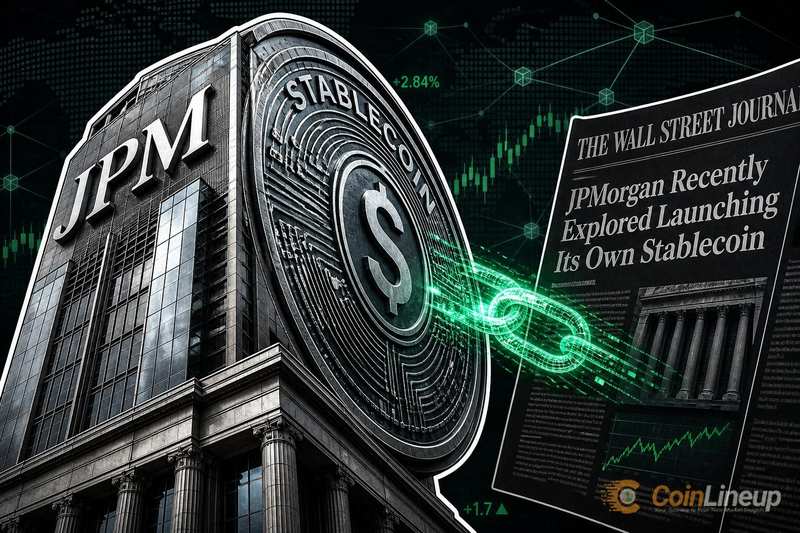
JPMorgan, the largest bank in the United States, recently explored launching its own stablecoin, according to a Wall Street Journal report. The move is still at the exploration stage, not a c
JPMorgan, the largest bank in the United States, recently explored launching its own stablecoin, according to a Wall Street Journal report. The move is still at the exploration stage, not a confirmed product, but it signals growing interest from major banks in digital dollar tokens.
A stablecoin is a crypto token designed to hold a steady value, usually pinned to one U.S. dollar. The Wall Street Journal reported that JPMorgan discussed creating such a token internally. Nothing has been officially launched or announced by the bank. For related coverage, see South Korea's Largest Bank to Launch JPMorgan Kinexys for Near-Instant USD Transfers.
KEY TAKEAWAYS
- The Wall Street Journal reported JPMorgan recently explored launching its own stablecoin.
- This is reported exploration, not a confirmed product or launch date.
- Interest from a bank this size is a signal that big finance is watching stablecoins closely.
What the report actually says
The core claim is simple. According to the Wall Street Journal, JPMorgan looked into issuing a stablecoin of its own. The word "explored" matters here. It means internal discussions, not a finished product. For related coverage, see Tanzania Central Bank Prepares Crypto and Stablecoin Rules.
We want to be careful with the language. There is a big difference between a bank studying an idea and a bank shipping it. As of now, the reporting describes the former, not the latter.
Why a bank like JPMorgan might want a stablecoin
Large financial institutions have spent years testing blockchain-based settlement, the process of moving money between parties. A dollar token could make internal transfers and payments faster and cheaper than older banking systems.
JPMorgan already runs blockchain payment infrastructure. Its Kinexys platform, for example, powers near-instant U.S. dollar transfers for South Korea's largest bank. The bank has also tokenized an Invesco ETF as a real-world asset token, showing steady work on digital asset rails.
A stablecoin would fit that direction. It is worth stressing the difference between a bank's private plumbing and public crypto markets. A JPMorgan token built mainly for institutional settlement is not the same as a coin you trade on a retail exchange.
Why this matters for crypto holders
JPMorgan is one of the world's largest banks, so even reported exploration carries weight. When an institution this big studies stablecoins, it adds fuel to the idea that digital dollars are becoming mainstream financial tools.
Stablecoins already sit at the center of crypto trading and payments. New entrants change the competitive picture, especially against established tokens like Tether's USDT and Circle's USDC. A bank-backed coin would be a new kind of competitor.
Regulation is also moving in parallel. U.S. lawmakers have advanced stablecoin rules, including a Treasury proposal setting a July 18, 2028 cutoff for certain offshore stablecoins serving U.S. customers. That framework is part of the backdrop banks are weighing.
For a regular holder, the practical takeaway is measured. Nothing here changes the price or safety of coins you already hold today. If you are curious about how these tokens compare to Bitcoin for spending, our guide on Bitcoin versus stablecoin payments breaks down fees, speed, and volatility.
The bottom line: this is a reported early-stage move, not a launch. It is worth watching as a signal, but it is not a market event you need to act on right now.
Additional source references: source document 1, source document 2.
Disclaimer: This article is for informational purposes only and does not constitute financial or investment advice. Cryptocurrency and digital asset markets carry significant risk. Always do your own research before making decisions.
Read original article on coinlineup.com