Zoi Network Tokenomics: How the 10 Billion ZOI Supply Is Used Before a token has a price, its rules are the only thing worth reading. Zoi Network tokenomics is a good case, because the supply
Zoi Network Tokenomics: How the 10 Billion ZOI Supply Is Used
Before a token has a price, its rules are the only thing worth reading. Zoi Network tokenomics is a good case, because the supply, the split and the unlock dates are already published in the official whitepaper.
Zoi is a network where phones pass payments to each other over Bluetooth and settle on-chain once one phone gets back online. ZOI is the one token behind it. This guide shows how much exists, who gets it and when.
Key Takeaways
The ZOI token supply is fixed at 10 billion, with no way to mint more.
70% of supply goes to the community, and mining alone holds 58%.
Team, treasury and investor tokens stay locked for one year, then unlock monthly.
What Is Zoi Network?
Zoi is a crypto network that works without the internet. Phones talk straight to each other over Bluetooth, and a transfer travels from phone to phone. It locks in on-chain the moment one of them gets back online. The free app is live today, and users earn ZOI by syncing and inviting friends.
Source: official website.
What Is ZOI Tokenomics?
Tokenomics is the plan behind a token: how much exists, who holds it, when it unlocks and what it is used for. For ZOI, all of this is written in the whitepaper, so anyone can check it before the token is tradable.
ZOI Total Supply: 10 Billion, Fixed From Day One
The ZOI total supply of 10 billion is set at genesis. There is no tail emission and no mint function for later. Every ZOI that will ever exist already sits in one of the allocations below.
That is the heart of Zoi Network tokenomics: one number, and no sequel.
Item
Detail
Total supply
10,000,000,000 ZOI
Community share
70%
Mining pool
5.8 billion ZOI
First halving
1 December 2028
Transfer fee
0.5 ZOI
Until TGE
Balances sit on the Zoi privatenet
At TGE
Planned 1:1 move to mainnet
How Is ZOI Token Distributed?
The ZOI token allocation has seven parts, and each has its own release rule.
Allocation
Share
ZOI
Release
Mining
58%
5.8B
Daily quota with halving, from 1 Dec 2026
Validators
4%
0.4B
Own quota with halving, once the validator set opens to the public
Ecosystem
8%
0.8B
Max 20% of the allocation per year
Liquidity
5%
0.5B
At token generation event
Treasury
7%
0.7B
1-year cliff, then monthly over 4 years
Team
12%
1.2B
1-year cliff, then monthly over 4 years
Investors and partners
6%
0.6B
1-year cliff, then monthly over 4 years
Validators run servers and settle transfers, so they get a small pool of their own. The ecosystem share pays for grants, creators and partnerships. The treasury covers audits, legal work and infrastructure. Liquidity fills exchange order books at launch.
If the investor share is not fully used, the rest moves to the treasury or ecosystem, and the change is logged in the changelog.
Why Does Zoi Give 58% of Supply to Mining?
Because the phones are the network. People who sync today, and later relay and witness transfers, are the ones building Zoi. The official whitepaper says they should hold the biggest share.
Relay and witness rewards sit in the same pool on purpose. It is the same people on the same phones, so there is one quota, one halving schedule and one rate for everyone. Nobody, the team included, can pull ZOI out of this pool for anything else.
How the ZOI Mining Pool Is Released
The pool does not pay a fixed reward per person. It releases a fixed quota per day, starting 1 December 2026 at 00:00 UTC. Sync, streak, referral and bonus rewards all come out of it.
The reason is simple maths. If a million people synced daily at a fixed rate, the 5.8 billion pool would last about five months. A daily quota avoids that. When few people are active, everyone earns the full amount. When many are active, each slice gets smaller, but nobody is turned away.
Unused quota is not lost. It goes to a network reserve that later pays relay and witness work.
ZOI Halving: When the Daily Quota Drops
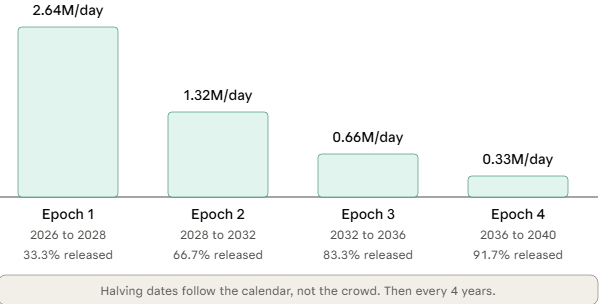
The first epoch runs two years. Every epoch after that runs four.
Epoch
Period
Daily quota
Released in total
1
1 Dec 2026 to 1 Dec 2028
~2.64M ZOI
33.3%
2
1 Dec 2028 to 1 Dec 2032
~1.32M ZOI
66.7%
3
1 Dec 2032 to 1 Dec 2036
~0.66M ZOI
83.3%
4
1 Dec 2036 to 1 Dec 2040
~0.33M ZOI
91.7%
Halving dates follow the calendar, not the crowd. The quota halves on 1 December 2028 even if the first epoch was not fully used. Half of a half never reaches zero, so mining slows down but does not stop on a set date. The validator allocation also halves every four years once the validator set opens.
ZOI Vesting Schedule: Who Waits and for How Long
Treasury, team and investor tokens share one schedule, and it starts at TGE.
When
What happens
At TGE
Clock starts, nothing unlocks
First year
Cliff, nothing unlocks
Next 4 years
1/48 unlocks every month
5 years after TGE
Fully unlocked
These tokens unlock on the same timeline as everyone else’s mainnet ZOI, never ahead of it. A cliff plus monthly steps means none of them can hit the market at once.
Is ZOI Supply Fixed or Inflationary?
Fixed. Issuance follows a published schedule, not demand.
A supply that can grow asks holders to trust that it won’t. A fixed one needs no trust, because the total is the total. Even fees do not create new tokens. Part of every fee returns to the mining pool, inside the same 10 billion, and the rest goes to contributors on that transfer’s path.
ZOI Token Utility: One Token, Four Jobs
Payment. Bearer notes are denominated in ZOI.
Rewards. Verified work is paid in ZOI. Today that means syncing, which pays a base of 10 ZOI every four hours. Streaks and active invitees raise it.
Bond.Certified payment points, and later validators, lock ZOI as a bond that is slashed on proven misbehaviour.
Fees. Every transfer costs 0.5 ZOI, online or offline.
What to Keep in Mind
Zoi Network tokenomics describes a plan, and dates are targets. Moved dates are announced in the whitepaper changelog.
Four things are fixed: total supply, mining pool size, start date and halving dates. Some things can change with notice: the split between sync and network work, bonus amounts, and streak and referral settings. Until TGE, balances live on the privatenet.
Final Thoughts
The numbers are easy to say: 10 billion ZOI, nothing more ever, 58% for the phones that run the network, and long waits for insiders. Zoi Network tokenomics is only as good as its delivery, so read the Supply and Allocation and ZOI Token pages yourself.
Disclaimer: This article is for information only and is not financial advice. Always do your own research.