Most comparative blockchain reviews either promote specific solutions or avoid clear conclusions. Technical documentation is written by project teams, and many analyses are marketing in disgu
Most comparative blockchain reviews either promote specific solutions or avoid clear conclusions. Technical documentation is written by project teams, and many analyses are marketing in disguise. Rather than evaluate promises, this piece focuses on verifiable metrics: real-world throughput, time to finality, and protocol governance structure.
The TPS Race: Who’s Actually Built for the Real World?
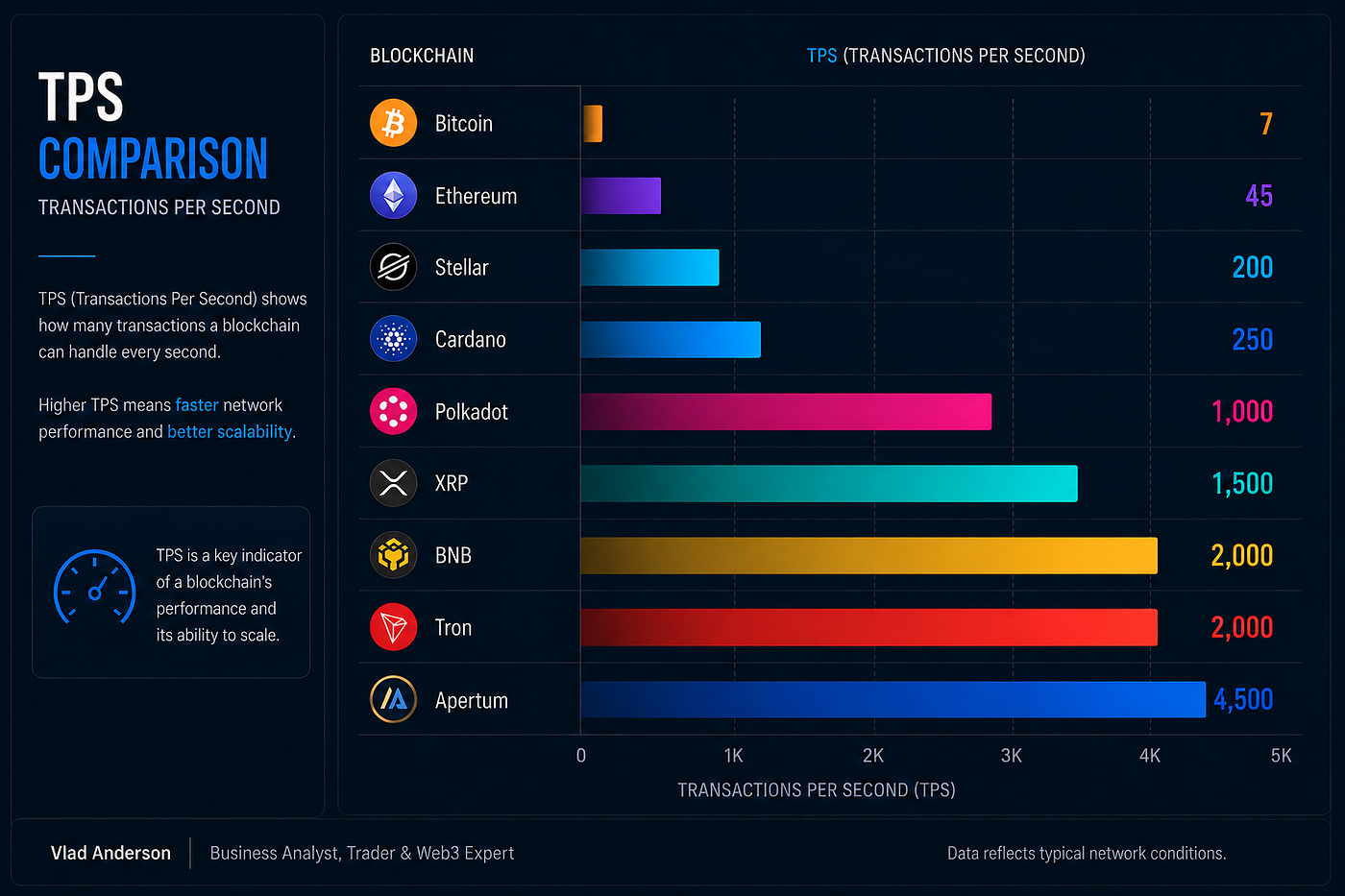
The theoretical TPS maximum in a whitepaper reflects architectural design, not guaranteed performance. Bitcoin (≈7 TPS) and Ethereum (≈45 TPS) deliberately constrain throughput in favor of security and decentralization. The mid-tier — Stellar (200), Cardano (250), Polkadot (1,000) — achieves scalability through different architectural trade-offs. The upper segment: XRP (1,500), BNB Chain (2,000), Tron (2,000), Apertum (4,500). For context, Visa’s average peak is approximately 1,700 TPS.
High throughput without infrastructure compatibility produces an isolated ecosystem. EVM compatibility allows applications to migrate from Ethereum and other EVM-based networks with minimal code adaptation. The combination of high TPS and EVM compatibility is a meaningful advantage; raw speed without integration capability has limited practical value.
The Number Every Serious Blockchain Evaluation Starts With
TPS measures how many transactions a network processes; TTF (Time to Finality) measures when a transaction becomes irreversible. In many real-world scenarios, TTF is the more critical metric. On exchanges, it determines how quickly deposits are credited; in DeFi, it defines the arbitrage window; in payment systems, it is the difference between an instant service and a noticeably slow one.
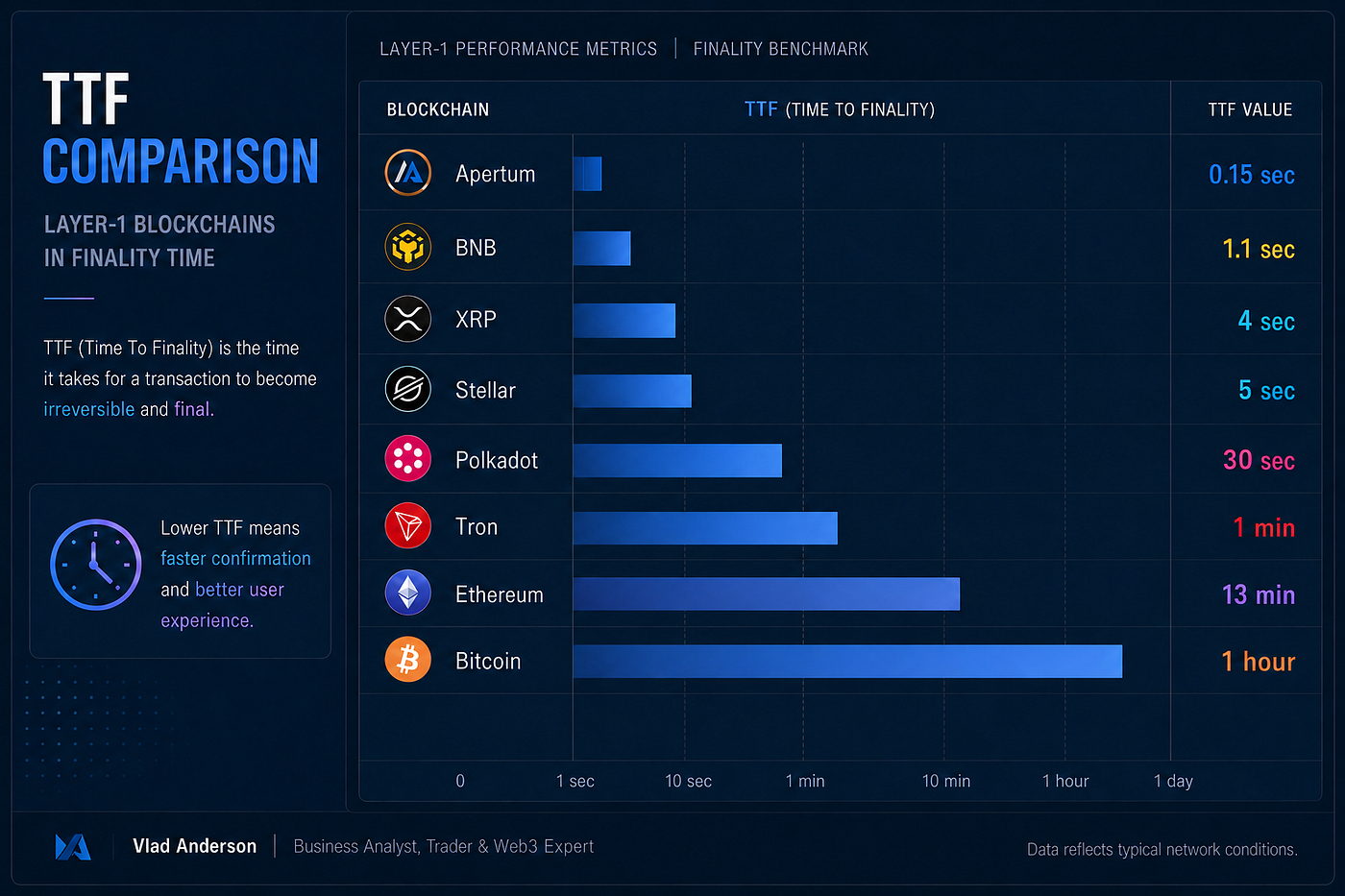
Comparative figures: Apertum — 0.15 s, BNB — 1.1 s, XRP — 4 s, Stellar — 5 s. Beyond that, the gap becomes qualitative: Polkadot — ≈30 s, Tron — ≈1 min, Ethereum — ≈13 min, Bitcoin — ≈1 hr. A network with lower TPS but fast finality will often deliver greater practical value than one with higher throughput and slow confirmation. For payment infrastructure, TTF is typically the primary metric; for trading systems, both matter equally.
The Positioning Map Every Serious Investor Should Understand
Plotting protocol performance on the vertical axis and development complexity on the horizontal naturally divides the market into four quadrants.
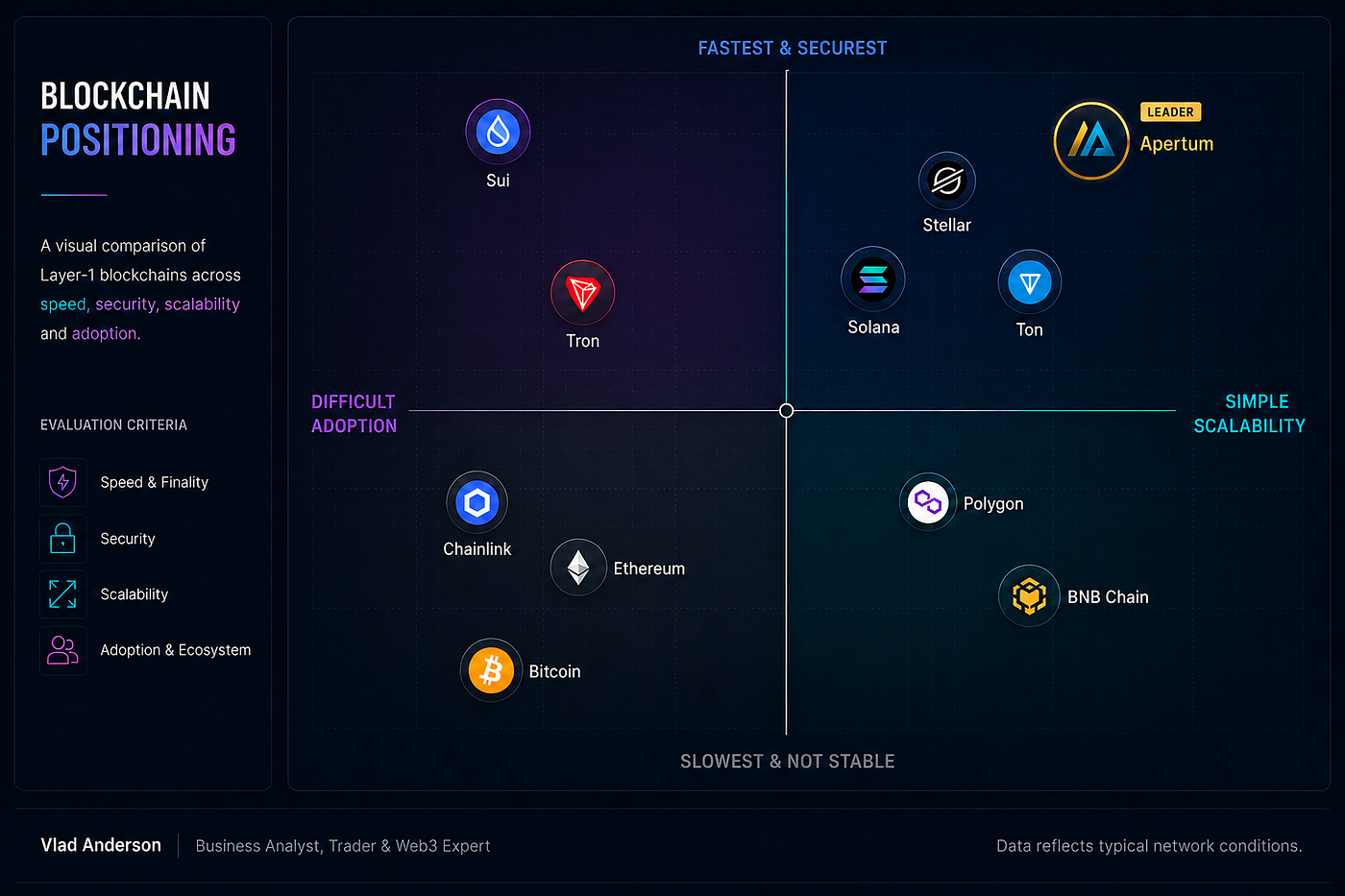
Upper-left — strong technical foundation, high barrier to entry. Sui is the representative example: efficient architecture and high throughput, but Move requires developers to effectively retrain and work within a far less mature tooling ecosystem. The lower quadrants contain networks that have deliberately prioritized other trade-offs: Ethereum and Bitcoin are not competing on throughput, while BNB Chain offsets its performance ceiling through ease of integration and the familiarity of the EVM stack.
The upper-right is the most contested segment of the current cycle: high performance combined with a low adoption barrier. Solana offers its own architectural approach, TON leverages the Telegram ecosystem, and Apertum combines EVM compatibility with the performance characteristics of modern high-throughput networks. Competition is concentrated around projects that narrow the gap between speed and developer convenience.
The Whales in the Room: What Ownership Structure Really Tells You
Technical specifications are straightforward to compare. Ownership structure and capital concentration are much harder to assess — and often where the most significant long-term risks are embedded. In Bitcoin, this means the large volume of coins associated with Satoshi; in Ethereum, the substantial holdings of early participants, funds, and major validators.
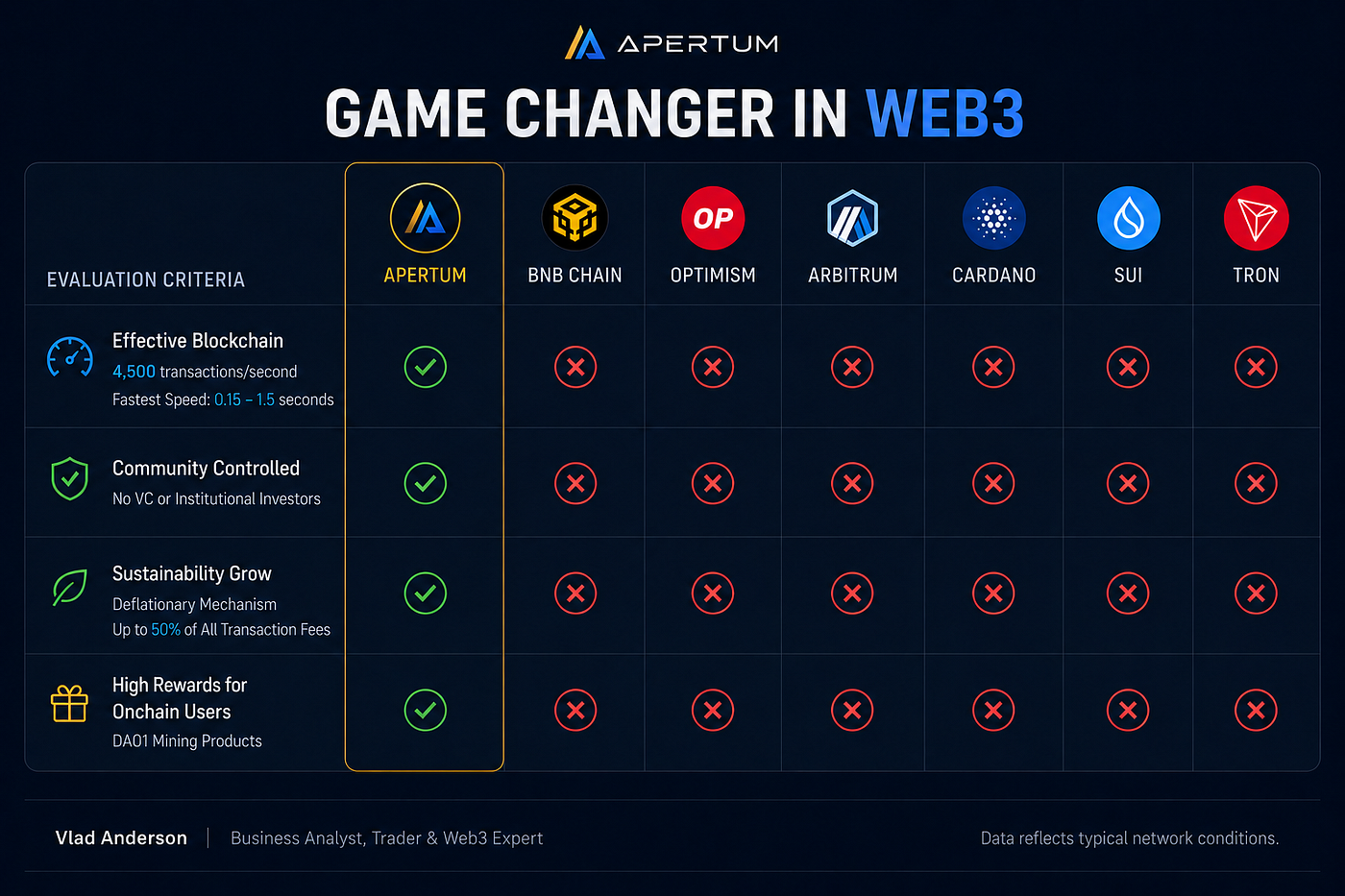
Institutional capital at an early stage provides growth resources and crisis-period support, but it also creates the risk that a small number of large players can influence the market regardless of a project’s fundamentals. Apertum was built without VC funding rounds or institutional investors, reducing the likelihood of large coordinated sell-offs; the protocol also burns up to 50% of transaction fees. The absence of major backers, however, means no external liquidity support during market downturns — a risk or an advantage depending on one’s priorities.
Conclusion
L1 selection is always a function of the specific use case. Ethereum remains the primary choice where liquidity and ecosystem scale are critical. BNB Chain appeals through integration simplicity and lower costs. Apertum combines high throughput, EVM compatibility, and a more decentralized development model, though it remains a relatively young network without a long operational track record. The choice between these options is determined not by marketing, but by which trade-offs are acceptable for a given product.
Disclaimer: This is not financial or investment advice. Do your own research before making any decisions. Use at your own risk.