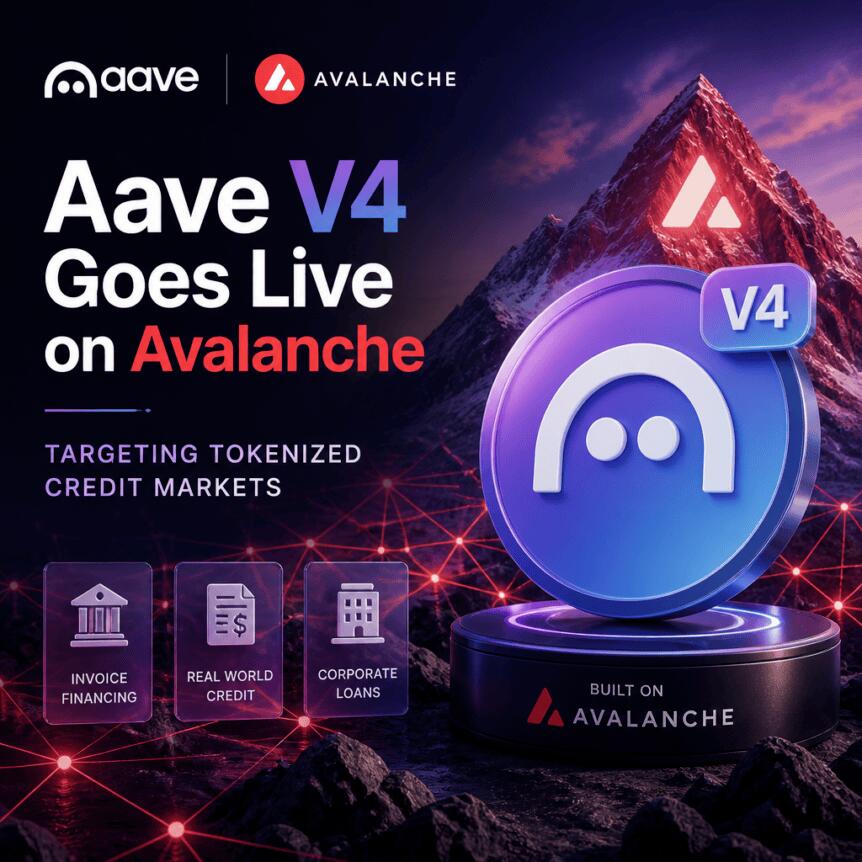
Aave has deployed its V4 lending infrastructure on Avalanche, extending the protocol’s newest market architecture beyond Ethereum for the first time. The move is positioned as a foundation fo
Aave has deployed its V4 lending infrastructure on Avalanche, extending the protocol’s newest market architecture beyond Ethereum for the first time. The move is positioned as a foundation for lending pools that can be tailored to different collateral types—potentially including tokenized real-world assets—while still benefiting from shared liquidity across the Aave network.
Announced as the start of a broader rollout, the Avalanche launch introduces Aave V4’s “Hub & Spoke” model. In this setup, specialized lending markets can set their own collateral requirements and risk parameters, but draw on liquidity routed through Aave’s overarching infrastructure.
Key takeaways
- Aave V4 is now live on Avalanche, representing the protocol’s first expansion of its latest lending framework beyond Ethereum.
- The Hub & Spoke architecture lets new lending markets define custom collateral rules and risk settings without fragmenting liquidity.
- Aave says one of the early Avalanche markets is planned to support borrowing against tokenized assets.
- Aave is the largest decentralized lending protocol by total value locked, with nearly $14 billion across 23 blockchains, per DeFiLlama data.
Why Aave’s Hub & Spoke design matters on Avalanche
The core promise of Aave V4’s Hub & Spoke approach is flexibility: different lending markets can be configured for distinct collateral profiles while remaining connected to a common liquidity backbone. For users, that can mean a wider selection of supported collateral types and potentially more tailored risk controls. For builders and market creators, the model is designed to make it easier to launch specialized credit markets without starting from scratch on liquidity and protocol-level plumbing.
According to Aave, the architecture is intended to support a broader range of collateral than earlier protocol iterations. While Aave has long relied on established DeFi-native assets, the V4 approach is explicitly oriented toward accommodating more complex collateral arrangements—an area that has become increasingly important as tokenized financial assets move closer to mainstream on-chain use.
Aave says that, among the first markets planned on Avalanche, it will support borrowing against tokenized assets. The protocol also indicates that future specialized markets on Avalanche could extend to tokenized categories such as US Treasurys, money market fund shares, private credit, and corporate bonds—each with customized collateral requirements and risk parameters.
That framing reflects a larger shift in the way tokenized real-world assets are being used. Rather than limiting tokenization to settlement or trading, institutions and blockchain infrastructure providers are increasingly focused on collateral use cases—where tokenized holdings can back borrowing and liquidity strategies in both traditional and decentralized finance.
For example, Cointelegraph previously reported that Franklin Templeton partnered with Binance in February to enable institutions to use tokenized money market fund shares as off-exchange collateral, while keeping the underlying assets in regulated custody. In the following month, Nasdaq announced plans to integrate its collateral management tooling with Talos’ digital asset infrastructure to streamline institutional workflows for managing tokenized collateral, combining collateral management, risk monitoring, and trade surveillance.
Other infrastructure firms are also aiming at the “operational layer” required for real-world asset collateral. In May, DTCC said it would integrate Chainlink technology into its tokenized collateral platform to support near real-time movement, valuation, and settlement ahead of a planned launch in the fourth quarter.
A broader institutional push meets DeFi lending demand
Aave’s Avalanche deployment arrives as the institutional ecosystem around tokenized assets keeps expanding. The latest wave is not only about issuance or custody, but about creating systems that can actually support borrowing, valuation updates, and risk controls in a way that financial institutions find usable.
More recently, Grove announced a $500 million warehouse lending facility with Galaxy Digital to finance institutional crypto-backed loans using blockchain-based infrastructure. While not directly tied to Aave V4, the move fits the same direction: institutions are building facilities and partnerships that rely on tokenized or blockchain-based infrastructure for collateral-backed lending.
At the same time, the category of tokenized real-world assets continues to grow. According to RWA.xyz, more than $34 billion worth of real-world assets are currently tokenized on public blockchains, up from about $12.8 billion a year earlier—an expansion that suggests collateral-backed DeFi markets may have more potential counterparties as the supply of tokenized assets increases.
What investors and users should watch next
With V4 now launched on Avalanche, the next questions are less about whether tokenized collateral is possible and more about how quickly specific markets go live and what collateral configuration details look like in practice. Readers should watch for Aave’s early Avalanche market rollout, signals about supported collateral types, and how the Hub & Spoke model performs as more specialized lending pools are introduced.
DeFi lending has historically been constrained by which assets can be supported efficiently and how risk parameters are enforced. Aave V4’s architecture is designed to reduce those barriers—so the key test will be whether tokenized collateral markets can scale with appropriate risk controls without sacrificing liquidity.
This article was originally published as Aave V4 Goes Live on Avalanche, Targeting Tokenized Credit Markets on Crypto Breaking News – your trusted source for crypto news, Bitcoin news, and blockchain updates.