Google Quantum AI shared a significant update on Oct. 15 in which it claimed to have achieved a major breakthrough in its goal of building a useful, error-corrected quantum computer. The tech
Google Quantum AI shared a significant update on Oct. 15 in which it claimed to have achieved a major breakthrough in its goal of building a useful, error-corrected quantum computer.
The tech giant said that its researchers have been able to successfully demonstrate the so-called “magic state cultivation” on its Willow quantum processor.
The breakthrough is crucial because it conquers a two-decade-old bottleneck to building huge, error-corrected quantum computers, the company said.
Grayscale's head of research: Quantum computing is 'just another hurdle' Bitcoin will clear (3:10)
Understanding Google's quantum breakthrough
First, let's quickly understand what a quantum computer is.
The computers we use today use binary electrical signals to represent ones or zeros. Quantum computers, on the other hand, use quantum bits (qubits), which are subatomic particles.
At their optimized states, qubits can simultaneously represent combinations of both ones and zeros. More qubits translate into more potential for large-scale compute power.

Attendees look at a display on the IBM quantum computer stand at the International AI Summit in Dublin, Ireland, on Wednesday, Oct. 14, 2026.
Getty Images
Google's latest breakthrough revolves around moving closer to building a so-called magic state. In simple words, a magic state is a specialized, pre-prepared quantum state required to execute certain operations essential for general-purpose quantum computing.
Producing a magic state can consume as much as 95% of a quantum computer’s capacity, leaving little room for actual computing.
But Google Quantum AI said its researchers have succeeding in reducing errors by around 40 times with 99.9% accuracy.
The tech giant acknowledged that plenty of technical challenges remain and it still needs to demonstrate magic state cultivation at a larger scale to make it realistic for practical quantum computing.
However, the breakthrough brings it another step closer to its goal of building a useful, error-corrected quantum computer, Google Quantum AI said.
Popular on TheStreet Roundtable:
Popular market analyst, known as Bull Theory on X, warned that though Google's latest breakthrough doesn't immediately threaten Bitcoin (BTC), the gap is getting "smaller."
The crypto community is concerned about the advancements in quantum computing because it fears when they get more powerful, they could be used by malicious actors to hack cryptocurrencies like Bitcoin.
In simple words, a cryptocurrency is a digital currency that relies on cryptography to encrypt financial details to ensure the integrity and security of funds. Encryption ensures that nobody other than those sending and receiving crypto have access to any sensitive financial data.
In the 1990s, the Massachusetts Institute of Technology (MIT) mathematician Peter Shor developed the first well-known quantum algorithm for breaking encryption.
If there is a very powerful quantum computer in the future, there is a fear of it being used by hackers to decrypt Bitcoin's encryption and steal the money.
Bull Theory doesn't think the threat is any closer. The most number of logical qubits reported so far is 96 but an attack on Bitcoin would take 13-15 times more qubits, he said.
"So Bitcoin is not in trouble today. No machine is close to doing this."
However, he warned of the narrowing gap in the advancement of building a quantum computer.
In fact, Google itself warned in April that a quantum system could attack a Bitcoin transaction in about nine minutes — not immediately but there is a possibility in the future that can't be ruled out.
The tech giant has already set a self-imposed deadline of 2029 to complete its company-wide migration to post-quantum cryptography (PQC) in the face of such threats.
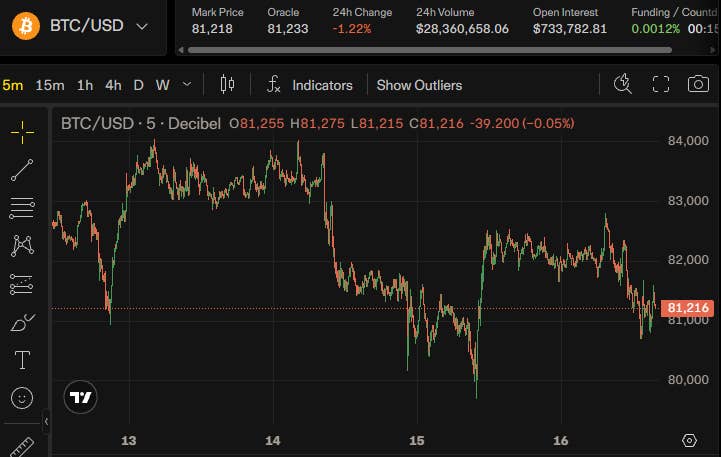
BTC/USD, Source: Decibel
Bitcoin was trading at $81,216 at the time of writing, as per Decibel.
Related: Google reveals major 2029 quantum threat for digital wallets