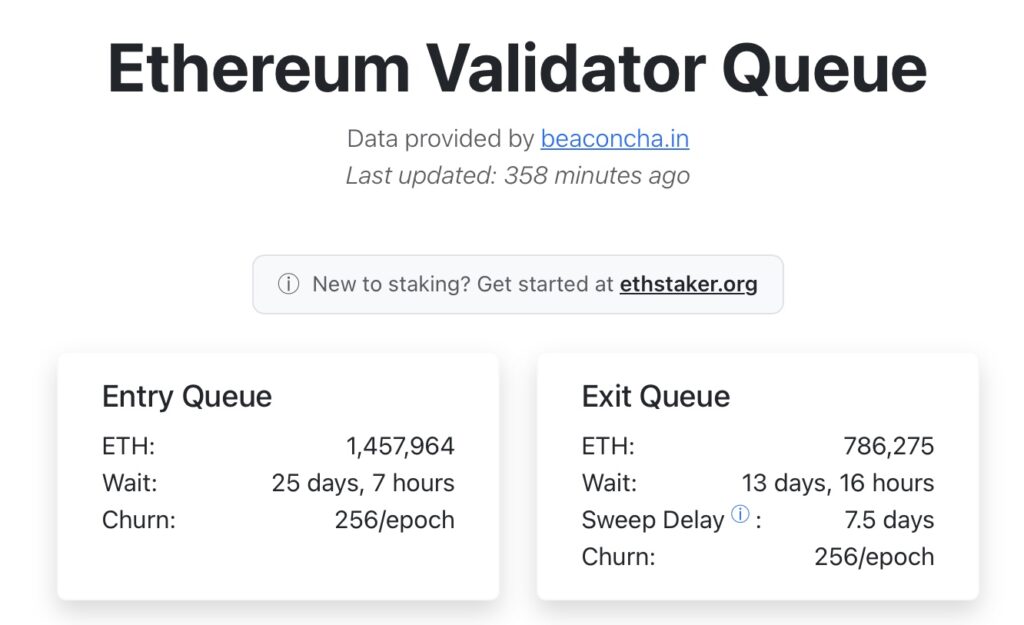
On October 5, 2026, about 1.5 million ETH, or nearly 4 billion dollars, were waiting to enter staking on Ethereum, with an estimated wait time of 25 days. In the opposite direction, 786,000 E
On October 5, 2026, about 1.5 million ETH, or nearly 4 billion dollars, were waiting to enter staking on Ethereum, with an estimated wait time of 25 days. In the opposite direction, 786,000 ETH were waiting to exit, after a peak of 851,000 ETH on October 2, largely fueled by the security incident announced by MetaMask on September 30. This is why these two queues tell completely different stories.
In brief
- 1.5 million ETH (nearly $4B) in the entry queue as of October 5, 2026, with about 25 days wait time (validatorqueue.com).
- Entry queue declining: nearly 2 million ETH and about 35 days wait time at the beginning of September.
- Exit queue: about 166,000 ETH on September 29, peak at 851,000 on October 2, 786,000 on October 5.
- Protocol cap: about 57,600 ETH per day in each direction.
Ethereum: Why are 1.5 Million ETH Waiting to Enter Staking?
Simply because Ethereum limits entry rates. As of October 5, 2026, about 1.5 million ETH, or nearly 4 billion dollars, were waiting to be activated in staking with an estimated delay of 25 days, according to validatorqueue.com data. The operation of staking on Ethereum relies on this bottleneck since it involves immobilizing ETH to help secure the network, in exchange for a reward. Validators, these computers that verify crypto transactions, cannot all join the network simultaneously. As a result, about 57,600 ETH can enter each day, and the same amount can exit.
 Ethereum staking waiting.
Since the Pectra upgrade, a validator can now hold up to 2,048 ETH, and large operators top up existing validators. Part of the queue thus concerns ETH already engaged in staking. In July, when the entry queue reached about 2.5 million ETH, Thomas Brunner, head of custody and staking at Sygnum Bank, nuanced it like this:
The entry queue measures both the pipeline and the demand.
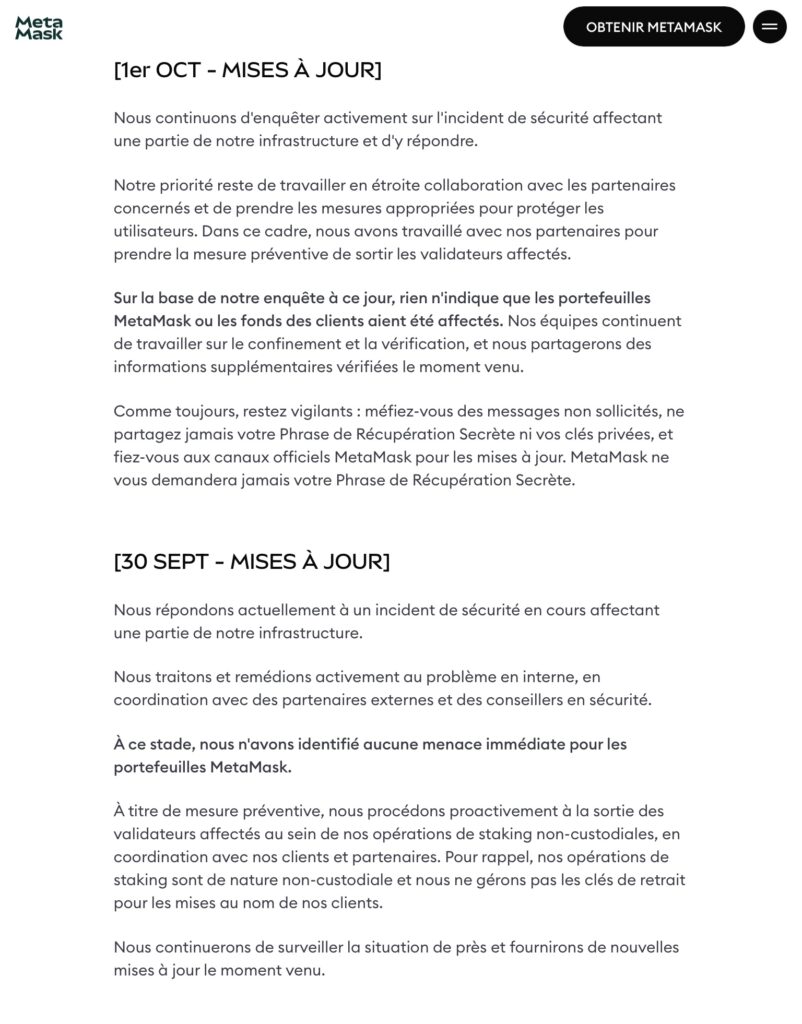
Because MetaMask Staking, formerly Consensys Staking, withdrew its validators after a security incident announced on September 30, 2026. The exit queue rose from about 166,000 ETH on September 29 to a peak of 851,000 ETH on October 2, its highest level in 2026, then 786,000 ETH on October 5. MetaMask Staking operates validators within Lido, a service pooling ETH from its users.
Your 1st cryptos with BitpandaThis link uses an affiliate program.
According to Lido, the last affected validators should have completed their exit from the validation process by October 7, without necessarily being fully withdrawn by that date. Lido expects these ETH to gradually return to the protocol after their exit, withdrawal, and possible reentry into staking within a period that may extend up to 45 days. MetaMask emphasizes the non-custodial nature of its staking and states it has identified no immediate threats to MetaMask wallets.
 MetaMask updates.
What Do the Two Queues Say Side by Side?
They do not tell the same story. The entry queue reflects strong activation demand but does not alone measure the new demand for Ethereum staking. The exit queue, about 786,000 ETH as of October 5 (nearly 2.1 billion dollars at the $2,720 price), is heavily driven by a single operator. This suggests a technical movement related to MetaMask Staking rather than a widespread disengagement wave.
Except that the figure of 1.5 million is read with its trend: in early September, the entry queue counted nearly 2 million ETH, with about 35 days wait time. The delay is shortening, the queue remains long. In July 2026, the exit queue was almost empty, according to Sygnum.
Date
Entry queue (ETH)
Exit queue (ETH)
Early September 2026
nearly 2 million (about 35 days)
not recorded
September 29, 2026
not recorded
about 166,000
October 2, 2026
not recorded
about 851,000 (peak of 2026)
October 5, 2026
about 1.5 million (about 25 days)
786,000 (about 14 days)
Source: validatorqueue.com, data as of October 5, 2026.
The queues tell the on-chain story, the $2,800 threshold tells the market story. ETH is trading around $2,720 on October 5, 2026, according to the weekly chart by analyst Ted Pillows on X. He places resistance, the level where sellers have so far halted the rise, at $2,800, about 3% from the price, and a first support at $2,547.50. According to him, a weekly close above $2,800 with sustained spot demand would change the reading.
What we Know, What we don’t Know
We know that an incident affected the MetaMask Staking infrastructure and that the two queues changed shape in a few days. We do not know what was compromised, nor how: at this stage, MetaMask has not detailed the origin of the incident. Security researcher Kaden estimated on X that the outflows concern about 17,000 validators and 523,000 ETH: these figures are reported by him and not confirmed by MetaMask.
On October 7, 2026, we await the completion of the exit of the last MetaMask validators, then the weekly close of ether above or below $2,800. The entry queue will say in the coming weeks if its decline continues. Meanwhile, the toll barrier remains fixed with its 57,600 ETH per day and not one more.