Key Takeaways AVAX trades near $6.78, holding just above its early-June low after a steep fall from above $9. Social sentiment has flipped sharply negative over developer-growth and competiti
Key Takeaways
- AVAX trades near $6.78, holding just above its early-June low after a steep fall from above $9.
- Social sentiment has flipped sharply negative over developer-growth and competition concerns.
- The institutional layer keeps expanding: a Nasdaq treasury listing, CME futures, and FIFA infrastructure.
- The gap between weak price and growing institutional utility is the story to watch.
- US spot AVAX ETFs drew just $340K the week of June 12, with most recent weeks at zero.
Avalanche has become one of the most talked-about tokens in crypto, but for the wrong reasons. AVAX trades near $6.78 on 16th of June, barely above its early-June low and down sharply from above $9 a month ago, even as the broader market rallied. The disconnect between a falling token and a steadily expanding institutional footprint is what makes Avalanche worth a closer look right now.
Price Sits Near Multi-Month Lows
The daily chart from Tradingview shows a token in a clear downtrend. After holding the $9 area through April and May, AVAX broke down hard in early June, falling to a low near $6.30 before stabilizing in a tight range around $6.50 to $7. At $6.78, it trades well below all three major moving averages, the 50-day at $8.62, the 100-day at $8.99, and the 200-day at $10.29, each sloping downward in a textbook bearish alignment. The daily RSI sits near 31, just above oversold, after spending early June below 25, which signals heavy selling pressure that has only recently begun to ease.
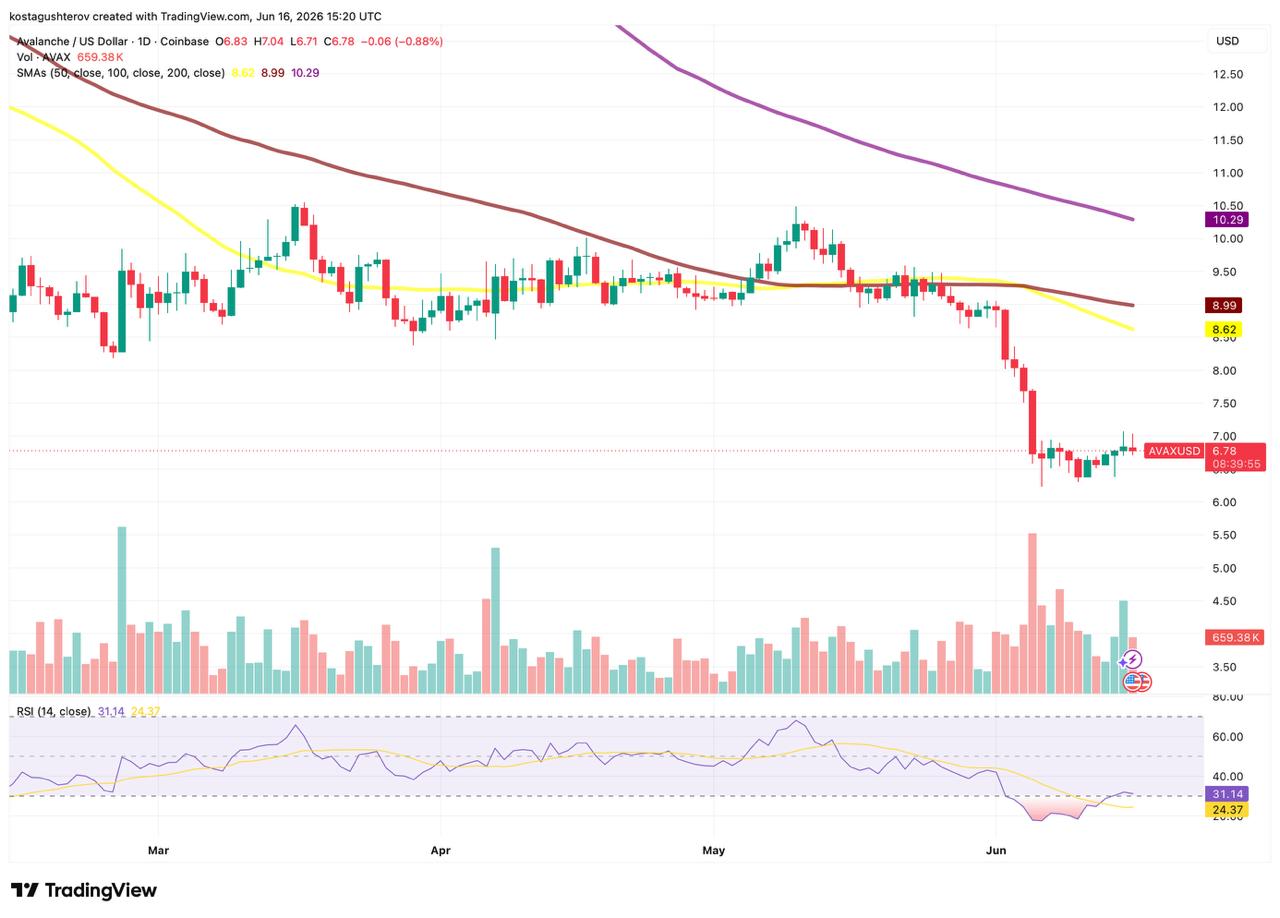
The one constructive detail is what has not happened: despite the broad-market relief rally that lifted Bitcoin and most large caps this week, AVAX has merely stabilized rather than bounced meaningfully. That relative weakness is itself information. It tells you the selling here is Avalanche-specific, not just a function of market-wide risk-off, which points back to the narrative problem rather than the macro one.
Sentiment Has Turned Sharply Negative
The driver behind the weakness is visible in the social data. According to Santiment, AVAX sentiment has swung from one of its most optimistic readings earlier this year to one of its most bearish, with negative commentary now outweighing positive by a wide margin. The criticism centers on a specific worry: that Avalanche’s developer activity, user growth, and ecosystem momentum have lagged faster-growing rivals like Solana and Sui.
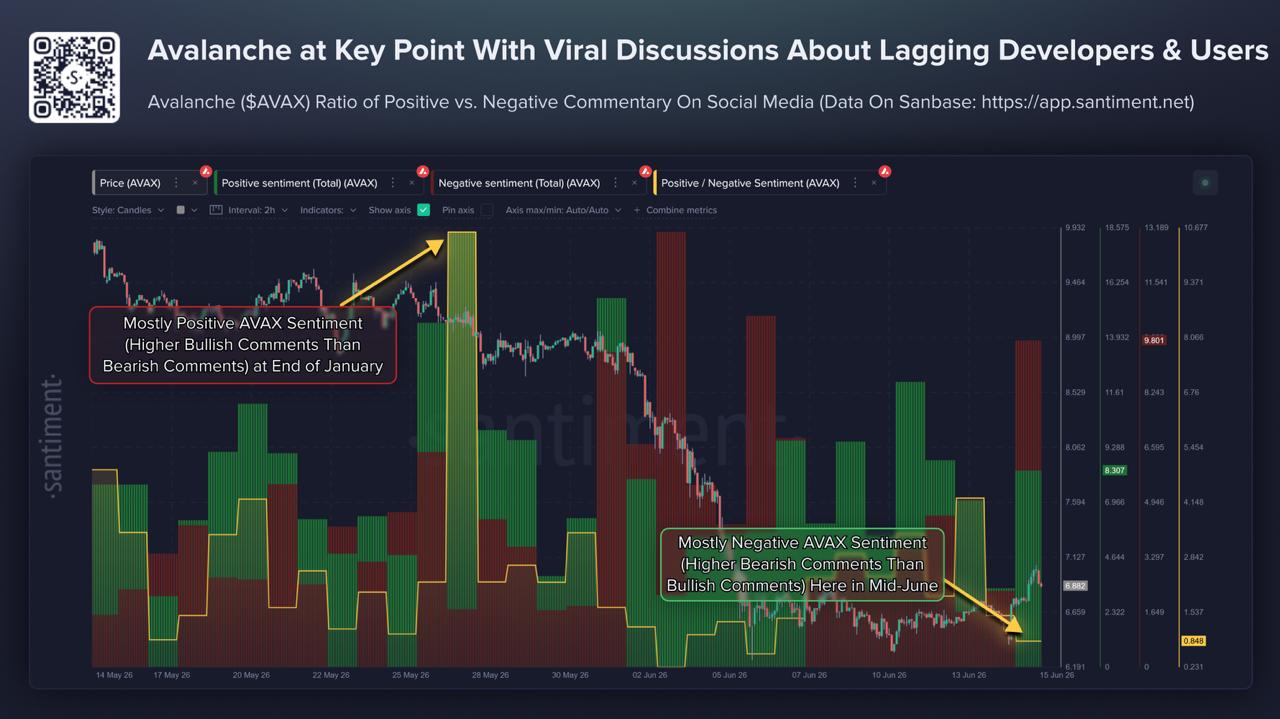
This is where context matters more than the raw sentiment score. Avalanche was among the top trending tokens this week not because of a rally but because of the volume of skepticism around it, a debate over whether the network can keep pace. Crowded negative sentiment is a double-edged signal. It reflects real concerns about competitive positioning, but extreme bearishness has historically been the kind of condition from which sharp reversals occur, precisely because so much pessimism is already priced in. Sentiment this lopsided describes the present mood; it does not, on its own, predict the next move.
The Institutional Layer Tells a Different Story
Set against the weak token and sour mood is an institutional buildout that has accelerated, not slowed. In June, Avalanche Treasury Co. began trading on the Nasdaq under the ticker AVAT, created through a roughly $675 million SPAC merger with Mountain Lake Acquisition Corp. and holding around 15 million AVAX, close to 3.5% of circulating supply. Notably, AVAT is structured as an active ecosystem-investment vehicle rather than a passive token-holder, with backers including VanEck, Galaxy Digital, Pantera Capital, and Kraken.
The derivatives infrastructure has expanded in parallel. CME Group listed cash-settled AVAX futures in May 2026, in standard 5,000-AVAX and micro 500-AVAX contracts, adding Avalanche to a regulated-futures roster that already includes Bitcoin, Ethereum, and Solana. On the utility side, Avalanche is serving as backend infrastructure for the 2026 FIFA World Cup’s digital ticketing and loyalty programs, and the network counts BlackRock, Franklin Templeton, Apollo, and the state of Wyoming among its users, with more than $1.65 billion in tokenized real-world assets reported on-chain.
There is a hole in the institutional story, though, and the ETF data from SoSoValue exposes it. Three spot AVAX ETFs are live in the US, but their inflows have been negligible: weekly net flows have been zero in most recent weeks, with the week of June 12 drawing just $340,060 and the prior nonzero week, May 15, only about $530,000.
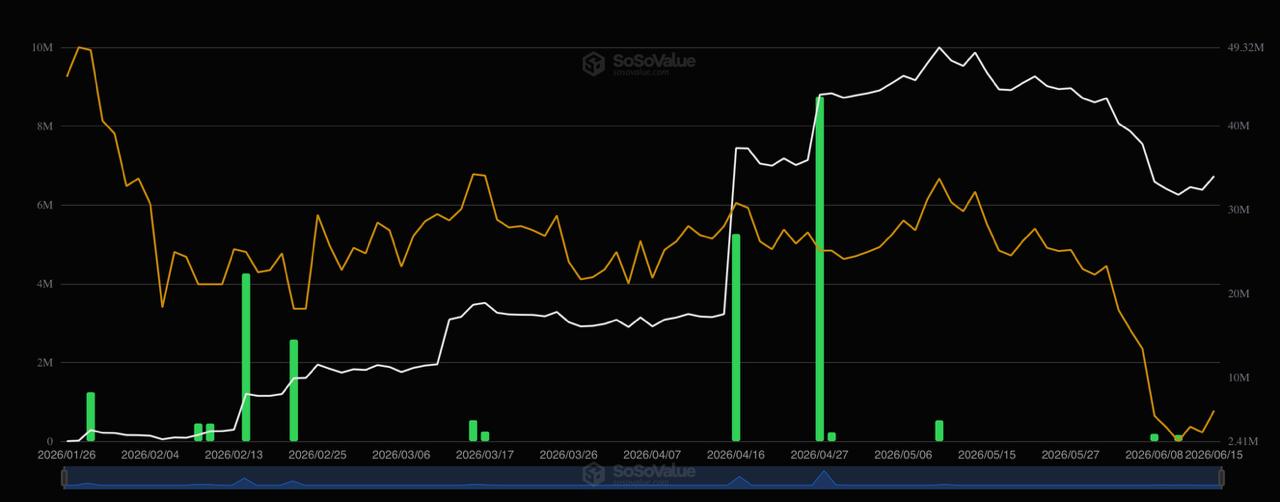
The standout weeks earlier in the year, roughly $8.97 million on May 1 and $5.26 million on April 17, now look like isolated spikes rather than a trend. For a token with a Nasdaq treasury vehicle and CME futures, that is strikingly little actual institutional capital flowing through the most direct buy-side channel. The infrastructure for institutional demand exists; the demand itself has not yet shown up in the one place it would be most visible.
READ MORE:
 Decoding Stablecoin Dominance: Data vs. Market Hype
Reading the Disconnect Honestly
The temptation is to pick a side, either the institutional story is bullish and the price is wrong, or the price is right and the partnerships are noise. The more accurate read holds both in tension. The institutional adoption is real and measurable, but it has so far failed to translate into token demand, and AVAT’s own debut underlined the gap: the stock fell roughly 38% in its first session, a blunt verdict on how a weak altcoin market is pricing even a structured, well-backed proxy. Infrastructure deals and equity vehicles do not mechanically lift a token’s price, especially when the prevailing narrative questions whether usage is actually growing.
What this leaves is a token caught between two timelines. The institutional layer is a multi-year bet on Avalanche as enterprise and settlement infrastructure; the price and sentiment reflect a near-term verdict that the ecosystem is losing the developer-and-user race to rivals. Both can be true at once, and which one matters more depends entirely on an investor’s horizon.
What Could Shift the Balance
The signals to watch are concrete on both sides. On the chart, a daily close back above the $8.62 (50-day moving average) can be the first technical sign the downtrend is loosening, while a break below the early-June low near $6.30 might confirm sellers remain in control. On the fundamental side, the question is whether the institutional infrastructure begins to show up as on-chain usage, developer activity, transaction growth, and real-world-asset volume that critics say has been lagging. Until the network can answer the developer-growth criticism with data, the institutional headlines and the token price are likely to keep telling different stories.
This article is for informational purposes only and does not constitute financial advice. Consult a professional before making investment decisions.The post AVAX: Institutional Utility Rising as Price Action Lags appeared first on Coindoo.