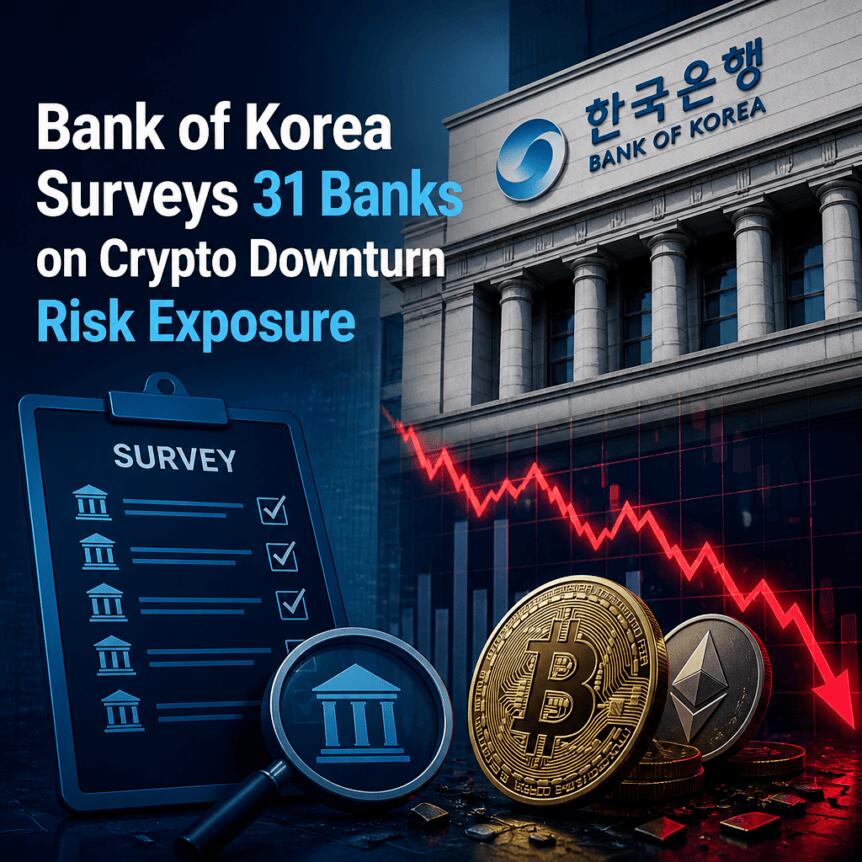
The Bank of Korea has begun a risk survey of South Korean banks and brokerages that are involved—or considering involvement—in virtual-asset activities, testing how traditional financial inst
The Bank of Korea has begun a risk survey of South Korean banks and brokerages that are involved—or considering involvement—in virtual-asset activities, testing how traditional financial institutions would cope with major crypto market shocks and exchange failures.
According to reporting from Business and Yonhap, the central bank started contacting 18 banks and 13 brokerages on Oct. 23 as part of what is described as its first review of financial institutions’ participation in the virtual asset market. Responses are reportedly due Wednesday.
Key takeaways
- The Bank of Korea is conducting its first reported institution-by-institution review of crypto risk, reaching 18 banks and 13 brokerages.
- Survey scenarios include a major exchange hack that forces a temporary halt of services, sustained crypto price declines, and contagion from losses at another financial institution.
- Questions cover staffing, budgets, and the amounts invested in both domestic and overseas crypto companies.
- The review arrives as South Korean players continue stablecoin testing, even as broader virtual-asset legislation—including stablecoin issuance rules—has moved more slowly.
- Regulators are also tightening cybersecurity expectations across the financial sector, following identified security deficiencies and prior incidents.
A stress-test for banks and brokerages
The survey is structured around practical stress scenarios rather than purely compliance-oriented questions. One prompt asks how financial firms would be affected if South Korea’s largest crypto exchange by market share temporarily suspended operations after a serious hack or similar incident.
Other questions examine the potential effects of a steep drop in cryptocurrency prices followed by a prolonged period of weak trading activity. The central bank also wants to understand what would happen if another financial institution suffered heavy losses linked to a crypto-related event—an implicit nod to system-wide and counterparty risk.
Beyond scenario analysis, the questionnaire reportedly asks banks and brokerages to describe their current crypto-related operational setup. That includes how many people are assigned to crypto-related work, the budgets allocated for virtual-asset activities, and what specific business activities they have undertaken or plan to undertake. The survey also seeks information on how much they have invested in crypto companies both within South Korea and abroad.
Why the Binance hack is part of the backdrop
While the Bank of Korea started the survey on Oct. 23, the timing overlaps with heightened attention to exchange security after last week’s reported $6.3 billion hack at Binance. The incident has been attributed by U.S. authorities to North Korean hackers, as Cointelegraph reported, underscoring the type of operational disruption and market fallout the central bank is now explicitly measuring.
For banks and brokerages, the broader issue is less about whether a single institution can prevent a hack and more about how they would limit downstream effects: operational exposure, reputational damage, liquidity pressure, and possible knock-on effects across corporate groups and counterparties.
Even if the survey began before the most recent Binance news, the incident offers a real-world reference point for what “temporarily suspended operations” could mean in practice—particularly when trading volumes, customer behavior, and settlement processes all shift at once during an attack.
Stablecoin pilots continue, even as legislation drags
The risk review lands during a period in which South Korean financial firms are still testing stablecoin-related services and infrastructure. Industry activity has not stalled while regulators finalize policy. According to Cointelegraph, KB Financial Group completed a won-denominated stablecoin pilot in May. Separately, Cointelegraph reported that Kakao Pay and KakaoBank partnered with Fireblocks in September to explore digital asset infrastructure.
The Bank of Korea has also reportedly pushed for bank-led stablecoin issuance. However, progress on the proposed Digital Asset Basic Act has been complicated by disagreements over which types of institutions should be allowed to issue stablecoins. That friction—regarding ownership and authority in stablecoin issuance—matters because issuance rules directly affect who carries the compliance burden, who holds controls, and how risk is distributed across the financial system.
In comments attributed to a Bank of Korea official by The Korea Herald via Business, financial institutions are continuing their own preparations even though virtual-asset legislation is moving more slowly than the market expected. That tension helps explain why a central bank would prioritize granular risk mapping: while the regulatory framework is still evolving, institutions are still building and testing capabilities.
Cybersecurity scrutiny is intensifying
The Bank of Korea’s survey is occurring alongside tighter cybersecurity oversight by South Korean regulators. In October, the Financial Services Commission proposed tougher security requirements after finding deficiencies at 130 of 555 financial companies, a development Cointelegraph reported.
The proposals include more frequent vulnerability assessments and greater executive accountability, following security incidents involving 16 companies—including crypto exchanges. Taken together, these measures suggest regulators are trying to raise baseline protections while also clarifying who is responsible when systems fail.
For banks and brokerages, this matters because the operational and reputational risks of crypto-linked activity often hinge on third-party resilience—particularly when exchanges, custodians, and digital infrastructure providers are involved. A central bank survey that focuses on staffing, budgets, and incident-based scenarios can be read as a precursor to more targeted expectations on governance and controls.
As the Bank of Korea’s survey responses roll in this week, investors and industry participants will likely watch for whether regulators tighten requirements specifically around exchange outage contagion, stablecoin operating models, and internal resourcing for virtual-asset risk. The key uncertainty is what—if anything—this first review will translate into next: guidance, supervisory expectations, or changes to how banks and brokerages are permitted to engage with crypto markets.
This article was originally published as Bank of Korea Surveys 31 Banks on Crypto Downturn Risk Exposure on Crypto Breaking News – your trusted source for crypto news, Bitcoin news, and blockchain updates.