Bitcoin slipped back below $80,000 on October 25 for the first time since October 21, while Uniswap (UNI) was the only asset in this watchlist to finish green. For anyone asking what crypto t

Bitcoin slipped back below $80,000 on October 25 for the first time since October 21, while Uniswap (UNI) was the only asset in this watchlist to finish green. For anyone asking what crypto to buy right now, UNI carries the cleanest dated catalyst on the board: it became the first decentralized-finance token with futures on CME Group, and it has held up better than Bitcoin, Ether and Solana across the whole week.
At about 23:50 UTC on October 25, a $1,000 position bought roughly 144 UNI at $6.91 per coin. If UNI ever matched Solana’s $59.5 billion market capitalization, that same stake would be worth close to $13,800. That arithmetic — not a token pitch — is the reason this piece centers on Uniswap, and the full math sits in its own section below.
The October 25 Snapshot: Bitcoin Loses the $80,000 Handle
The majors spent October 25 giving back the week’s gains. Bitcoin closed the day near $79,908, down 1.14% over 24 hours, after touching a seven-day high of $84,898 on October 21, per CoinGecko data. Ether fell 1.63% to $2,318.25, Solana dropped 1.42% to $100.85, and XRP eased 0.58% to $1.29.
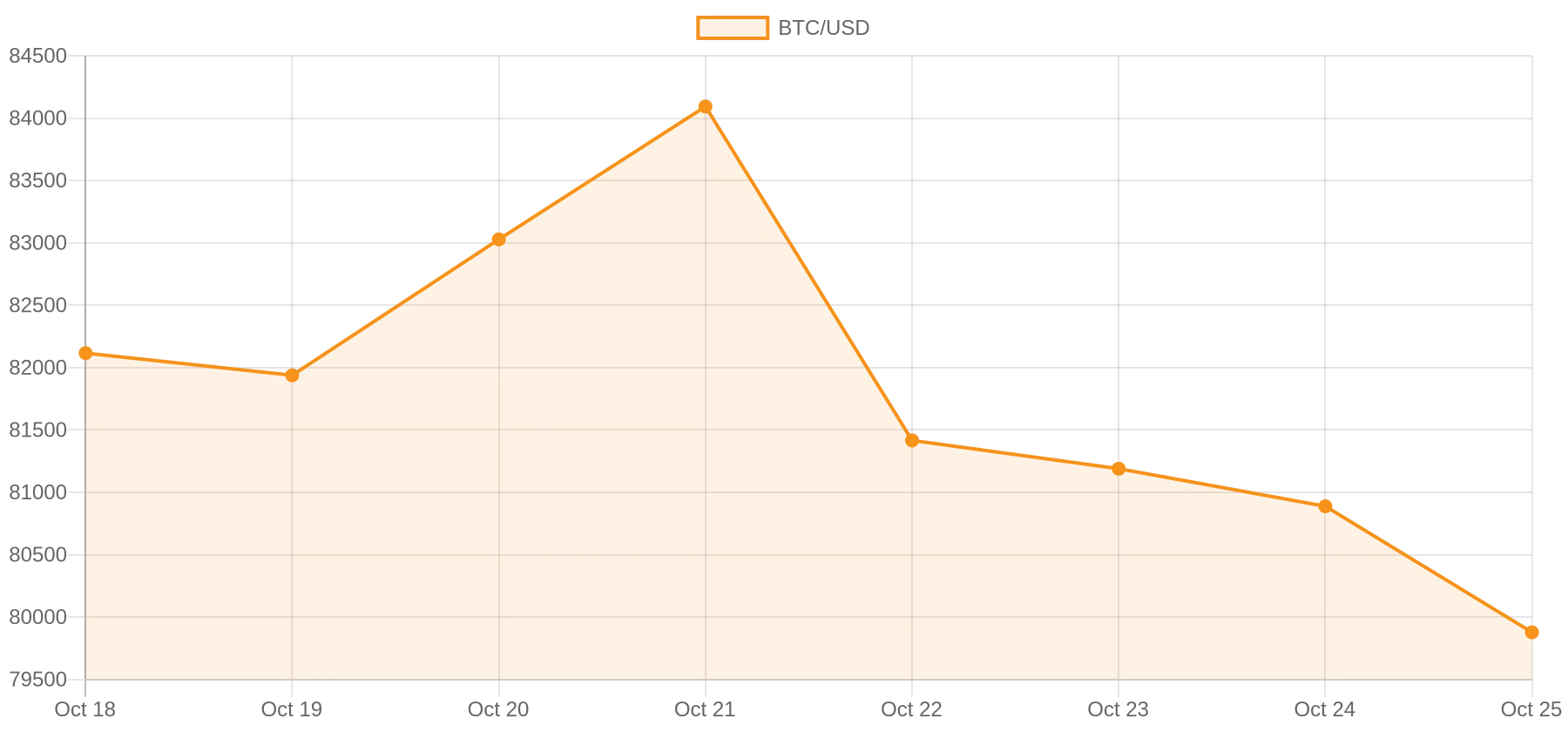
Bitcoin’s daily close from October 18 through October 25. Source: Binance daily candles via CoinGecko.
The one asset moving against the tape was Uniswap. UNI added 0.44% to $6.91 while Bitcoin Cash sat nearly flat at $277.41, down 0.18%. The split is not random. Bitcoin and Ether are re-pricing a macro tape, while UNI is still digesting a structural change that arrived six days ago. The rotation echoes the Monero Kraken-clarity screen from earlier this week, where a single dated catalyst moved XMR 5% against a falling tape — this time the green token is Uniswap and the catalyst is a regulated listing, not an exchange walk-back.
The UNI Outlier: A DeFi Token on a Regulated US Exchange
On October 19, CME Group listed Bitcoin Cash and Uniswap futures, and on October 20 the exchange announced that market makers FalconX and GSR had executed the first block trade in both contracts. UNI became the first DeFi protocol token with futures on the exchange — a claim Uniswap itself made in a post on X: “UNI is now the first DeFi protocol token with futures on @CMEGroup.”
The distinction matters more than it sounds. UNI has traded as a perpetual on offshore venues for years. A contract on CME means a United States-regulated, centrally cleared venue where institutions can hedge or take exposure without touching a decentralized exchange or holding the token directly.
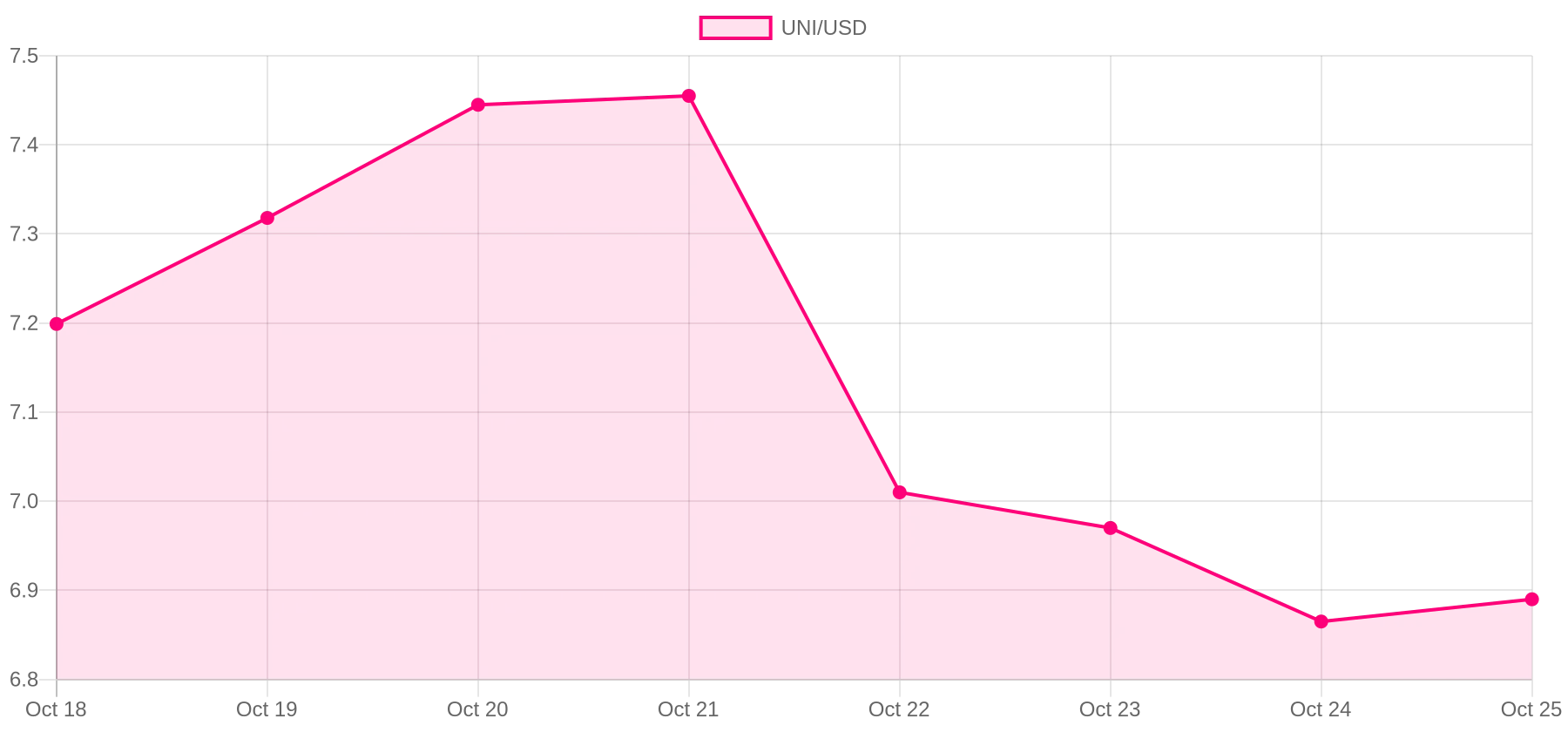
Uniswap’s daily close from October 18 through October 25. Source: Binance daily candles via CoinGecko.
Giovanni Vicioso, CME Group’s global head of cryptocurrency products, framed the launch in the exchange’s own release: “With trading now underway in our Bitcoin Cash and Uniswap futures, we are providing clients with more versatility to manage cryptocurrency risk and exposure through our robust 24/7 marketplace.”
Griffin Sears, FalconX’s head of derivatives, was more specific about where demand is heading: “FalconX is pleased to execute the first block trade in CME Group’s new Bitcoin Cash and Uniswap futures alongside GSR. Institutional demand is moving beyond the largest digital assets toward tokens with distinct use cases, like Bitcoin Cash in payments and Uniswap in decentralized finance.”
GSR’s chief executive, Xin Song, tied the listing to the firm’s longer view of the market: “Providing liquidity in crypto derivatives has long been a cornerstone of GSR’s business, making it a natural fit for us to support CME Group’s new Bitcoin Cash and Uniswap futures from day one.”
The volume backdrop is real. CME reported year-to-date 2026 average daily volume of more than 242,000 crypto futures and options contracts, worth about $7.9 billion in notional, and average daily open interest of nearly 240,000 contracts, or $14.3 billion. The exchange said its 2026 expansion into Cardano, Chainlink, Stellar, Avalanche and Sui futures added nearly $2 billion in notional value before UNI and Bitcoin Cash even launched.
The Market-Cap Math: What UNI Is Worth at Solana’s Size
This is the layer a press release cannot supply. UNI trades at $6.91 with a market capitalization of roughly $4.31 billion. Solana, four places above it in the large-cap ranks, carries a $59.49 billion market cap. The gap between the two is the entire bull case in one number.
Divide $59.49 billion by $4.31 billion and you get 13.8. That is the multiple UNI would need to reach Solana’s size today. Multiply the current price by that same factor — $6.91 times 13.8 — and the implied price is $95.36.
Put another way: $1,000 buys about 144 UNI. At Solana’s valuation, those tokens are worth roughly $13,800. The same $1,000 in Bitcoin at $79,908 buys 0.0125 BTC; Bitcoin would need to reach about $1.1 million for that stake to deliver the same 13.8x. None of this is a forecast. It is the scale of the move required, stated plainly, and it is why UNI’s asymmetry shows up on a money-angle screen.
What the CME Listing Does and Does Not Change
A futures listing is not a spot listing, and it is not an endorsement. A CME contract lets a trader express a view or hedge, but it does not put UNI in a custody account or change the fundamentals of the Uniswap protocol. The most important caveat is that the listing is now six days old: the initial re-rating may already be in the price, and UNI’s 0.44% gain on October 25 is a rounding error, not a breakout.
The flip side is equally precise. The listing expands who can touch the asset — a regulated, cleared path that did not exist for any DeFi token before October 19 — and it arrives while Uniswap remains the largest decentralized exchange by a wide margin. Whether that translates into sustained buying is a question the next few sessions will answer, not the press release.
The Levels to Watch
For Bitcoin, the $80,000 mark is now resistance, not support. The October 25 daily low of $79,845 is the first shelf to hold; a daily close back above $80,900 — the level Bitcoin reclaimed after its October 24 dip — would signal the breakdown failed. On the downside, $79,200 is the next area where the October 23-24 lows cluster. The invalidation for a bearish read is a close above $82,300, the top of the October 23 range.
For UNI, the week’s range is $6.51 to $7.79. A push through $7.04 — the high of October 25 — opens the $7.30 area where it consolidated on October 23 and 24. Losing $6.65, the October 24 low, would put the CME re-rating story on hold until the next catalyst. None of these levels are guarantees; they are the zones where the last week of volume actually traded.
Frequently Asked Questions
Why is Bitcoin below $80,000?
Bitcoin fell 1.14% on October 25 to about $79,908 after peaking near $84,898 on October 21. The pullback followed four days of steady declines and pushed the asset back under the $80,000 round level it had reclaimed earlier in the week, per CoinGecko data.
What does Uniswap being on CME futures mean?
It means UNI is the first DeFi protocol token with futures on a United States-regulated, centrally cleared exchange. Institutions can now hedge or take exposure to UNI without holding the token or using an offshore venue. CME launched the contract on October 19 and confirmed the first block trade on October 20.
Is UNI a good buy right now?
This article does not give investment advice. UNI trades at $6.91 with a $4.31 billion market cap. Reaching Solana’s $59.49 billion valuation would imply a price near $95.36, a 13.8x move — but that is the scale of the move required, not a prediction, and a futures listing is not a guarantee of spot demand.
What is the difference between a futures listing and a spot listing?
A futures contract lets traders express a price view or hedge using margin and derivatives. A spot listing lets buyers own the actual token. CME’s UNI product is a futures contract, so it does not by itself put UNI into custody or change the Uniswap protocol’s fundamentals.
Which other assets did CME add futures for?
Alongside Uniswap, CME launched Bitcoin Cash futures on October 19. In 2026 the exchange also expanded into Cardano, Chainlink, Stellar, Avalanche and Sui futures, adding nearly $2 billion in notional value before the UNI and Bitcoin Cash launch, according to CME Group.